Sugar Grinding Machines Information With Food Processing Equipment and Technical Insights
Sugar grinding machines are food processing equipment designed to reduce granulated sugar crystals into smaller particles or fine powder.
These machines are used in bakeries, confectionery production, beverage manufacturing, pharmaceutical ingredient preparation where permitted, and other industries that require consistent sugar particle sizes. Their operating principles generally involve impact, cutting, shearing, or mechanical friction to break sugar crystals into smaller particles.
The need for sugar grinding developed alongside industrial food manufacturing, where manual crushing became insufficient for larger production volumes and consistent product requirements. Modern equipment allows manufacturers to control particle size, process quantities, and material handling more systematically.
Depending on the machine design, the output may range from relatively coarse granulated sugar to fine powdered sugar. The required result depends on the recipe, the characteristics of the final product, and the processing equipment used in subsequent production stages.
Main Types of Sugar Grinding Equipment
Different grinding systems are suitable for different processing requirements. The selection depends on the desired fineness, production capacity, sugar condition, cleaning requirements, and the operating environment.
Hammer mills: Use rotating hammers to break sugar crystals through repeated impact. They are commonly considered for applications requiring relatively high throughput and adjustable particle size.
Pin mills: Use rotating and stationary pins to create repeated impacts. Their configuration can support fine grinding when the material and operating conditions are suitable.
Impact pulverizers: Use mechanical impact to reduce sugar particles into a finer powder. Their performance depends on rotor design, feed rate, and operating speed.
Roller mills: Pass sugar between rotating rollers to reduce particle size through compression and shearing. Their suitability depends on the required output and material characteristics.
Specialized powder grinding systems: Combine grinding, screening, and material collection components to support more controlled powder production.
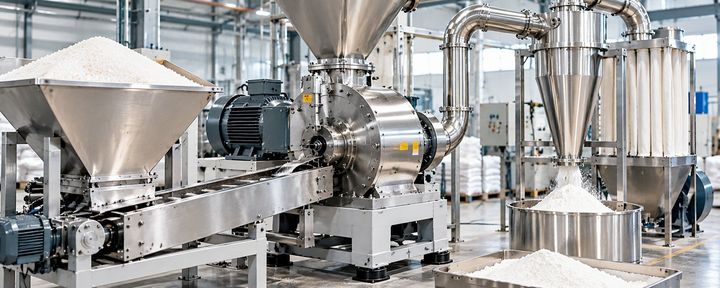
Some systems include integrated sieves, dust collection equipment, feeding mechanisms, and enclosed discharge arrangements. These components help manage material flow and separate particles according to the required size range.
How a Sugar Grinding Machine Works
A typical sugar grinding process begins with feeding granulated sugar into a grinding chamber. Mechanical forces reduce the crystals, after which the ground material may pass through a screen or classifier to separate particles according to size.
The finished powder then moves into a collection container, packaging stage, or another processing unit. Some systems use controlled feeding and enclosed transfer arrangements to reduce material loss and limit airborne dust.
Particle size depends on several factors, including rotor speed, screen openings, feed rate, sugar moisture, and machine geometry. Adjusting one variable can affect output fineness, processing temperature, throughput, and energy consumption.
Importance
Role in Food Processing
Sugar grinding machines support the preparation of powdered sugar used in icing, cake decoration, confectionery coatings, fillings, dessert mixes, and selected beverage formulations. Fine particles can disperse differently from larger crystals, affecting texture, dissolution, mixing, and the appearance of finished products.
Manufacturers must consider the relationship between sugar particle size and the intended recipe. Powder that is too coarse may produce a grainy texture, while excessively fine particles can increase dust formation and create handling difficulties.
Production Consistency and Efficiency
Industrial food processing often requires repeatable material characteristics across multiple production batches. Mechanical grinding helps manufacturers establish operating parameters that can be monitored and adjusted to maintain a defined particle-size range.
Important operational considerations include:
Particle-size consistency: Helps maintain predictable mixing and product texture.
Throughput: Determines how much material the machine can process over a specified period.
Energy use: Depends on the motor, grinding mechanism, material properties, and operating conditions.
Cleaning requirements: Affect changeovers between production batches and control of unwanted residues.
Material recovery: Influences how much processed sugar reaches the next stage.
Maintenance: Helps reduce unexpected interruptions caused by worn components or blockages.
Who Uses Sugar Grinding Machines?
These machines can be relevant to commercial bakeries, confectionery manufacturers, ingredient processors, food research facilities, and industrial plants that prepare powdered sugar.
Small-scale operations may use compact equipment for limited batches, while larger facilities may require continuous feeding, automated collection, and integration with other production systems. The appropriate configuration depends on actual production needs rather than machine size alone.
Recent Updates
Automation and Process Monitoring
Across the food processing equipment sector during 2024–2026, manufacturers have continued to develop more integrated control systems and automated material handling arrangements. These developments can include variable-speed drives, monitored operating conditions, automatic feeding, and controls that help operators maintain consistent processing parameters.
For sugar grinding, controlled feeding can help reduce sudden increases in chamber load. Monitoring motor current, temperature, vibration, and operating time can also help identify conditions that may require inspection.
Automation does not remove the need for trained operators or routine maintenance. Equipment settings must still be selected according to the material, required output, and manufacturer's operating instructions.
Dust Control and Enclosed Processing
Fine sugar powder can become airborne during grinding, discharge, transfer, and collection. Equipment designs increasingly emphasize enclosed material paths, suitable extraction systems, and dust management arrangements.
These features serve two purposes: limiting workplace exposure to airborne particles and managing combustible dust hazards. Fine sugar dust can ignite under appropriate conditions when dispersed in air and exposed to an ignition source, so dust control requires careful engineering rather than relying only on general ventilation.
Energy and Material Efficiency
Another broad development is the evaluation of energy use, material recovery, and equipment durability. Manufacturers may compare motor efficiency, processing time, screen performance, wear-part life, and cleaning requirements when assessing a grinding system.
Digital monitoring can help record operating data and identify changes in performance. However, actual energy savings and output improvements depend on the installation, operating conditions, maintenance practices, and the sugar being processed.
Comparison of Common Machine Types
Machine type | Grinding principle | Typical application | Important consideration |
|---|---|---|---|
Hammer mill | Repeated impact | General sugar size reduction | Screen selection and dust control |
Pin mill | Impact between pins | Fine powder preparation | Heat generation and feed consistency |
Impact pulverizer | High-speed impact | Powder production | Rotor condition and operating speed |
Roller mill | Compression and shearing | Controlled particle reduction | Roller gap and material characteristics |
Integrated grinding system | Grinding with screening or classification | Larger or more controlled processes | Cleaning and system integration |
These are general descriptions. Actual performance varies by machine model, configuration, and operating conditions.
Laws or Policies
Food Safety and Equipment Hygiene
Sugar grinding machines used in food production must be managed according to applicable food safety requirements in the country where the equipment operates. These requirements may cover hygienic design, contamination prevention, cleaning procedures, suitable food-contact materials, and maintenance records.
Equipment surfaces that contact sugar should be appropriate for the intended use and designed to support effective cleaning. Lubricants, coatings, seals, and replacement components must also be selected to reduce the risk of contaminating the product.
Worker Safety and Machinery Protection
Industrial grinding equipment contains moving components that can cause serious injuries. Appropriate guarding, emergency stops, electrical protection, safe access arrangements, and documented operating procedures are important elements of machine safety.
Operators should not remove guards while equipment is running or attempt to clear blockages without following the prescribed isolation procedure. Maintenance work may require lockout and tagout or an equivalent method to prevent unexpected machine startup.
Combustible Dust Management
Sugar dust can create a fire or explosion hazard when combustible particles accumulate, become suspended in air, and encounter an effective ignition source under suitable conditions. Risk assessment should consider the grinding chamber, collection equipment, ducts, filters, and locations where dust may accumulate.
Depending on the facility and jurisdiction, relevant requirements may address dust extraction, ignition control, equipment grounding, explosion protection, housekeeping, and emergency procedures. Ordinary vacuum cleaners or improvised extraction arrangements should not be assumed suitable for combustible dust.
Environmental and Operational Requirements
Factories may also need to comply with applicable rules concerning noise, waste handling, ventilation, and industrial emissions. Requirements vary according to facility size, location, equipment design, and the nature of the production process.
Tools and Resources
Particle-Size Measurement
Particle-size analysis helps determine whether ground sugar meets the specifications required for a particular application. Sieve analysis separates particles according to defined openings, while laser diffraction can measure particle-size distributions in suitable laboratory or industrial settings.
Results should be interpreted using a consistent test method. A single average value may not describe the complete distribution, because a powder can contain both very fine particles and larger fragments.
Capacity and Operating Calculations
Basic production calculations help estimate how a grinding machine fits into a wider processing line.
For example:
Parameter | Example value | Meaning |
|---|---|---|
Required output | 200 kg/hour | Target processed quantity |
Operating period | 6 hours | Planned daily processing time |
Theoretical daily output | 1,200 kg | Output before interruptions |
Operating availability | 85% | Assumed proportion of productive time |
Illustrative adjusted output | 1,020 kg | Output after applying availability |
The adjusted figure is calculated as 200 × 6 × 0.85. It is an illustration rather than a performance prediction; actual output depends on feed conditions, downtime, cleaning, maintenance, and the machine's rated capacity.
Maintenance and Inspection Resources
A structured inspection checklist can help operators monitor equipment condition and document routine work. Relevant checks may include:
Grinding chamber cleanliness and residue removal.
Screen condition and correct installation.
Rotor, hammer, pin, or roller wear.
Motor temperature, unusual vibration, and noise.
Dust collector and filter condition.
Electrical connections and safety guards.
Emergency stop operation and maintenance records.
The manufacturer's operating manual should guide inspection intervals, replacement procedures, lubrication, and approved cleaning methods.
Equipment Selection Considerations
When comparing sugar grinding machines, facilities generally examine target particle size, hourly capacity, feed characteristics, motor requirements, material-contact construction, cleaning access, dust-control provisions, and available floor space.
Testing representative sugar under controlled conditions can help establish whether a proposed configuration meets the required specifications. Equipment suitability should be evaluated as a complete system, including feeding, collection, ventilation, and downstream processing.
FAQs
What is a sugar grinding machine used for?
A sugar grinding machine reduces granulated sugar into smaller particles or powdered sugar for applications such as icing, confectionery, baking ingredients, and selected food formulations.
Which sugar grinding machine is suitable for fine powder?
Pin mills and impact pulverizers are commonly used for fine powder production, although suitable hammer mills and other systems may also achieve the required result. Selection depends on particle-size specifications, throughput, and operating conditions.
How does a sugar grinding machine control particle size?
Particle size is influenced by grinding speed, screen openings, feed rate, material moisture, and the machine's internal design. Screening or classification may separate particles that fall outside the required size range.
What safety precautions are important for sugar grinding equipment?
Important precautions include machine guarding, dust extraction, ignition control, proper grounding where required, regular housekeeping, and safe isolation during maintenance. Fine sugar dust can present a combustible dust hazard.
How is a sugar grinding machine maintained?
Maintenance generally includes cleaning, inspection of grinding components, checking screens and filters, monitoring vibration and temperature, and following the manufacturer's replacement and lubrication schedules.
Conclusion
Sugar grinding machines are important food processing equipment for preparing powdered sugar with controlled particle characteristics. Machine type, operating speed, screening arrangements, and feed conditions influence the final product and processing performance. Food hygiene, machine guarding, combustible dust control, and routine maintenance are essential considerations in industrial installations. Appropriate equipment selection depends on production requirements, product specifications, and the operating environment.