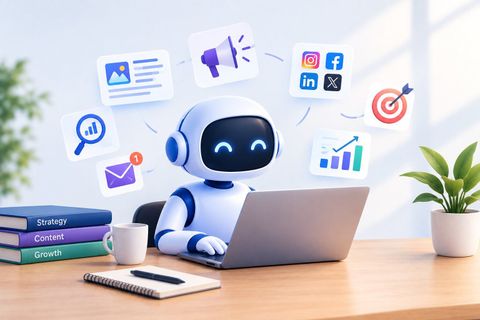
Learn AI for Digital Marketing: How It Works, Tools, Strategies, Analytics and Customer Insights
AI for digital marketing refers to the use of artificial intelligence to support activities such as audience research, content creation, advertising, campaign analysis, personalization, and customer insights. Instead of relying only on manual analysis, marketers can use AI systems to process large amounts of information, identify patterns, generate content variations, and support decisions.
Context
The connection between AI and marketing developed from earlier forms of automation, statistical analysis, recommendation systems, and machine learning. Generative AI has expanded this area by allowing systems to work with natural language, images, audio, and other forms of content.
Learning AI for digital marketing does not necessarily require advanced programming knowledge. A basic understanding of marketing principles, customer behavior, data interpretation, and AI capabilities provides a foundation for using these technologies responsibly.
How AI works in digital marketing
AI systems process information and use learned patterns to produce predictions, classifications, recommendations, or generated content. In digital marketing, these capabilities can be applied to different stages of the customer journey.
For example, AI can analyze search behavior to identify changing interests, group audiences according to shared characteristics, suggest content topics, identify patterns in campaign data, and generate variations of advertising copy.
A simplified AI marketing workflow can be described as:
- Data collection: Information is gathered from appropriate digital sources.
- Data analysis: AI identifies patterns, relationships, or changes within the information.
- Insight generation: The system produces predictions, classifications, summaries, or recommendations.
- Marketing action: Marketers use those insights when planning content or campaigns.
- Measurement: Results are examined to understand what happened and what needs further analysis.
The quality of AI output depends partly on the quality, relevance, completeness, and appropriate use of the information provided to the system.
Importance
AI has become relevant to digital marketing because audiences interact with organizations through many digital channels. Marketers may need to understand search behavior, website activity, advertising results, content engagement, and customer interactions at the same time.
Manual analysis can become difficult when the amount of information increases. AI can help organize large datasets and identify patterns that might require substantial manual effort to discover.
However, AI does not automatically understand business objectives or human motivations. An AI-generated recommendation can be based on incomplete information, and generated text can contain factual errors. Human interpretation remains important when decisions involve context, brand identity, privacy, or sensitive customer information.
AI and customer insights
Customer insights are observations about audience behavior, preferences, interests, and interactions. AI can help identify patterns across different datasets, such as which content receives attention, which audiences interact with particular topics, and where users leave a digital journey.
Google describes audience solutions as using information such as interests and demographic characteristics to help advertisers understand and reach relevant audiences across digital environments.
AI can also help identify changes in search interest. Google's Search Trends insights, for example, provide information about changes in search demand over different periods and can help identify subjects receiving increased attention.
Common digital marketing applications
| Marketing area | Possible AI application | Human role |
|---|---|---|
| Content | Topic research and draft generation | Fact-checking and editing |
| Search | Query and trend analysis | Search strategy |
| Advertising | Audience and creative analysis | Campaign planning |
| Analytics | Pattern detection and summaries | Interpretation |
| Customer insights | Audience segmentation | Context and validation |
| Personalization | Content or message recommendations | Privacy and relevance review |
| Reporting | Data summaries | Business interpretation |
These applications demonstrate where AI can assist rather than suggesting that every marketing activity should be automated.
Recent Updates
AI in digital marketing has developed considerably during 2024–2026. Advertising platforms have increasingly incorporated AI into campaign creation, audience analysis, creative development, measurement, and reporting.
Google's recent advertising updates describe AI-powered campaign features, AI-assisted creative tools, expanded measurement capabilities, and conversational analysis within analytics environments.
This development reflects a broader shift from AI being used mainly for individual tasks toward AI being integrated into larger marketing workflows.
AI-powered campaign strategies
Modern advertising systems can use machine learning to evaluate signals and adjust campaign activity according to selected objectives. Google describes AI Max for Search campaigns as combining targeting and creative features, including search-term matching, text customization, and landing-page expansion.
This means learning AI for digital marketing increasingly involves understanding how automated systems make decisions rather than simply learning how to generate text.
Marketers also need to understand what information they provide to these systems. Google recommends using relevant customer data and audience signals to help its AI understand the characteristics of valuable audiences.
Analytics and measurement
AI is also becoming more closely connected with marketing analytics. Recent developments include cross-channel measurement, additional campaign data connections, and conversational approaches to exploring analytics data.
Google's 2025 advertising updates describe Analytics Advisor capabilities that allow users to ask questions about customer journeys and continue analysis through natural-language interactions.
This changes the role of analytics from simply reading dashboards toward asking structured questions about customer behavior and campaign performance.
Generative AI and content
Generative AI can create drafts, variations, images, summaries, and other marketing materials. This can change the speed of the content development process, but generated material still needs review for accuracy, relevance, originality, and appropriate use of data.
The increasing use of AI-generated content also makes transparency and content provenance more important. Organizations need to understand how platforms identify or disclose synthetic material and what rules apply to particular types of content.
Laws or Policies
AI for digital marketing is affected by privacy, data protection, advertising, intellectual property, consumer protection, and platform policies. The exact requirements vary between jurisdictions and can also depend on the type of information being processed.
Privacy rules may restrict how personal information is collected, combined, stored, analyzed, and used for marketing purposes. Some jurisdictions require organizations to provide information about data processing or obtain a suitable legal basis before using personal information for particular activities.
Advertising and AI-generated content
Advertising rules generally require marketing communications to avoid deceptive claims and provide appropriate disclosures where necessary. AI-generated content does not automatically remove these responsibilities.
For example, if an AI system creates a statement about a product, audience behavior, performance result, or customer experience, the organization using that material remains responsible for ensuring that the published claim is accurate and appropriately supported.
Data protection and customer insights
Customer insights often depend on data, making privacy an important part of AI marketing strategy. Information should be collected and processed according to applicable requirements, particularly when it can identify an individual or reveal sensitive characteristics.
Marketers should also consider data quality. A dataset can contain errors, outdated information, or unintended bias. AI may reproduce patterns present in the underlying information rather than determining whether those patterns are appropriate.
Because AI regulation continues to develop, organizations should consult current official regulations and platform policies relevant to their activities rather than relying on general summaries alone.
Tools and Resources
Learning AI for digital marketing involves several categories of tools and resources. Analytics platforms can help examine website activity, audience behavior, conversions, and campaign performance. Search-trend tools can help identify changes in audience interest.
AI writing and research systems can assist with brainstorming, outlines, summaries, and content variations. Their output should be reviewed rather than treated as automatically accurate.
Advertising platforms increasingly include AI-supported campaign creation, targeting, creative development, and measurement. Google Ads, for example, has introduced AI Max for Search campaigns and additional AI-supported campaign and measurement features.
Analytics tools can also combine information from multiple marketing channels. Google describes expanded cross-channel measurement and additional campaign-data connections within its marketing analytics ecosystem.
A practical learning framework can include:
- Marketing fundamentals: Understand audiences, positioning, customer journeys, and campaign objectives.
- AI fundamentals: Learn what generative AI, machine learning, prediction, and automation mean.
- Data literacy: Understand metrics, datasets, trends, attribution, and limitations.
- Prompting: Learn how to provide clear context, instructions, constraints, and examples.
- Analytics: Practice interpreting patterns rather than simply reading individual numbers.
- Privacy awareness: Understand why personal data requires careful handling.
- Human review: Check AI outputs for factual accuracy, relevance, bias, and context.
FAQs
How can I learn AI for digital marketing?
Start by learning digital marketing fundamentals, then study basic AI concepts, prompting, analytics, audience research, and automation. Practical exercises using sample marketing data can help connect AI concepts with everyday marketing tasks.
How does AI work in digital marketing?
AI processes data or other inputs to identify patterns, generate content, make predictions, classify information, or support decisions. Digital marketers can apply these capabilities to research, advertising, content, analytics, and customer insights.
What AI tools are used in digital marketing?
AI tools are used for content generation, audience analysis, advertising optimization, search research, analytics, customer segmentation, reporting, and workflow automation. The appropriate tool depends on the marketing task and the available data.
How does AI help with customer insights?
AI can analyze patterns across customer interactions, audience characteristics, search behavior, and campaign data. These patterns can help marketers understand interests and behaviors, although the results still require human interpretation and appropriate data practices.
How is AI changing digital marketing strategies?
AI is shifting digital marketing strategies toward greater use of automated analysis, predictive systems, generative content, audience signals, and conversational analytics. Marketers increasingly need to understand both the technology and the data behind its recommendations.
Conclusion
AI for digital marketing combines artificial intelligence with established practices such as audience research, content planning, advertising, analytics, and customer insight analysis. Recent developments have expanded AI from individual marketing tasks into broader campaign and measurement workflows. At the same time, data quality, human oversight, privacy, transparency, and accurate interpretation remain important considerations. Understanding these principles provides a foundation for evaluating how AI can be applied within different digital marketing activities.