Cement Manufacturing Overview: Production Process, Machinery, Materials and Quality Control
Cement manufacturing is an industrial process that converts mineral raw materials into a powdered binding material used in concrete, mortar, and other construction applications. The process generally involves preparing raw materials, producing clinker through high-temperature treatment, grinding the clinker with selected additional materials, and controlling the finished cement's physical and chemical properties.
Context
Limestone is the principal source of calcium in conventional cement production. Other materials, such as clay, shale, iron-bearing materials, gypsum, and selected mineral additions, can be used to provide the chemical components required for clinker and cement production.
The production route has developed from relatively simple grinding and kiln systems into highly controlled processes involving automated material handling, laboratory testing, process instrumentation, heat recovery, dust-control equipment, and computerized plant controls.
Main stages of cement manufacturing
Although plant layouts differ, a typical cement manufacturing process contains several connected stages:
Raw material extraction and preparation
Crushing and size reduction
Raw material proportioning and grinding
Homogenization and storage
Preheating and pre-calcination
Clinker production in a rotary kiln
Clinker cooling
Cement grinding
Storage and packing
The exact equipment arrangement depends on the production process, raw materials, fuel system, plant capacity, and type of cement being produced.
Main materials used
The chemical composition of the raw mix has a direct relationship with clinker formation and cement properties. Limestone primarily contributes calcium, while clay and similar materials can provide silica and alumina. Iron-bearing materials may help adjust the required chemical balance.
Gypsum is commonly added during cement grinding to help regulate setting characteristics. Depending on the cement type and applicable standards, other mineral materials may also be incorporated.
| Material or input | General role in production |
|---|---|
| Limestone | Major calcium-bearing raw material |
| Clay or shale | Source of silica and alumina |
| Iron-bearing material | Helps adjust the raw mix chemistry |
| Gypsum | Helps regulate setting characteristics |
| Mineral additions | Used in certain cement formulations |
| Fuel | Provides heat for clinker production |
| Electricity | Powers crushing, grinding, conveying and other equipment |
Importance
Cement manufacturing matters because cement is a key component of concrete and mortar used in buildings, roads, bridges, foundations, industrial structures, and other infrastructure. Its production therefore connects mineral resources, industrial machinery, energy use, construction materials, and quality testing.
The manufacturing process also presents several technical challenges. Raw materials can vary in chemical composition, moisture, and particle size. Kiln conditions must remain within an appropriate operating range, while grinding systems need to produce cement with controlled fineness.
Why process control matters
Small changes in raw material chemistry or kiln operation can influence clinker composition. Variations during grinding can also affect cement fineness and other properties.
Quality control therefore takes place throughout the production chain rather than only after the finished cement has been produced. Typical control activities include:
Chemical analysis of raw materials
Monitoring of raw meal composition
Kiln and clinker monitoring
Measurement of cement fineness
Setting-time testing
Soundness testing
Compressive-strength testing
Monitoring of storage and handling conditions
These checks help manufacturers maintain consistency between production batches and verify conformity with the specifications applicable to a particular cement type.
Cement production machinery
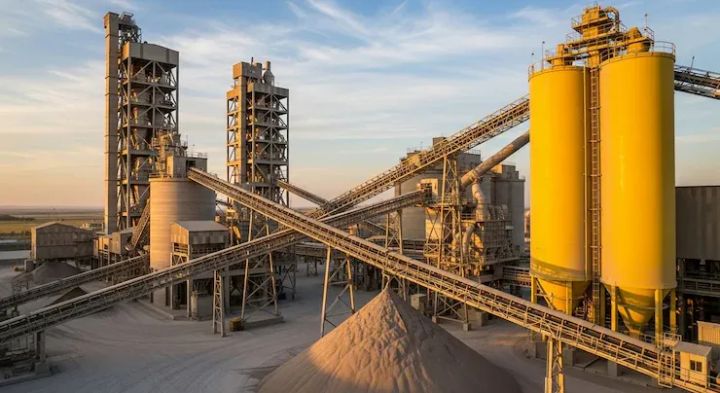
Different machines perform different functions within a cement plant. A typical arrangement can include crushers, raw mills, blending systems, preheaters, rotary kilns, clinker coolers, cement mills, separators, conveyors, silos, and packing equipment.
The rotary kiln is a central piece of equipment in the clinker production stage. The prepared raw meal passes through a high-temperature environment where chemical reactions transform the material into clinker nodules.
After cooling, the clinker is ground with gypsum and, depending on the cement formulation and applicable specification, other permitted materials. Grinding equipment may use different technologies, including vertical roller mills and ball mills.
Energy and environmental considerations
Cement production requires substantial thermal energy during clinker formation and electrical energy for processes such as grinding and material handling. The kiln stage also produces process emissions because limestone releases carbon dioxide during calcination.
Current industry research therefore focuses on several areas, including improved thermal efficiency, alternative fuels, clinker substitution, waste-heat recovery, electrification research, and carbon capture. The International Energy Agency identifies material efficiency, supplementary cementitious materials, alternative fuels, and carbon capture among the pathways being explored for reducing emissions from cement and concrete production.
Recent Updates
Recent developments in cement manufacturing have increasingly focused on reducing energy use, lowering emissions, improving process control, and making greater use of suitable alternative raw materials and fuels.
One significant area is clinker reduction. Because clinker production is responsible for a substantial portion of cement-related emissions, reducing the clinker-to-cement ratio where technically and standards-wise appropriate can reduce the amount of clinker required for a given quantity of cement.
Alternative materials and clinker substitution
Supplementary cementitious materials can include materials such as granulated blast-furnace slag, fly ash, calcined clay, and certain forms of limestone. Their suitability depends on chemical characteristics, availability, cement specifications, and the intended application.
Research and industrial development are also examining calcined clay and other lower-clinker approaches. The IEA's recent work identifies greater use of supplementary cementitious materials and alternative fuels as important elements of the cement sector's transition.
Process automation and monitoring
Modern cement plants increasingly use automated control systems to monitor temperatures, pressures, material flows, chemical composition, energy consumption, and equipment conditions.
Online analyzers can provide information about raw materials and process streams, while laboratory systems can verify chemical and physical properties. Data from these systems can help operators identify process variation and maintain more consistent operating conditions.
Waste-heat recovery
Heat leaving the kiln and clinker-cooling system contains usable thermal energy. Waste-heat recovery systems can capture part of this energy and convert it into useful heat or electricity, depending on the plant configuration.
Other areas receiving attention include improved grinding efficiency, alternative fuel preparation, improved dust collection, and carbon-capture technologies. These technologies differ considerably in maturity and suitability, so their application depends on individual plant conditions.
Laws or Policies
Cement manufacturing is generally subject to rules concerning product quality, worker safety, air emissions, waste handling, energy use, and environmental management. The specific requirements vary by jurisdiction and by the type and capacity of the manufacturing facility.
Environmental rules commonly address particulate emissions and gaseous pollutants associated with fuel combustion and high-temperature processing. Cement plants can generate dust at locations such as crushers, raw mills, kilns, clinker coolers, cement mills, and packing areas. The Central Pollution Control Board has identified these as important emission sources in cement manufacturing.
Product standards establish requirements for different cement types and their physical and chemical characteristics. In India, for example, BIS maintains standards covering cement specifications and test methods, including standards for ordinary Portland cement and methods covering properties such as fineness, setting time, soundness, and compressive strength.
The regulatory framework is not limited to the finished product. Manufacturing facilities can also be subject to requirements concerning emissions, environmental monitoring, waste materials, fuel handling, and plant operations. Because these requirements vary by jurisdiction and can be revised, the applicable authority and current rules should be checked when compliance is being assessed.
Tools and Resources
Several technical resources are used to understand cement manufacturing, evaluate raw materials, monitor production, and assess finished cement.
Laboratory testing equipment
Cement laboratories commonly use equipment for determining properties such as fineness, setting time, soundness, density, and compressive strength. Chemical analysis equipment can also determine the concentration of major oxides and other relevant constituents.
For example, the IS 4031 series covers physical testing methods for hydraulic cement, including fineness, setting time, soundness, and compressive strength.
Process-control systems
Distributed control systems and plant monitoring platforms can display temperatures, pressures, feed rates, gas conditions, material levels, and other operating parameters. These systems help operators monitor interconnected production stages from a centralized interface.
Quality-control records
Production plants commonly maintain records covering raw-material tests, chemical composition, kiln conditions, clinker quality, grinding parameters, and finished cement test results. Comparing results across production batches can help identify changes in material or process conditions.
Standards and technical references
Cement standards and technical publications provide specifications and testing procedures for different cement types. BIS's cement standards compendium, for example, brings together information on specifications, physical and chemical requirements, testing, storage, packaging, and marking.
FAQs
What are the main steps in cement manufacturing?
The main steps generally include raw material preparation, raw grinding, homogenization, preheating, clinker production, clinker cooling, cement grinding, storage, and packing. The exact arrangement varies between plants and production technologies.
What machinery is used in cement manufacturing?
Common cement manufacturing machinery includes crushers, raw mills, preheaters, rotary kilns, clinker coolers, cement mills, separators, conveyors, silos, dust-collection equipment, and packing systems. Process-control and laboratory equipment are also important parts of a modern plant.
What materials are used in cement production?
Limestone is the principal calcium-bearing material in conventional cement production. Clay or shale, iron-bearing materials, gypsum, and approved mineral additions may also be used depending on the cement formulation and applicable specifications.
How is cement quality controlled?
Cement quality control involves chemical and physical testing at several stages. Common checks include raw-material chemistry, clinker composition, cement fineness, setting characteristics, soundness, and compressive strength. The applicable cement standard determines which requirements and test methods apply.
How is modern cement manufacturing becoming more efficient?
Current developments include improved kiln and grinding efficiency, process automation, waste-heat recovery, alternative fuels, greater use of suitable supplementary cementitious materials, and research into carbon capture and lower-clinker cement systems. These approaches are being developed at different levels of technological maturity.