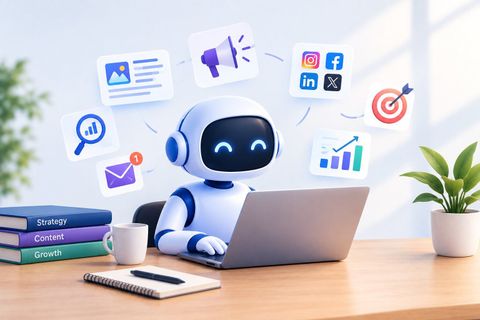
AI Business Tools Overview: Types, Automation, Analytics Business Uses and Benefits
AI business tools are software applications that use artificial intelligence to help organizations analyze information, automate repetitive activities, generate content, support decisions, and organize business processes. These tools have developed from earlier forms of machine learning, statistical analysis, natural language processing, and rule-based automation.
Context
Traditional business software generally follows predefined instructions. AI business tools can add capabilities such as recognizing patterns, processing natural language, generating text or images, classifying information, predicting possible outcomes, and responding to changing inputs.
The rapid development of generative AI has expanded the range of business applications. Instead of using AI only for specialized analytics, organizations can now use AI-enabled applications for writing, research, data analysis, coding, document processing, customer communication, workflow automation, and internal knowledge management.
AI business tools vary considerably in their capabilities. Some focus on a single task, while others combine several functions through integrated platforms. Their usefulness depends on factors such as data quality, workflow design, human oversight, security controls, and the specific business objective.
Main categories of AI business tools
AI business tools can be grouped according to the type of work they support. Common categories include:
- Generative AI tools: Produce or transform text, images, audio, code, summaries, and other content.
- AI analytics tools: Examine business data, identify patterns, generate forecasts, and support reporting.
- Automation tools: Connect applications and automate repetitive workflows based on defined conditions.
- AI assistants: Help users search information, draft documents, summarize material, or interact with internal knowledge.
- Predictive tools: Use historical information and statistical or machine-learning techniques to estimate possible future outcomes.
- AI agent tools: Allow AI systems to perform multiple connected steps using software tools, data sources, or applications.
These categories can overlap. A single business application may combine generative AI, analytics, automation, and agent capabilities.
Importance
AI business tools matter because organizations handle increasing amounts of documents, messages, transactions, records, and operational data. Processing all of this information manually can require substantial time and coordination.
AI can help with activities such as sorting information, summarizing documents, identifying unusual patterns, preparing reports, and organizing repetitive digital workflows. OECD research published in 2025 found that AI adoption among firms is influenced by factors including digital infrastructure, skills, management capabilities, and access to suitable data.
AI adoption is also becoming relevant to smaller organizations. However, adoption is not uniform across businesses. Differences in technical skills, infrastructure, organizational readiness, and data practices can affect how effectively AI is incorporated into everyday work.
Common business uses
AI business tools can be applied across many departments without being limited to one industry.
- Marketing and communications: Drafting content, summarizing audience information, organizing campaign data, and analyzing written feedback.
- Finance and accounting: Classifying documents, identifying unusual transactions, preparing summaries, and supporting financial analysis.
- Human resources: Organizing internal documents, preparing routine communications, and assisting with information retrieval while maintaining appropriate controls around personal data.
- Operations: Monitoring processes, identifying patterns, forecasting demand, and supporting workflow automation.
- Sales operations: Organizing records, summarizing interactions, and helping teams analyze pipeline information.
- Manufacturing: Supporting predictive maintenance, quality analysis, production planning, and equipment monitoring.
- Management: Combining information from different sources to support reports, planning, and business analysis.
AI does not remove the need for human review. Generated information can contain errors, incomplete reasoning, outdated information, or incorrect interpretations, particularly when the underlying data is incomplete.
Potential benefits and limitations
Potential benefits include faster information processing, easier access to business knowledge, automation of repetitive activities, and improved ability to examine large datasets. These benefits can vary significantly depending on how an organization implements the technology.
| AI business tool category | Typical use | Main input | Typical output |
|---|---|---|---|
| Generative AI | Content and document work | Prompts and source material | Text, summaries, code, media |
| AI analytics | Data analysis | Structured datasets | Trends, reports, insights |
| Workflow automation | Repetitive processes | Rules and application data | Automated actions |
| Predictive AI | Forecasting | Historical data | Predictions or estimates |
| AI assistants | Knowledge support | Documents and databases | Answers and summaries |
| AI agents | Multi-step workflows | Instructions, tools, data | Completed workflow steps |
Limitations can include inaccurate outputs, privacy concerns, cybersecurity risks, integration difficulties, inconsistent results, and dependence on high-quality data. These issues make governance and human oversight important parts of an AI implementation.
Recent Updates
AI business tools have changed considerably from 2024 through 2026. One notable development has been the expansion of generative AI from standalone writing and question-answering applications into business applications connected to organizational data and workflows.
OECD data published in 2026 reported that the share of firms using AI across OECD countries with available data increased from 14.2% in 2024 to 20.2% in 2025. The same data showed substantial differences between large and small firms, indicating that AI adoption remains uneven.
Another development is the growing attention given to AI agents. These systems are designed to perform sequences of actions rather than simply produce a single response. NIST announced an AI Agent Standards Initiative in 2026 focused on interoperability, security, and reliable use of agent-based systems.
Expansion of AI analytics and automation
AI analytics is increasingly being integrated with business intelligence and data platforms. Instead of examining only historical reports, organizations can combine descriptive analytics with predictive models and natural-language interfaces.
Automation is also becoming more connected. A workflow may receive information from one application, have an AI system classify or summarize it, and then pass the result to another application. Such workflows require clear permissions, reliable data connections, and appropriate review points.
The broader trend is toward AI being embedded within existing business software rather than functioning only as a separate application. OECD research indicates that digital infrastructure, human skills, and organizational capabilities remain important factors in successful AI adoption.
Laws or Policies
AI business tools are affected by several types of rules, including data protection requirements, intellectual property rules, cybersecurity obligations, consumer protection requirements, employment regulations, and sector-specific requirements. The applicable rules depend on the jurisdiction and the purpose for which an AI system is used.
Because no target country was specified, this section provides an international overview rather than describing one national legal framework.
The European Union's AI Act provides an example of a risk-based regulatory approach. The legislation entered into force in 2024, with different requirements becoming applicable in stages. By 2026, several provisions had become applicable, including rules concerning prohibited AI practices, AI literacy, general-purpose AI, and certain transparency requirements.
The European Commission also stated that new transparency requirements began applying in 2026 to certain AI systems, including requirements concerning disclosure of AI interaction and labeling of certain AI-generated or altered content.
Organizations using AI business tools may therefore need to consider where data is processed, what information enters an AI system, whether personal information is involved, how outputs are reviewed, and which regulatory requirements apply to the particular use case.
Tools and Resources
Several types of resources can help organizations understand AI business tools and establish appropriate governance practices.
AI risk and governance frameworks
The NIST AI Risk Management Framework provides a structured approach for organizations working with AI risks. It can be used as a reference for considering issues such as governance, measurement, evaluation, and risk management.
AI adoption research
The OECD publishes research on AI adoption, digital transformation, workplace skills, and the use of AI by firms. Its research can help readers understand adoption patterns and the organizational factors associated with AI implementation.
Data and workflow documentation
Organizations can also use internal documentation such as:
- AI use-case inventories
- Data classification guides
- Workflow diagrams
- Human-review checklists
- AI output evaluation records
- Access-control policies
- Model or application documentation
These resources can help establish where AI is being used and which processes require additional oversight.
Business analytics tools
Business intelligence platforms, spreadsheet applications, databases, and reporting systems can provide the underlying data used by AI analytics tools. The usefulness of an AI analysis depends partly on whether the source data is accurate, relevant, sufficiently complete, and appropriately governed.
FAQs
What are AI business tools?
AI business tools are software applications that use artificial intelligence for activities such as content generation, data analysis, workflow automation, forecasting, information retrieval, and decision support. Their functions vary according to the underlying technology and intended business use.
How are AI business tools used for automation?
AI business tools can automate activities such as document classification, information extraction, data entry, report preparation, and workflow routing. More advanced AI agents can coordinate multiple steps using connected applications and tools, although additional controls may be needed when systems can take actions independently.
What are AI analytics tools used for?
AI analytics tools can examine structured or unstructured information to identify patterns, summarize datasets, detect anomalies, and support forecasting. Their results should be checked against the underlying data and business context.
What are the benefits of AI business tools?
Potential benefits include reducing repetitive manual work, processing information more efficiently, supporting analytics, improving access to organizational knowledge, and assisting with routine content or reporting tasks. Actual results depend on implementation, data quality, employee skills, and the type of workflow involved.
Are AI business tools regulated?
Some AI applications are subject to laws or regulatory requirements, but the rules differ by jurisdiction, industry, data type, and use case. Organizations may need to consider privacy, cybersecurity, transparency, intellectual property, employment, and sector-specific requirements when deploying AI.
Conclusion
AI business tools include generative AI, analytics, automation, predictive systems, assistants, and increasingly agent-based applications. Their uses range from document processing and reporting to workflow automation, forecasting, manufacturing analysis, and organizational knowledge management. Recent developments show growing adoption alongside greater attention to skills, data governance, security, transparency, and regulatory requirements. The practical value of an AI business tool depends on its purpose, data, workflow design, oversight, and the environment in which it is used.