Industrial Automation Guide: Machinery, Control Systems, Robotics and Smart Manufacturing Technologies
Industrial automation refers to the use of machinery, control systems, software, sensors, robotics, and communication networks to perform or coordinate manufacturing and industrial processes with limited manual intervention. It has developed from basic mechanical controls and electrical systems into connected production environments that can collect data, adjust processes, and communicate with other equipment.
Context
Industrial automation refers to the use of machinery, control systems, software, sensors, robotics, and communication networks to perform or coordinate manufacturing and industrial processes with limited manual intervention. It has developed from basic mechanical controls and electrical systems into connected production environments that can collect data, adjust processes, and communicate with other equipment.
The foundations of industrial automation include technologies such as programmable logic controllers (PLCs), industrial computers, sensors, motors, drives, human-machine interfaces (HMIs), and supervisory control and data acquisition (SCADA) systems. These components work together to monitor physical processes and control machines according to programmed instructions.
Industrial automation is used across manufacturing, food processing, packaging, automotive production, textiles, chemicals, energy, logistics, and other industrial activities. The machinery involved can range from individual automated machines to complete production lines containing robots, conveyors, inspection equipment, and interconnected control systems.
Main components of an automation system
An industrial automation system normally combines several layers of technology. Sensors collect information about temperature, pressure, position, speed, flow, or other physical conditions. Controllers process that information and determine whether an action is required.
Actuators, motors, valves, pneumatic equipment, and other mechanical components then carry out the required action. HMIs allow operators to view process information and interact with the control system.
A simplified automation structure can be represented as:
Sensors → Controller → Actuators and Machinery → Process → Data and Monitoring
More advanced systems connect this equipment to production-management software, databases, cloud platforms, and industrial networks.
Importance
Industrial automation matters because modern production environments often involve repetitive processes, precise timing, continuous monitoring, and coordination between multiple machines. Automation can help organizations manage these activities through programmed control and consistent operating procedures.
The technology also affects people who interact with manufactured products. Automated inspection systems, controlled production processes, and digitally monitored equipment can influence how products are manufactured, packaged, tested, stored, and transported.
Automation and manufacturing operations
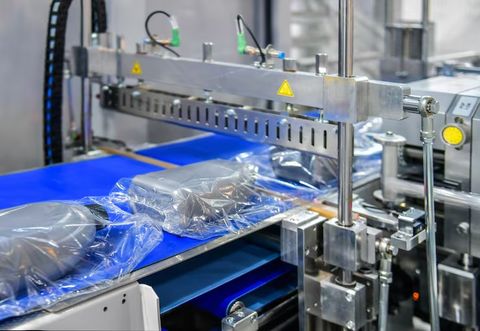
Different industries use different combinations of automation technologies. A packaging line may use sensors, conveyors, robotic handling equipment, vision systems, and PLCs. A textile production facility may connect spinning, weaving, inspection, and material-handling equipment through coordinated controls.
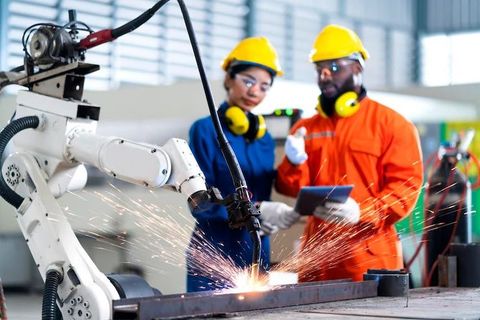
Automation can also be applied to individual machines. CNC equipment can control cutting and machining movements, while robotic systems can perform tasks such as material handling, welding, assembly, or inspection.
The role of automation can vary according to the process:
- Repetitive movement can be handled through mechanical automation or robotics.
- Process variables can be monitored using sensors and controllers.
- Product inspection can use cameras and machine-vision systems.
- Production information can be collected through industrial networks.
- Equipment conditions can be tracked through monitoring software.
Industrial automation technologies
| Technology | Primary role | Typical application |
|---|---|---|
| PLC | Machine and process control | Production machinery |
| HMI | Operator interaction | Machine monitoring |
| SCADA | Supervisory monitoring | Large industrial processes |
| Industrial robot | Automated physical movement | Assembly and handling |
| Sensors | Process measurement | Position, pressure, temperature |
| VFD | Motor speed control | Pumps, fans and conveyors |
| Machine vision | Automated inspection | Quality and identification |
| Industrial network | Equipment communication | Connected production systems |
The combination of these technologies creates an automation architecture rather than a single machine or software product.
Recent Updates
Industrial automation has increasingly moved toward connected equipment, robotics, artificial intelligence, industrial Internet of Things (IIoT) technologies, digital twins, edge computing, and data-driven production management. The general direction from 2024 through 2026 has been toward greater integration between physical machinery and digital systems.
Robotics and intelligent automation
Industrial robots continue to expand beyond traditional fixed-position applications. Collaborative robots, commonly called cobots, are designed for applications where people and robotic equipment may operate within the same broader work environment, subject to appropriate risk assessment and safeguards.
Robotic systems are also increasingly combined with cameras, force sensors, artificial intelligence, and advanced motion control. These technologies can help robots respond to variations in objects, positions, or production conditions rather than following only a fixed sequence.
Smart manufacturing
Smart manufacturing connects production equipment with data systems so that information can be collected and analyzed across different stages of an operation. Sensors may record machine conditions, production counts, energy consumption, temperatures, vibration, or other process variables.
Digital twins are another area of development. A digital twin represents a physical asset, process, or system through a digital model that can incorporate operational information. Depending on its design, it can be used for simulation, monitoring, analysis, or process planning.
Edge computing and industrial data
Industrial facilities increasingly use edge computing to process certain information close to the machinery generating it. This can reduce the need to send every piece of operational data to a distant system and can support applications that require rapid local processing.
At the same time, industrial systems are becoming more connected to enterprise software and external networks. This creates opportunities for data integration but also increases the importance of cybersecurity.
Cybersecurity developments
Cybersecurity has become an important part of industrial automation planning because connected control systems can create additional pathways through which systems may be affected by cyber incidents. The IEC 62443 family addresses cybersecurity for industrial automation and control systems, covering areas including organizational security programs, risk assessment, system requirements, and component security.
Recent standards work has also addressed newer connected environments. IEC PAS 62443-1-6, published in 2025, provides guidance on applying the IEC 62443 framework to Industrial Internet of Things environments.
Laws or Policies
Industrial automation is affected by several categories of rules and standards, including machinery safety, electrical safety, workplace protection, electromagnetic compatibility, functional safety, data protection, and cybersecurity requirements. The exact legal requirements depend on the country, industry, machine type, and intended operating environment.
International standards can provide technical frameworks for designing, assessing, and documenting automated machinery. However, a technical standard and a legal requirement are not necessarily the same thing. Applicable regulations determine the legal obligations, while standards may provide recognized methods for addressing particular technical requirements.
Machinery safety
Automated machinery can contain moving parts, electrical systems, pressure systems, heat sources, and other hazards. Safety requirements therefore commonly address areas such as guarding, emergency stopping, protective systems, risk assessment, instructions, and technical documentation.
The European Union's Machinery Regulation provides one example of a modern regulatory framework. Regulation (EU) 2023/1230 establishes health and safety requirements for machinery, related products, and partly completed machinery and is scheduled to apply from January 2027.
Industrial cybersecurity
Cybersecurity policies increasingly consider industrial control systems separately from ordinary office information systems because production equipment can have long operating lifespans and may use specialized technologies.
IEC 62443-2-1:2024 establishes security-program requirements for asset owners operating industrial automation and control systems. It also recognizes challenges associated with legacy systems whose hardware or software may no longer receive regular updates.
Organizations implementing automation should therefore consider applicable machinery regulations, electrical requirements, cybersecurity frameworks, workplace rules, and industry-specific requirements together.
Tools and Resources
Industrial automation projects use a wide range of engineering and information resources. The appropriate combination depends on the machinery, process, safety requirements, and level of automation.
Automation design tools
PLC programming environments are used to create control logic. HMI development platforms allow engineers to create screens for machine status, alarms, controls, and process information.
SCADA platforms can collect information from multiple machines and present it through supervisory dashboards. Industrial network configuration tools are used to establish communication between controllers, sensors, drives, robots, and other equipment.
Simulation and digital models
Simulation software can represent machines and processes before physical implementation. Engineers may use these models to examine sequences, movement, throughput, or interactions between equipment.
Digital twin platforms can extend this concept by connecting a digital representation with information from an operating physical system.
Measurement and maintenance resources
Industrial organizations may use condition-monitoring tools to examine vibration, temperature, current, pressure, and other parameters. Historical measurements can then be compared to operating patterns.
Common resources include:
- PLC and HMI programming environments
- SCADA monitoring platforms
- Industrial network diagnostic tools
- Robot simulation software
- Digital twin platforms
- Machine-vision development tools
- Condition-monitoring systems
- Risk-assessment templates
- Machinery documentation and technical standards
These resources support different stages of automation, from system design and commissioning to operation, monitoring, and maintenance.
FAQs
What is industrial automation?
Industrial automation is the use of control systems, machinery, sensors, software, robotics, and communication technologies to monitor and control industrial processes with limited manual intervention.
What are the main components of an industrial automation system?
Common components include PLCs, HMIs, sensors, actuators, motors, variable-frequency drives, industrial networks, SCADA systems, robots, and safety systems. The exact combination depends on the production process.
How are robotics used in industrial automation?
Industrial robots can perform tasks such as assembly, welding, material handling, packaging, palletizing, painting, and inspection. Modern robotic systems can also incorporate machine vision, sensors, and advanced control software.
What is smart manufacturing technology?
Smart manufacturing connects machinery, control systems, data platforms, sensors, and analytics to create a more connected production environment. Technologies can include IIoT, edge computing, artificial intelligence, digital twins, and industrial analytics.
Why is cybersecurity important in industrial automation?
Connected automation systems can communicate with other networks and digital platforms, creating additional cybersecurity considerations. Frameworks such as IEC 62443 provide structured approaches for addressing cybersecurity risks in industrial automation and control systems.
Conclusion
Industrial automation combines machinery, control systems, sensors, robotics, software, and communication networks to manage industrial processes. Current developments are increasingly focused on connected equipment, smart manufacturing, robotics, artificial intelligence, edge computing, digital twins, and industrial cybersecurity. Machinery safety and cybersecurity standards also play an important role in the design and operation of automated systems. The appropriate automation architecture depends on the production process, technical requirements, operating environment, and applicable regulations.