Industrial Microfiltration Systems Explained: Types, Membrane Technology, Applications and Benefits
Industrial microfiltration systems are filtration technologies used to separate suspended particles, microorganisms, and other relatively large impurities from liquids or gases. These systems use porous membranes or specialized filter media to retain particles while allowing the surrounding fluid to pass through. Industrial microfiltration systems are used in manufacturing, food processing, pharmaceutical production, water treatment, and other industries where the removal of suspended material is important.
Context
Industrial microfiltration systems are filtration technologies used to separate suspended particles, microorganisms, and other relatively large impurities from liquids or gases. These systems use porous membranes or specialized filter media to retain particles while allowing the surrounding fluid to pass through. Industrial microfiltration systems are used in manufacturing, food processing, pharmaceutical production, water treatment, and other industries where the removal of suspended material is important.
Microfiltration developed from conventional filtration methods, which use screens, cloth, sand, and other porous materials to separate unwanted particles. Advances in membrane materials and manufacturing techniques made it possible to create membranes with controlled pore sizes and more consistent separation characteristics. Modern systems can operate continuously and can be integrated into larger industrial processing lines.
How Industrial Microfiltration Works
Microfiltration generally uses membranes with pores approximately 0.1 to 10 micrometers in diameter, although the exact range varies by application and technical definition. Liquid or gas moves toward the membrane under an applied pressure difference or another suitable driving force. Particles larger than the effective openings are retained, while much of the fluid and smaller dissolved substances pass through.
The filtered output is called the permeate, while retained particles accumulate in a concentrated stream or on the membrane surface. The retained material may be removed through cleaning, backwashing, or replacement of a filter element, depending on the system design. Microfiltration is a physical separation process and does not automatically remove dissolved salts, small dissolved molecules, or every type of microorganism.
Main Components of a Microfiltration System
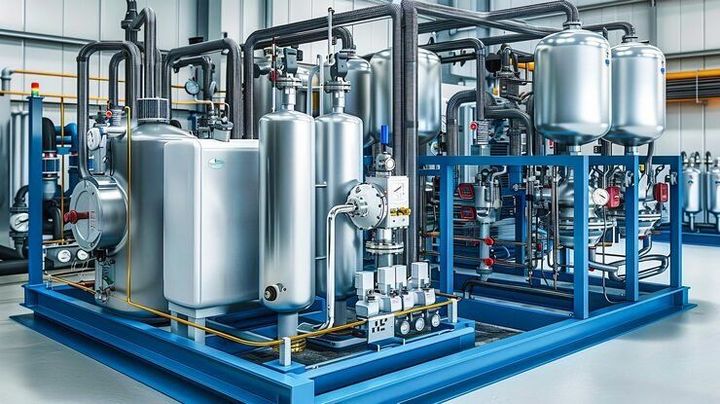
An industrial microfiltration installation typically includes several connected components. These may include a feed tank, pump, membrane housing, filtration membrane, pressure gauges, flow meters, valves, and a system for collecting the filtered output.
Some installations also include automatic controls that monitor pressure, flow rate, temperature, and cleaning cycles. The combination of components depends on the liquid being treated, the quantity processed, the required output quality, and the operating conditions.
Importance
Industrial microfiltration systems help manage suspended particles that can affect product quality, equipment performance, and downstream processing. In manufacturing, unwanted solids can interfere with production equipment, create deposits, or change the appearance and consistency of a finished product. Filtration can reduce these problems when the particle characteristics match the membrane's separation capabilities.
Water treatment facilities also use microfiltration as one stage of a broader treatment process. Removing suspended solids can improve water clarity and reduce the particle load reaching subsequent treatment equipment. However, the appropriate treatment method depends on the water source and the contaminants present.
Industrial Applications
Microfiltration has several practical applications across different sectors:
Food and beverage processing: Used for clarification of selected liquids, removal of suspended particles, and certain microbial reduction applications.
Pharmaceutical manufacturing: Applied in process-fluid clarification and selected filtration stages where compatible membranes and validated procedures are required.
Water treatment: Used to remove suspended solids and, under suitable conditions, certain microorganisms.
Chemical manufacturing: Helps separate solid particles from process liquids and selected chemical mixtures.
Electronics manufacturing: Can support the treatment of process water and certain liquid streams where particle control is important.
Automotive and metalworking: Used in some coolant and process-liquid filtration arrangements to remove suspended debris.
Biotechnology: Applied in selected separation processes involving biological materials and liquid clarification.
The suitability of microfiltration depends on particle size, fluid chemistry, temperature, pressure, and the required output. It may need to be combined with other technologies when dissolved substances or smaller contaminants must also be removed.
Microfiltration Compared With Other Filtration Methods
Different membrane technologies separate materials according to different physical characteristics. The following table summarizes common distinctions.
| Technology | General separation function | Typical applications |
|---|---|---|
| Coarse filtration | Removes relatively large debris | Initial liquid treatment |
| Microfiltration | Retains suspended particles and some microorganisms | Clarification and particle control |
| Ultrafiltration | Retains smaller particles and many macromolecules | Protein separation and water treatment |
| Nanofiltration | Separates certain small dissolved compounds and ions | Water softening and selected chemical separations |
| Reverse osmosis | Removes many dissolved salts and other dissolved substances | Desalination and high-purity water production |
These technologies have overlapping applications, and actual separation performance depends on membrane characteristics and operating conditions. Microfiltration is not a substitute for every other membrane process.
Recent Updates
Developments in industrial microfiltration during 2024–2026 have continued to focus on membrane durability, process monitoring, water reuse, and more efficient cleaning methods. Research and industrial engineering increasingly examine how membrane properties can be adapted to particular fluids while maintaining suitable flow rates and separation performance. The extent of adoption varies among industries and facilities.
Membrane Materials and System Design
Traditional microfiltration membranes may be manufactured from polymers such as polypropylene, polyvinylidene fluoride, and polysulfone-based materials. Ceramic membranes are also used where chemical resistance, temperature tolerance, or repeated cleaning requirements make them suitable. Each material has different characteristics, and compatibility must be assessed against the fluid and operating environment.
Current engineering work also examines surface modifications that may reduce particle attachment or make membranes easier to clean. These approaches may help manage fouling, although their effectiveness depends on the membrane, feed composition, and operating conditions. No single membrane material is appropriate for every industrial application.
Automation and Process Monitoring
Industrial facilities increasingly use sensors and automated controls to monitor filtration pressure, flow rate, and operating cycles. A rise in transmembrane pressure or a decline in permeate flow may indicate membrane fouling, blockage, or changing feed conditions. Monitoring these measurements can help operators identify when inspection or cleaning is needed.
Digital monitoring systems may also record operating data and support maintenance planning. Their usefulness depends on sensor accuracy, suitable alarm settings, and how the recorded information is interpreted. Automated monitoring does not remove the need for routine inspections and validation where required.
Water Reuse and Resource Management
Water reuse remains an important consideration in industrial process design. Microfiltration can form part of a treatment sequence that removes suspended solids before further treatment or reuse. Depending on water quality requirements, additional processes such as activated carbon treatment, ultrafiltration, disinfection, or reverse osmosis may be necessary.
Laws or Policies
Industrial microfiltration systems must be designed and operated in accordance with the requirements that apply to their industry, location, and intended use. Relevant rules may cover water discharge, drinking water, workplace safety, pressure equipment, food processing, pharmaceutical manufacturing, and environmental protection. Requirements differ according to the fluid being treated and the purpose of the filtration process.
Environmental and Water Regulations in India
In India, industrial facilities may be subject to the Water (Prevention and Control of Pollution) Act, 1974, and applicable environmental rules governing wastewater discharge. The Environment (Protection) Act, 1986, provides a broader framework for environmental protection, including standards and requirements issued under it. State Pollution Control Boards and Pollution Control Committees may have relevant responsibilities depending on the location and type of facility.
Installing a microfiltration system does not by itself establish compliance with wastewater requirements. Facilities must consider the complete treatment process, the quality of the discharge, applicable permissions, and monitoring obligations.
Industry-Specific Requirements
Food processing facilities must consider applicable food safety requirements, including relevant provisions administered by the Food Safety and Standards Authority of India. Pharmaceutical manufacturers may need to meet applicable manufacturing standards and demonstrate that filtration equipment is suitable for its intended process.
Industrial operators should also follow equipment manufacturers' technical instructions, workplace safety procedures, and relevant engineering standards. Requirements for pressure-rated housings, electrical systems, cleaning chemicals, and waste handling depend on the system design and operating environment.
Tools and Resources
Several technical resources can help engineers, facility managers, and students understand industrial microfiltration systems. Their usefulness depends on whether the task involves selecting a membrane, monitoring a process, evaluating water quality, or checking regulatory requirements.
Membrane Selection and Performance Tools
Membrane manufacturers commonly publish technical datasheets describing pore size, material, chemical compatibility, operating temperature, pressure limits, and recommended cleaning procedures. These details help establish whether a membrane is suitable for a particular process fluid.
Basic filtration calculations can support preliminary system assessment. Flow rate is commonly expressed as volume per unit time, while membrane flux describes the volume passing through a unit membrane area over a specified period. These calculations provide useful comparisons, but actual performance must be assessed under representative operating conditions.
Monitoring and Maintenance Resources
Pressure gauges, flow meters, turbidity meters, and data logging systems can help track operating conditions. Depending on the application, laboratory analysis may also be required to determine particle concentration, microbial levels, or other water-quality characteristics.
Useful reference resources include:
Central Pollution Control Board and relevant State Pollution Control Board publications for environmental requirements in India.
Bureau of Indian Standards publications for applicable technical standards.
Food Safety and Standards Authority of India guidance for relevant food processing requirements.
Membrane manufacturers' technical documentation for material compatibility and operating limits.
Engineering maintenance logs for recording cleaning cycles, pressure changes, flow rates, and membrane replacement.
The correct combination of tools depends on the filtration objective and the level of process control required.
FAQs
What are industrial microfiltration systems used for?
Industrial microfiltration systems remove suspended particles and certain microorganisms from liquids in applications such as water treatment, food processing, chemical manufacturing, and selected pharmaceutical processes.
What pore size do microfiltration membranes use?
Microfiltration membranes commonly have pore sizes of approximately 0.1 to 10 micrometers. The appropriate pore size depends on the particles being retained and the required separation performance.
What is the difference between microfiltration and ultrafiltration?
Microfiltration generally targets larger suspended particles and certain microorganisms, while ultrafiltration retains smaller particles and many macromolecules. The two technologies have different membrane characteristics and operating requirements.
Can industrial microfiltration systems remove dissolved salts?
Microfiltration generally does not remove dissolved salts because these substances are much smaller than its typical membrane pores. Processes such as reverse osmosis or suitable ion-removal methods may be needed for dissolved contaminants.
What factors affect microfiltration system performance?
Performance depends on membrane material, pore size, feed composition, pressure, temperature, flow rate, and membrane fouling. Regular monitoring and appropriate cleaning procedures help maintain operating conditions.
Conclusion
Industrial microfiltration systems separate suspended particles from fluids through membranes or specialized filter media. Their applications include manufacturing, water treatment, food processing, and other industries that require particle control. Membrane selection, operating conditions, cleaning practices, and regulatory requirements all influence system performance. Microfiltration may also form part of a larger treatment process when additional contaminants must be removed.

You May Also Like