Industrial Automation Solutions: Guide to AI, Robotics & Smart Manufacturing
Industrial automation refers to the use of control systems, machines, software, sensors, robotics, and data technologies to perform manufacturing activities with limited manual intervention. It is an important part of Industry 4.0, where physical production systems are connected with digital technologies.
Traditional factories often depend on separate machines and manual monitoring. Modern industrial automation connects equipment so that information can move between machines, production systems, operators, and management platforms. This creates a more connected manufacturing environment.
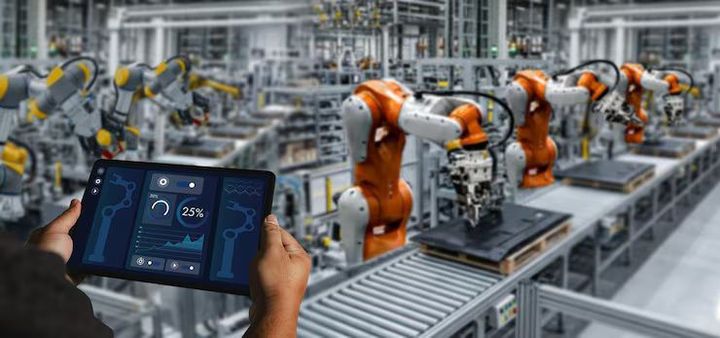
Artificial intelligence, machine learning, industrial Internet of Things (IIoT), robotics, programmable logic controllers (PLCs), human-machine interfaces (HMIs), digital twins, machine vision, and cloud or edge computing are among the technologies used in smart manufacturing.
The main purpose is not simply to replace manual activity. Automation can also help people monitor complex processes, identify abnormal conditions, maintain consistent quality, and make decisions using production data.
A modern automation system may include:
- Sensors for collecting machine and process data
- PLCs for controlling industrial equipment
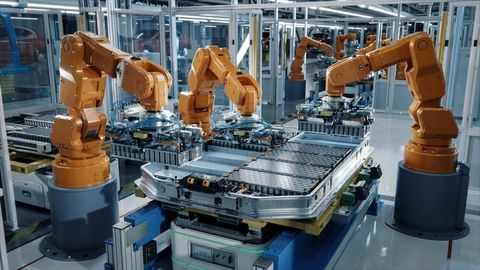
- Robots for repetitive or precision-based operations
- AI systems for pattern recognition and analysis
- Machine vision for automated inspection
- IIoT platforms for connecting equipment
- Digital twins for simulating physical processes
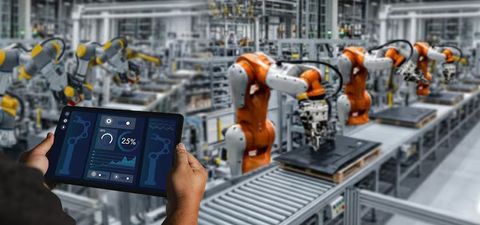
- HMI systems for operator monitoring and control
- Data analytics platforms for production insights
These technologies can be used separately or integrated into a broader smart factory architecture.
Why Industrial Automation Matters Today
Industrial automation has become increasingly important as manufacturers manage more complex production requirements, tighter quality expectations, energy considerations, and growing amounts of operational data.
For manufacturers, automation can improve process consistency. A programmed system can repeat defined operations according to established parameters, helping reduce variation between production cycles.
Automation can also support workplace safety. Robots and automated equipment can perform certain repetitive, high-temperature, heavy, or hazardous operations while people supervise processes, maintain systems, and handle tasks that require human judgment.
Another important area is predictive maintenance. Sensors can continuously monitor variables such as temperature, vibration, pressure, current, or operating cycles. Analytical software can identify unusual patterns that may indicate developing equipment problems.
Industrial automation also affects several groups:
- Manufacturing engineers: monitor processes and improve production systems.
- Plant operators: use HMI and control systems to supervise equipment.
- Maintenance teams: analyze machine conditions and maintenance data.
- Quality teams: use automated inspection and data analysis.
- Management teams: review production information for planning.
- Technology developers: create AI, robotics, IIoT, and automation solutions.
- Students and professionals: develop skills related to Industry 4.0 technologies.
The broader goal is to create manufacturing environments that are more connected, measurable, adaptable, and data-driven.
Key Automation Technologies
| Technology | Main Function | Typical Manufacturing Use |
|---|---|---|
| PLC | Machine control | Automated production lines |
| Robotics | Physical automation | Assembly and material handling |
| AI/ML | Data analysis | Prediction and process optimization |
| IIoT | Equipment connectivity | Real-time monitoring |
| Machine Vision | Image-based inspection | Quality control |
| Digital Twin | Process simulation | Planning and optimization |
| HMI | Human-machine interaction | Operator monitoring |
| Edge Computing | Local data processing | Fast industrial decisions |
Recent Developments in AI, Robotics and Smart Manufacturing
Industrial automation has continued moving toward AI-enabled and more adaptable systems during 2025 and 2026.
In October 2025, NITI Aayog released its roadmap titled Reimagining Manufacturing: India’s Roadmap to Global Leadership in Advanced Manufacturing. The roadmap identified artificial intelligence and machine learning, advanced materials, digital twins, and robotics as important technologies across priority manufacturing sectors.
In February 2026, India’s Office of the Principal Scientific Adviser held a Technology Advisory Group meeting focused on a strategic roadmap for robotics. Discussions included embodied AI, tactile perception, industrial robotics, domestic capabilities, standards, testing, research, and workforce development.
Another February 2026 development was the launch of a white-paper concept focused on AI for Manufacturing Engineering Technology. The initiative highlighted AI adoption, skills development, productivity, sustainability, and collaboration among government, academia, and industry.
In June 2026, the Ministry of Steel highlighted AI, machine learning, IIoT, digital twins, robotics, and advanced data analytics as technologies relevant to the digital transformation of steel manufacturing.
These developments show a shift from basic automation toward connected, intelligent, and increasingly adaptive manufacturing systems.
Another emerging direction is physical AI. Instead of AI being limited to software analysis, physical AI combines intelligent algorithms with machines, sensors, robots, and real-world environments. This can support robots that respond to changing conditions rather than following only fixed sequences.
Laws, Standards and Government Policies
Industrial automation in India is influenced by several areas of regulation and government policy rather than one single automation law.
Workplace safety requirements are important when industrial robots, machinery, electrical systems, pressure equipment, or automated production lines are installed. Organizations need to consider applicable occupational safety requirements and relevant technical standards for their equipment and processes.
Cybersecurity is also becoming more significant because connected industrial equipment can create digital access points. Industrial control systems should therefore be designed with appropriate authentication, network controls, monitoring, backup procedures, and incident-response practices.
India's National Mission on Interdisciplinary Cyber-Physical Systems (NM-ICPS) supports technologies including artificial intelligence, machine learning, IoT, robotics, autonomous systems, cybersecurity, and data analytics. As reported by the Government of India in August 2026, the mission has established 25 Technology Innovation Hubs across premier academic institutions.
Government programs are also emphasizing advanced skills. PMKVY 4.0 includes future-oriented areas such as AI, machine learning, robotics, IoT, data analytics, cloud computing, cybersecurity, and other emerging technologies.
In February 2026, a government consultation on advanced manufacturing systems discussed CNC machine-tool control systems, robotics and robotic arms, and advanced additive manufacturing. The discussions also covered technology gaps, domestic capabilities, testing, standards, and industrial adoption.
For organizations implementing automation, applicable electrical, machinery, occupational safety, data protection, cybersecurity, environmental, and sector-specific requirements should be reviewed according to the actual application and location.
Tools and Resources for Learning Industrial Automation
People learning about industrial automation can begin with basic concepts before moving toward advanced systems.
Useful categories of tools and learning resources include:
- PLC programming simulators for practicing control logic
- HMI design software for learning operator interfaces
- Industrial robotics simulators for virtual robot programming
- CAD tools for mechanical automation concepts
- Digital twin platforms for process simulation
- IIoT dashboards for studying equipment data
- Spreadsheet tools for basic production analysis
- Data visualization tools for monitoring industrial metrics
- Machine learning environments for predictive analytics
- Electrical circuit simulators for control-system fundamentals
- Technical standards databases for safety and engineering guidance
- Government technology portals for policy and program information
- Online technical courses for PLC, robotics, AI, and IoT fundamentals
A structured learning path can begin with electrical and mechanical fundamentals, followed by PLCs and sensors. Learners can then study HMI, industrial networking, robotics, data analytics, and AI applications.
For an existing factory, automation planning should begin with the production problem rather than selecting technology first. A clear process map can identify where monitoring, control, inspection, material handling, or predictive analytics may provide practical value.
Frequently Asked Questions About Industrial Automation
What is industrial automation?
Industrial automation is the use of control systems, machines, software, sensors, robotics, and data technologies to perform or monitor manufacturing processes with limited manual intervention.
How does AI support smart manufacturing?
AI can analyze production and machine data to identify patterns, detect anomalies, support quality inspection, forecast equipment conditions, and assist with process decisions. Its usefulness depends on data quality, system design, and appropriate human oversight.
What is the difference between automation and robotics?
Automation is a broad concept covering systems that control or perform processes automatically. Robotics is a specific area involving programmable physical machines capable of carrying out movements or tasks. Robots can therefore be one component of an industrial automation system.
What is a smart factory?
A smart factory is a manufacturing environment where machines, sensors, software, people, and production systems are digitally connected. Data can be collected and analyzed to support monitoring, quality management, maintenance, and production decisions.
Is industrial automation only suitable for large factories?
No. Automation technologies can be applied at different scales. The appropriate approach depends on production volume, process complexity, equipment, workforce, data requirements, safety considerations, and the specific manufacturing objective.
Conclusion
Industrial automation is evolving from fixed machine control toward connected and intelligent manufacturing. PLCs, robotics, sensors, IIoT, machine vision, AI, digital twins, and analytics can work together to create more measurable and adaptable production environments.