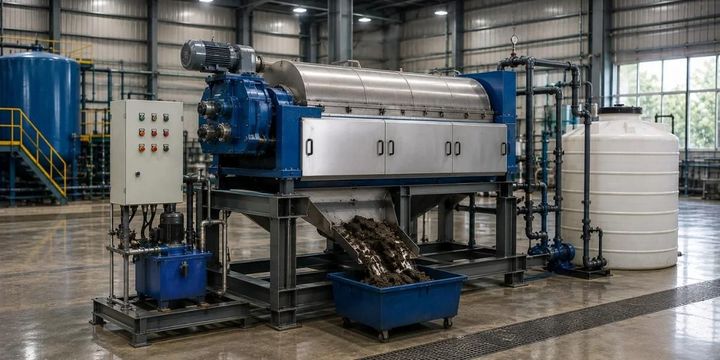
Industrial Sludge Dewatering Systems: Process and Equipment Insights
Industrial sludge dewatering systems are used to remove a portion of the water contained in sludge produced by industrial operations. Sludge is a wet mixture of water and solid materials that may include suspended particles, organic matter, minerals, treatment chemicals, and other residues. Its composition depends on the industrial process that generates it.
Industries such as food processing, textiles, paper manufacturing, chemical production, metal finishing, and mining may generate substantial amounts of sludge. Wastewater treatment facilities also produce sludge when they separate contaminants from water.
Fresh sludge often contains a high percentage of moisture. This makes it heavy, difficult to handle, and challenging to transport or process further. Dewatering reduces its water content, producing a more concentrated material known as dewatered sludge or sludge cake.
The main purpose of dewatering is to improve sludge handling and prepare the material for its next treatment or disposal stage. It does not necessarily eliminate hazardous substances, destroy pathogens, or make the resulting solids safe for unrestricted use.
Industrial sludge dewatering equipment uses mechanical pressure, centrifugal force, gravity, or a combination of these methods to separate water from solids. The appropriate system depends on the sludge characteristics, treatment requirements, available space, and applicable environmental rules.
Importance of Industrial Sludge Dewatering Today
Industrial sludge management is an important part of wastewater treatment and environmental protection. As manufacturing activities expand and water management requirements become more demanding, industries need practical methods for handling the solid residues generated by their operations.
Reducing sludge volume
Water often makes up most of the initial sludge volume. Removing some of this water can reduce the amount of material that must be moved, stored, or sent for additional treatment. The actual reduction depends on the sludge composition and the performance of the equipment.
Improving handling and storage
Wet sludge can be difficult to pump, transfer, and store. Dewatered sludge is generally easier to handle using suitable conveyors, containers, and material-handling equipment. Proper storage remains essential to prevent leaks, odors, and environmental contamination.
Supporting wastewater treatment
Dewatering is commonly used after biological, chemical, or physical wastewater treatment. It separates concentrated solids from the water remaining in the sludge. The separated liquid, called filtrate or centrate depending on the equipment, may need additional treatment before reuse or discharge.
Supporting environmental management
Industrial sludge may contain heavy metals, oils, chemical residues, or other pollutants. Dewatering helps manage the physical volume of the material but does not remove every contaminant. Testing and appropriate treatment are necessary to determine its handling requirements.
Helping industries plan operations
Reliable sludge management requires coordination between wastewater treatment, maintenance, environmental compliance, and production teams. Understanding dewatering performance helps these teams plan equipment operation, storage capacity, and downstream treatment.
Common industries that use these systems include:
Food and beverage processing
Textile dyeing and finishing
Pulp and paper production
Mining and mineral processing
Chemical and pharmaceutical manufacturing
Metal processing and surface treatment
Municipal and industrial wastewater treatment
Industrial Sludge Dewatering Process Explained
The dewatering process usually follows several stages. The exact sequence depends on the type of sludge, the equipment selected, and the required quality of the separated water and solids.
Sludge collection and characterization
Sludge is collected from treatment tanks, clarifiers, settling units, or industrial processes. Operators assess its moisture content, solids concentration, particle size, and chemical composition. These details help determine which dewatering method is suitable.
Sludge conditioning
Some sludge requires conditioning before mechanical dewatering. Conditioning may involve adding polymers or other appropriate chemicals to help fine particles combine into larger groups called flocs. These flocs release water more readily during separation.
Chemical selection should be based on laboratory testing and operating trials. Excessive chemical addition can increase residue generation or affect the quality of the separated liquid.
Mechanical separation
The conditioned sludge enters a dewatering machine. Depending on the system, water passes through a filter medium, separates under centrifugal force, or drains through a combination of gravity and mechanical pressure.
Collection of solids and liquid
The dewatered solids are collected for further treatment, storage, transport, or authorized disposal. The separated liquid is collected separately and evaluated for return to the treatment process or further treatment.
Monitoring and maintenance
Operators monitor moisture levels, solids capture, throughput, pressure, and other operating parameters. Routine maintenance helps maintain consistent performance and reduces the risk of blockages or mechanical failures.
Types of Industrial Sludge Dewatering Equipment
Different machines use different separation principles. Selecting equipment requires an understanding of sludge characteristics, production volume, operating conditions, and downstream requirements.
Equipment type | Working principle | Common applications |
|---|---|---|
Filter press | Pressure forces water through filter cloth | Chemical, metalworking, and mineral-processing sludge |
Belt filter press | Moving belts squeeze water from sludge | Biological and municipal wastewater sludge |
Decanter centrifuge | Rapid rotation separates solids from liquid | Industrial wastewater and process sludge |
Screw press | A rotating screw compresses sludge through a drainage screen | Food processing and selected biological sludges |
Rotary vacuum filter | Vacuum draws liquid through a filter medium | Certain mineral and industrial suspensions |
Drying bed | Gravity drainage and evaporation reduce moisture | Suitable sludge under appropriate site conditions |
Equipment performance varies with feed characteristics, machine configuration, and operating conditions. No single technology is appropriate for every sludge type.
Filter presses
Filter presses hold sludge between filter plates and apply pressure to separate water. They can produce relatively dry sludge cake when the material responds well to filtration. However, they commonly operate in cycles that include filling, pressing, opening, and cake removal.
Belt filter presses
Belt presses move sludge through drainage and pressure zones using porous belts. They can operate continuously and are often used where steady processing is important. Belt washing, alignment, and polymer control are important parts of routine operation.
Decanter centrifuges
Centrifuges use rapid rotation to separate particles from liquid according to differences in density. They are useful for continuous processing, but electricity demand, wear, noise, and maintenance requirements need careful consideration.
Screw presses
Screw presses move sludge through a screened chamber while gradually applying pressure. Their relatively steady operation can suit certain fibrous or biological materials. Actual performance depends on sludge properties and machine design.
Recent Developments and Technology Trends
During 2025 and 2026, industrial waste management has continued to emphasize resource efficiency, better monitoring, and more accountable waste handling. The relevance of individual developments depends on the industry and jurisdiction.
Smarter process monitoring
Automated control systems can track feed flow, pressure, motor load, and other operating variables. Some facilities use sensors and process data to identify changing sludge conditions and adjust operating settings. These systems can support process consistency, but they still require calibration and competent supervision.
Improved water management
Industries are increasingly examining how separated water can be returned to appropriate treatment stages or reused in suitable processes. Reuse depends on water quality, chemical composition, and the requirements of the receiving process.
Energy and resource efficiency
Equipment selection increasingly considers energy use, chemical consumption, maintenance needs, and the quantity of solids captured. Evaluating the entire treatment process provides a more realistic picture than measuring machine throughput alone.
Digital environmental reporting
Environmental authorities are placing greater attention on documentation, traceability, and responsible waste management. In India, the Central Pollution Control Board's reporting systems and waste-management guidance form part of a wider regulatory framework. Changes introduced during 2025 and 2026 make it especially important to verify which rules apply to each waste category.
These trends do not mean every facility requires advanced automation. Smaller operations may achieve appropriate results through sound process design, regular testing, and consistent maintenance.
Laws and Policies Affecting Sludge Management
Industrial sludge regulations vary by country, state, industry, and waste composition. The main concerns are typically pollution prevention, worker safety, wastewater discharge, hazardous waste classification, and environmentally responsible disposal.
Environmental rules in India
In India, the Water (Prevention and Control of Pollution) Act, 1974, and the Environment (Protection) Act, 1986, provide important foundations for pollution control. The Central Pollution Control Board and State Pollution Control Boards have roles in environmental oversight and compliance. Industrial facilities may need applicable consents and must meet relevant discharge conditions.
The Hazardous and Other Wastes (Management and Transboundary Movement) Rules, 2016, as amended, may apply when industrial sludge meets the relevant hazardous waste criteria. Applicable requirements can include authorization, safe storage, recordkeeping, transport, treatment, and disposal through permitted channels.
The Solid Waste Management Rules, 2026, were notified on 27 January 2026 and came into force on 1 April 2026. However, industrial process sludge should not automatically be treated as ordinary solid waste. Its classification and the applicability of the relevant rules must be assessed separately.
Key compliance practices
Industrial operators should:
Characterize sludge through appropriate laboratory testing.
Identify whether the material is hazardous under applicable rules.
Maintain required records of generation, treatment, movement, and disposal.
Follow the facility's applicable environmental permissions and discharge limits.
Provide suitable protective equipment and safe operating procedures.
Use authorized treatment or disposal routes where required.
Rules in other countries may differ substantially. Facilities should verify current requirements with the relevant environmental regulator rather than relying on general guidance alone.
Tools and Resources for Sludge Dewatering
Selecting and operating industrial sludge dewatering equipment requires reliable process data and a clear understanding of the material being treated. Several general tools can support planning, monitoring, and evaluation.
Laboratory testing tools
Moisture analyzers, filtration test equipment, and laboratory balances help determine solids concentration and moisture content. Chemical analysis can identify contaminants that influence sludge classification and treatment decisions.
Process monitoring instruments
Flow meters, pressure gauges, temperature sensors, and motor-load indicators help operators monitor equipment performance. These instruments can reveal changes in feed conditions or indicate a need for maintenance.
Dewatering performance calculations
Basic calculations help compare equipment performance under different operating conditions.
Measurement | Calculation | Purpose |
|---|---|---|
Solids content (%) | Dry solids ÷ wet sample mass × 100 | Measures the proportion of solids |
Moisture content (%) | Water mass ÷ wet sample mass × 100 | Measures the proportion of water |
Solids capture (%) | Captured solids ÷ feed solids × 100 | Estimates how much solid material is retained |
Throughput | Processed sludge mass ÷ operating time | Measures processing rate |
For example, if a 100 kg sludge sample contains 20 kg of dry solids, its solids content is 20%. Its moisture content is 80%, assuming the sample consists of water and dry solids.
Maintenance and operating records
Daily inspection checklists, maintenance schedules, chemical-use logs, and process-performance records help identify recurring problems. Records can also support environmental audits and operational planning.
Technical learning resources
Useful learning materials include wastewater treatment manuals, equipment operation guides, laboratory testing procedures, occupational safety instructions, and environmental compliance guidance. General process calculators and spreadsheet templates can help organize measurements and compare operating results.
Frequently Asked Questions
What is the main purpose of industrial sludge dewatering?
Its main purpose is to remove a portion of the water from sludge, making the remaining solids easier to handle, store, transport, and process further.
Which equipment is most suitable for industrial sludge dewatering?
The appropriate equipment depends on sludge composition, solids concentration, processing volume, required cake dryness, and operating conditions. Filter presses, belt presses, centrifuges, and screw presses are common options.
Does dewatering make hazardous sludge safe?
No. Dewatering primarily separates water from solids. Hazardous substances may remain concentrated in the resulting sludge cake, so classification, testing, and authorized handling are still necessary.
Can water separated during dewatering be reused?
Potentially. The separated liquid may be returned to a treatment process or reused in an appropriate industrial application if its quality meets the relevant requirements. Further treatment may be necessary.
How can operators improve dewatering performance?
Operators can characterize the incoming sludge, optimize conditioning chemicals, maintain equipment, monitor operating parameters, and evaluate solids capture and moisture content regularly. Improvements should be confirmed through testing.
Conclusion
Industrial sludge dewatering systems play an important role in wastewater treatment and industrial waste management. By separating water from concentrated solids, they help facilities manage residual materials and prepare them for further treatment or appropriate disposal.