Industrial Time-Series Databases: Guide to Real-Time Data Analytics
An industrial time-series database is a specialized data storage system designed to manage information recorded over time. It is commonly used in manufacturing plants, energy facilities, water treatment systems, transportation networks, and other industrial environments.
Unlike a conventional database that primarily stores customer records, product details, or business transactions, a time-series database focuses on measurements associated with timestamps. These measurements may include machine temperature, motor speed, electrical current, vibration, pressure, production rates, and energy consumption.
For example, a temperature sensor installed on an industrial boiler might record a measurement every second. Over one day, it can generate thousands of individual readings. When many machines and sensors operate together, the amount of information grows rapidly.
A time-series database organizes this information so that engineers and analysts can examine historical patterns, identify unusual changes, and understand current operating conditions.
How Time-Series Data Works
Time-series data generally contains three important elements:
Timestamp: The date and time when a measurement was recorded.
Measurement: The recorded value, such as 85°C or 1,500 revolutions per minute.
Metadata: Additional information identifying the machine, sensor, production line, or measurement type.
These elements help organizations connect individual readings with specific equipment and operational events.
Common Applications in Industry
Industrial time-series databases support several applications:
Factory automation and machine monitoring.
Predictive maintenance and equipment health analysis.
Industrial Internet of Things (IIoT) platforms.
Electrical grid monitoring and renewable energy systems.
Environmental monitoring and process control.
Production performance and quality analysis.
Building management and industrial refrigeration.
The main purpose is to turn continuous streams of measurements into useful operational information.
Why Industrial Time-Series Databases Matter Today
Managing Growing Industrial Data Volumes
Modern factories increasingly use connected sensors, programmable logic controllers (PLCs), supervisory control and data acquisition (SCADA) systems, and industrial gateways. These technologies generate continuous streams of information that traditional data systems may struggle to process efficiently when workloads involve large numbers of time-based measurements.
A time-series database is designed to handle these workloads by organizing readings around their timestamps and supporting queries across selected periods.
For example, a plant engineer can compare motor temperatures during the morning shift with readings from the previous week. This helps reveal recurring patterns that might otherwise remain unnoticed.
Supporting Predictive Maintenance
Unexpected equipment failures can interrupt production, damage components, and create safety risks. Time-series analytics helps maintenance teams identify patterns that may indicate developing problems.
Useful indicators include:
Increasing vibration levels in rotating equipment.
Gradual temperature changes in bearings.
Repeated pressure fluctuations in pipelines.
Rising energy consumption under similar operating conditions.
Changes in machine cycle duration.
These indicators do not automatically prove that equipment will fail. However, when combined with engineering knowledge and suitable analytical models, they can help maintenance teams investigate potential faults earlier.
Improving Operational Visibility
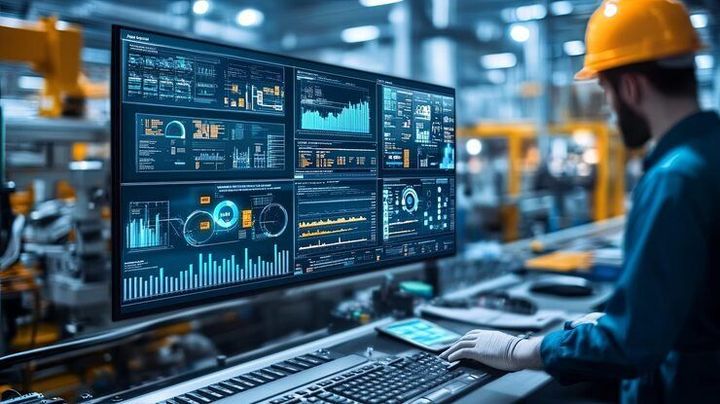
Industrial managers need reliable information about production performance, energy use, and equipment availability. Time-series databases make it easier to create dashboards that display current measurements alongside historical trends.
This information can help teams investigate production interruptions, compare machine performance, and identify periods of unusual resource consumption.
Time-Series Databases Compared With Traditional Databases
Feature | Time-Series Database | Traditional Relational Database |
|---|---|---|
Primary focus | Time-stamped measurements | Structured records and relationships |
Typical data | Sensor readings and machine metrics | Orders, inventories, and transactions |
Query patterns | Time windows and historical trends | Record lookup and relational queries |
Common use | Monitoring and operational analytics | Business applications and reporting |
Data reduction | Often supports time-based aggregation | Depends on schema and implementation |
Neither database type is universally better. Many industrial architectures use both, selecting each system according to the workload.
Recent Developments in Industrial Time-Series Analytics
Edge Computing and Real-Time Data Processing
During 2025 and 2026, industrial data architectures have continued to emphasize edge computing, cloud integration, and faster operational analysis. These approaches help organizations process information closer to the equipment that generates it.
Edge computing allows an industrial computer or gateway to analyze selected sensor readings locally. Instead of transmitting every measurement to a remote platform, the system can identify important changes and send relevant information for further analysis.
This approach is useful when factories have limited network bandwidth or need rapid responses to changing conditions. However, critical control functions should remain within appropriately designed and validated control systems.
Artificial Intelligence and Predictive Analytics
Artificial intelligence (AI) and machine learning are increasingly used to analyze historical industrial measurements. These technologies can help detect unusual patterns, estimate equipment degradation, and identify relationships between operating conditions and production outcomes.
For example, a machine-learning model may analyze vibration, temperature, and rotational speed to identify operating patterns associated with abnormal equipment behavior.
Recent development priorities include:
Combining sensor data with maintenance records.
Using anomaly detection to identify unexpected measurements.
Supporting automated analysis of large historical datasets.
Connecting operational analytics with digital twins.
Improving the monitoring of energy consumption and equipment performance.
These applications depend on data quality, appropriate model design, and regular evaluation. AI predictions should not be treated as guaranteed outcomes.
Cloud-Native and Hybrid Architectures
Industrial organizations increasingly consider architectures that combine local data collection with centralized analytics. Local systems can support immediate monitoring, while centralized platforms can compare performance across multiple facilities.
Hybrid architectures also allow organizations to retain sensitive operational information locally while transferring selected measurements for broader analysis.
The appropriate design depends on connectivity, data volume, security requirements, latency, and the consequences of a system interruption.
Data Quality and Interoperability
Another important development is the growing focus on consistent data definitions and reliable integration between industrial systems.
A temperature reading is useful only when its timestamp, unit, sensor identity, and operating context are understood. Incorrect timestamps, missing readings, duplicate events, and inconsistent measurement units can distort analytical results.
Industrial teams are therefore paying greater attention to synchronized clocks, standardized naming conventions, metadata management, and data validation.
These are ongoing technology trends rather than claims about a single newly introduced product or regulation.
Laws, Regulations, and Industrial Data Policies
Data Protection and Cybersecurity
Industrial time-series databases may contain sensitive information about production processes, facility operations, equipment performance, and energy usage. Organizations should assess the legal and cybersecurity requirements that apply to their locations and industries.
Relevant considerations include:
Access control and user authentication.
Encryption for data transmission and, where appropriate, stored information.
Secure system configuration and software updates.
Data retention and deletion policies.
Backup, recovery, and incident response procedures.
Restrictions on transferring data across national borders.
Requirements vary by country, industry, and the type of information collected. Industrial measurements are not automatically personal data, but records linked to identifiable individuals may trigger privacy obligations.
India-Specific Considerations
For organizations operating in India, several regulatory frameworks may be relevant, depending on the application.
The Digital Personal Data Protection Act, 2023, establishes a framework for digital personal data protection. Its applicability to an industrial analytics system depends on whether personal data is processed and on the relevant legal provisions and commencement arrangements.
The Information Technology Act, 2000, and applicable rules may also be relevant to information security and electronic records. Organizations should verify which provisions and requirements apply to their specific activities.
For certain critical information infrastructure and covered entities, additional cybersecurity requirements and directions may apply. Industrial operators should determine their obligations based on their sector, designation, and current regulatory instructions.
International Standards and Industrial Security
Organizations with international operations may also consider established technical standards and cybersecurity frameworks.
Examples include:
IEC 62443: A family of standards addressing cybersecurity for industrial automation and control systems.
ISO/IEC 27001: A standard for establishing and continually improving an information security management system.
NIST Cybersecurity Framework: Guidance for managing cybersecurity risks.
Industry-specific requirements: Additional obligations may apply to energy, healthcare, transportation, and other regulated sectors.
These standards and frameworks are not interchangeable, and not every organization is legally required to follow each one. Their relevance depends on contractual obligations, regulatory requirements, and operational risks.
Tools and Resources for Industrial Time-Series Databases
Selecting a database involves more than comparing storage capacity. Organizations should consider ingestion speed, query performance, reliability, integration, security, and long-term data management.
Essential Tools and Capabilities
Tool or capability | Main purpose |
|---|---|
Industrial sensors and gateways | Collect measurements from equipment |
Data acquisition platforms | Receive and organize incoming readings |
Time-series database engines | Store and query time-stamped information |
Monitoring dashboards | Display current values and historical trends |
Data visualization tools | Compare measurements across periods |
Anomaly detection tools | Identify unusual patterns |
Backup and recovery utilities | Protect data and restore operations |
Data quality checks | Detect missing, duplicated, or invalid readings |
How to Evaluate a Database
Before choosing a system, assess these technical requirements:
Data ingestion: Estimate the number of sensors, readings per second, and expected growth.
Query performance: Test common tasks, such as retrieving the last hour of readings or calculating daily averages across several machines.
Retention policies: Determine how long detailed measurements must be retained and whether older readings can be summarized.
Reliability: Examine backup methods, replication, recovery objectives, and behavior during network interruptions.
Integration: Check compatibility with PLCs, SCADA systems, industrial communication protocols, analytics platforms, and reporting tools.
Security: Review authentication, permissions, encryption, auditing, and network separation.
A Simple Data Planning Example
Consider a facility with 100 sensors, each recording one measurement every second.
Metric | Example value |
|---|---|
Number of sensors | 100 |
Readings per sensor per second | 1 |
Total readings per second | 100 |
Readings per day | 8,640,000 |
Readings over 30 days | 259,200,000 |
These figures assume continuous recording without missing measurements. They represent individual readings, not the total storage capacity required. Actual storage needs depend on timestamps, metadata, compression, indexing, replication, and retention policies.
A simple capacity estimate helps teams plan infrastructure before deploying a large sensor network.
Frequently Asked Questions
What Is the Main Purpose of an Industrial Time-Series Database?
Its main purpose is to store and analyze measurements recorded over time. It helps industrial teams monitor equipment, investigate operating changes, evaluate energy usage, and support predictive maintenance.
How Is a Time-Series Database Different From a Regular Database?
A time-series database is optimized for workloads involving time-stamped measurements and time-based queries. A traditional relational database is often better suited to structured business records and complex relationships. Some systems can perform both types of work.
Can Time-Series Databases Support Real-Time Analytics?
Yes. Many time-series databases can ingest incoming measurements and make them available for queries and dashboards with low latency. Actual performance depends on the system architecture, data volume, network conditions, and configuration.
Are Time-Series Databases Useful for Predictive Maintenance?
Yes. Historical temperature, vibration, pressure, and other machine measurements can help identify patterns associated with equipment deterioration. Reliable predictions also require suitable analytical methods, accurate data, and engineering validation.
How Should an Organization Choose a Time-Series Database?
Start by assessing data volume, ingestion speed, query requirements, retention periods, integration needs, security, and recovery capabilities. Test the shortlisted systems using representative workloads before making a final technical decision.
Conclusion
Industrial time-series databases play an important role in modern manufacturing, industrial automation, energy management, and connected equipment monitoring. By organizing measurements according to when they occur, these systems help organizations understand operating conditions and identify meaningful patterns in large volumes of industrial data.