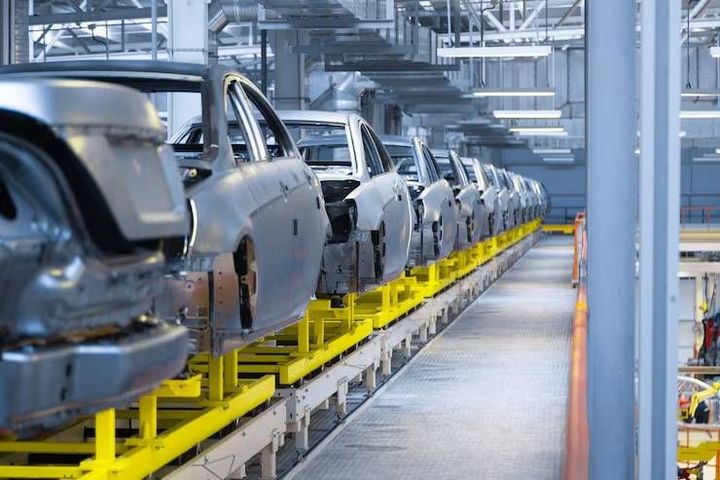
Automotive Production Explained: How Cars Are Built Today and Where the Industry Is Heading
Automotive production is the process of transforming raw materials, engineered components, and electronic systems into finished vehicles. It combines mechanical engineering, industrial machinery, robotics, software, quality inspection, and coordinated manufacturing activities. Modern car production includes vehicles powered by petrol or diesel engines, hybrid systems, and battery-electric powertrains.
Context
The industry developed from small-scale workshops into large factories where standardized parts could be assembled in repeatable sequences. Moving assembly lines, automated machinery, and interchangeable components made it possible to manufacture vehicles in greater volumes while maintaining consistent production methods.
Today, automotive manufacturing involves much more than assembling a body and installing an engine. A modern vehicle may contain thousands of individual components, including sensors, wiring, electronic control units, safety systems, interior fittings, and connected technologies. These parts often come from different suppliers and must arrive at the manufacturing plant according to carefully coordinated schedules.
Main stages of automotive production
Car manufacturing usually follows a sequence of interconnected operations. The precise arrangement varies by vehicle design, factory layout, production volume, and powertrain type.
Product design and engineering: Engineers develop vehicle structures, mechanical systems, electrical architecture, and digital models before physical production begins.
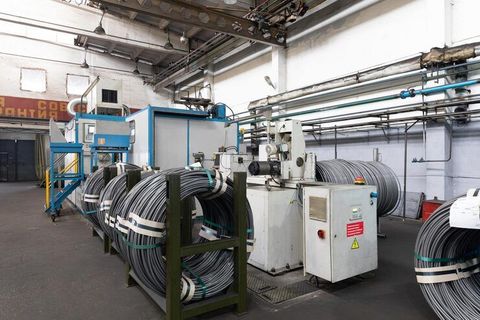
Material preparation: Metals, plastics, glass, rubber, and other materials are processed into components suitable for manufacturing.
Body construction: Presses shape metal sheets, while robotic equipment and specialized joining processes create the vehicle body.
Surface treatment and painting: The body undergoes cleaning, corrosion-protection treatments, coating, and finishing.
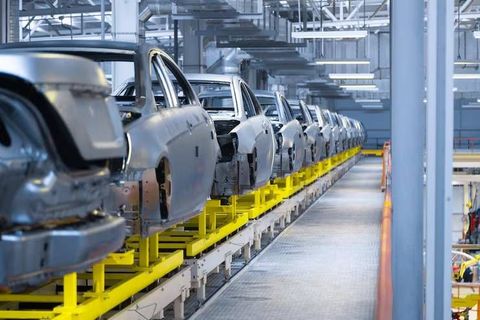
Component assembly: Workers and automated systems install wiring, seats, dashboards, suspension, powertrain components, and other equipment.
Testing and inspection: Completed vehicles undergo checks to assess assembly quality, electrical operation, braking systems, and other relevant functions.
Each stage depends on the accuracy of the preceding operations. A dimensional error in a body panel, for example, can create alignment problems during final assembly.
Importance
Automotive production affects transportation, industrial development, employment across manufacturing supply chains, and the availability of personal and commercial vehicles. It also supports related industries that produce steel, aluminium, tyres, electronics, batteries, glass, software, and factory equipment.
For manufacturers, the central challenge is coordinating many production activities without allowing defects, equipment failures, or material shortages to disrupt the entire process. A problem at one workstation can affect downstream operations, particularly in factories designed for continuous assembly-line production.
Modern vehicles also contain increasingly complex electrical and electronic systems. This means that manufacturing quality depends not only on the physical fit of components but also on software configuration, electrical connections, sensor performance, and communication between control systems.
The role of automation and robotics
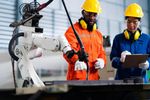
Industrial robots are widely used for repetitive and precision-sensitive tasks such as welding, adhesive application, painting, and component handling. Automated guided vehicles and autonomous mobile robots can move parts between designated locations, depending on the factory's design.
Automation can improve repeatability and reduce the need for people to perform certain physically demanding tasks. However, it also introduces requirements for equipment maintenance, software integration, worker training, and safe interaction between people and machines.
Human workers remain important in many production activities, including complex assembly, equipment oversight, problem-solving, inspection, and maintenance. The balance between manual and automated operations differs across manufacturers and vehicle platforms.
Common production technologies
| Technology | Main purpose in automotive manufacturing |
|---|---|
| Stamping presses | Shape sheet metal into body panels |
| Robotic welding | Join selected metal components |
| Paint systems | Apply protective and finishing coatings |
| Assembly conveyors | Move vehicles through production stages |
| Machine vision | Inspect components and identify visible defects |
| Digital production systems | Monitor equipment, material flow, and production data |
| Automated testing equipment | Check specified vehicle functions and system performance |
Recent Updates
Automotive production is changing as manufacturers respond to electrification, software-based vehicle functions, supply-chain uncertainty, and changing customer requirements. Across the industry, factories are adapting existing production lines while developing facilities designed for newer vehicle architectures.
Battery-electric vehicles have influenced factory planning because their construction differs from that of vehicles powered solely by internal combustion engines. Battery packs, high-voltage wiring, electric motors, power electronics, and thermal-management systems introduce additional manufacturing and testing requirements. Some assembly operations can be shared across vehicle types, while others require dedicated equipment and safety procedures.
Electrification and battery manufacturing
Battery production has become an important part of the automotive manufacturing ecosystem. Battery cells may be manufactured at specialized facilities before being assembled into modules or packs, depending on the battery design. The completed pack must meet specified electrical, mechanical, thermal, and safety requirements before installation in a vehicle.
Manufacturers are also exploring different battery chemistries, cell formats, and pack structures. These developments can affect factory layouts, material handling, inspection processes, and the coordination between vehicle assembly and battery suppliers. Their adoption varies according to technical maturity, production capacity, and regional market conditions.
Software and digital manufacturing
Digital manufacturing systems allow factories to collect production information from machines, inspection stations, and assembly equipment. Engineers can use these data to identify recurring faults, monitor equipment conditions, and investigate production delays.
Artificial intelligence is also being explored for visual inspection, predictive maintenance, process monitoring, and production planning. These applications depend on data quality, suitable testing, and integration with existing equipment. Automated analysis does not eliminate the need for human review, especially when a detected issue could affect vehicle safety.
Another development is the use of digital twins. A digital twin is a computer-based representation of a physical product, machine, or production process. Depending on its design, it can help engineers evaluate factory layouts, test process changes, and examine possible equipment bottlenecks before making physical modifications.
Flexible production systems
Manufacturers increasingly consider flexible production arrangements that can accommodate several vehicle variants on a shared line. This can involve adjustable tooling, programmable robots, modular assembly stations, and manufacturing software that manages different component configurations.
However, flexibility requires careful engineering. Different vehicle sizes, battery systems, body structures, and electrical architectures may still require specialized stations or substantial equipment changes. A flexible factory is not automatically suitable for every vehicle design.
Laws or Policies
Automotive manufacturing is shaped by regulations and technical requirements concerning vehicle safety, emissions, environmental protection, workplace conditions, and product traceability. The applicable rules depend on the country where a vehicle is manufactured, the markets where it will be sold, and its vehicle category and powertrain.
Vehicle manufacturers generally need to demonstrate that applicable models meet relevant requirements before they can be placed on a particular market. These requirements may address braking, lighting, crash protection, emissions, electrical safety, and other vehicle characteristics. Testing and approval arrangements differ between regulatory systems, so compliance in one market does not automatically establish compliance in every other market.
Environmental policies also influence production methods. Rules concerning industrial emissions, wastewater, hazardous materials, waste handling, energy use, and battery recycling can affect factory equipment and operating procedures. Requirements may apply to the manufacturing site, the vehicle, its components, or several of these areas.
In India, the Ministry of Road Transport and Highways oversees central motor vehicle rules and related vehicle requirements. The Central Motor Vehicles Rules and applicable amendments establish requirements for matters such as vehicle construction, safety, testing, and certification. The Automotive Research Association of India and other designated testing agencies perform specified testing and certification functions within the applicable framework.
Internationally, the United Nations Economic Commission for Europe develops vehicle regulations through the World Forum for Harmonization of Vehicle Regulations. These regulations are adopted and applied through participating jurisdictions according to their respective legal frameworks.
Manufacturers must also consider occupational safety requirements covering machinery guarding, hazardous energy, robotic work cells, chemical handling, and worker exposure. Meeting the relevant requirements involves documented procedures, appropriate equipment, training, and ongoing monitoring rather than relying on a single inspection.
Tools and Resources
Automotive manufacturing relies on engineering software, production-management systems, technical standards, and inspection tools to coordinate complex processes.
Computer-aided design and manufacturing
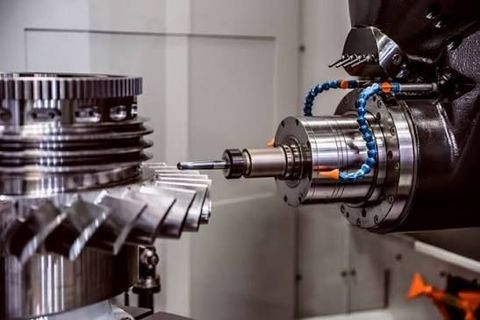
Computer-aided design software helps engineers create detailed digital models of vehicle parts and assemblies. Computer-aided manufacturing tools support production planning, machining operations, and the preparation of manufacturing instructions. Simulation software can also help assess whether components fit together and whether equipment can complete a proposed operation.
Manufacturing execution systems
A manufacturing execution system, or MES, coordinates and records production activities on the factory floor. Depending on its configuration, it may track work orders, component batches, equipment status, inspection results, and the progress of individual vehicles through assembly.
These records can help engineers trace a production issue to a particular component batch or workstation. The usefulness of the system depends on accurate data entry, reliable equipment connections, and appropriate access controls.
Quality inspection and testing tools
Factories use dimensional measurement equipment, machine-vision systems, electrical testers, torque-monitoring tools, and diagnostic equipment to check different aspects of vehicle construction. End-of-line testing may examine specified functions such as lighting, braking performance, electronic systems, and fluid leakage.
Technical and industry resources
The International Organization for Standardization publishes standards relevant to quality management, environmental management, and automotive manufacturing. The International Organization of Motor Vehicle Manufacturers provides industry information and production statistics, while national transport authorities publish applicable vehicle regulations and approval requirements.
These resources help explain manufacturing practices, regulatory frameworks, and industry trends, although the relevant standard or rule depends on the specific production activity and market.
FAQs
How are cars manufactured in modern automotive production?
Modern automotive production generally includes engineering, metal stamping, body construction, painting, component installation, and final inspection. Robots, conveyors, digital monitoring systems, and trained workers coordinate these stages according to the vehicle design and factory layout.
What machines are used in automotive manufacturing?
Common machines include stamping presses, robotic welding systems, industrial painting equipment, conveyors, automated material-handling systems, machine-vision equipment, and electrical testing stations. The exact equipment depends on the vehicle type and the degree of factory automation.
How is automation changing automotive production?
Automation is used for repetitive assembly tasks, precision joining, material movement, inspection, and production monitoring. It can improve process consistency, but factories still need maintenance, safety controls, trained personnel, and checks to verify that equipment operates correctly.
How does electric vehicle production differ from conventional car manufacturing?
Electric vehicle production includes battery packs, electric motors, power electronics, and high-voltage systems. Conventional combustion-engine vehicles require different engine, fuel, exhaust, and transmission arrangements. Some body and interior assembly processes can be shared, depending on the vehicle platform.
What regulations affect automotive production?
Requirements may cover vehicle safety, emissions, electrical systems, manufacturing quality, workplace safety, and environmental management. The precise obligations depend on the jurisdiction, vehicle category, production process, and intended market.