Collaborative Robots Insights: Working, Safety Features, Automation Tasks and Applications
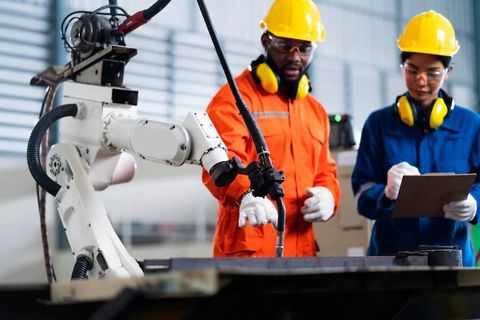
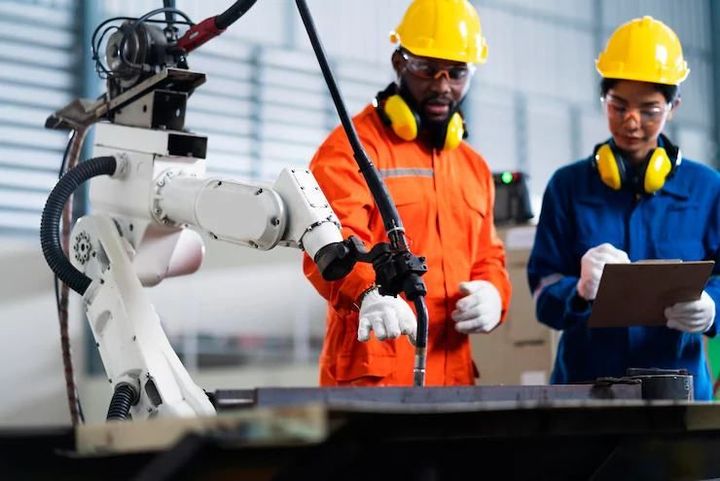
Collaborative robots, commonly called cobots, are industrial robots designed to perform selected tasks in environments where people and robotic equipment may work in close proximity. Unlike conventional industrial robots that often operate inside guarded areas, collaborative robots can be designed with sensing, control, and safety functions that support particular forms of human-robot interaction.
Context
The concept developed from the broader field of industrial automation, where robots were introduced to perform repetitive, precise, or physically demanding activities. As sensors, controllers, software, and mechanical components developed, robot systems became capable of detecting changes around them and adjusting their movements under defined operating conditions.
A collaborative robot normally consists of a robotic arm, motors and joints, a controller, sensors, an end effector, and programming software. The end effector is the device attached to the robot arm for handling a particular task. It may be a gripper, vacuum tool, screwdriver, welding tool, inspection device, or another application-specific attachment.
The term "collaborative" does not mean that every cobot can safely work beside people under every condition. The complete application, including the robot, tool, workpiece, movement, speed, force, workspace, and surrounding equipment, must be considered when evaluating risks.
How collaborative robots work
A collaborative robot receives programmed movement instructions through its controller. Sensors and feedback systems provide information about joint position, movement, and certain external conditions.
Depending on the system design, safety functions may cause the robot to stop, reduce speed, or change its behavior when a defined condition is detected. These functions are part of a wider risk-reduction approach rather than a substitute for application-specific safety assessment.
A typical operating sequence can include:
- Task programming defines the required movements and operating conditions.
- Sensors and controllers monitor the robot during operation.
- The end effector interacts with the material or component.
- Feedback systems help control movement and positioning.
- Safety functions respond to defined abnormal or hazardous conditions.
Importance
Collaborative robots are relevant because manufacturing environments increasingly require automation that can handle repetitive activities while remaining adaptable to changing production arrangements. They are used in applications ranging from assembly and machine tending to inspection, packaging, material handling, and laboratory-related industrial processes.
For workers, the main significance is not simply that a robot performs a task. The design of the human-robot workspace determines how people and machines interact, what hazards may occur, and what protective measures are necessary.
Cobots can also be configured for tasks that involve frequent product changes. Their programming and tooling can sometimes be adjusted for different operations, although the suitability of a particular system depends on the application and technical requirements.
Common automation tasks
Collaborative robots can perform many structured activities when the task is compatible with their reach, payload, accuracy, speed, tooling, and environmental conditions.
Common applications include:
- Assembly of small or medium components
- Machine tending for loading and unloading equipment
- Pick-and-place movement of parts
- Packaging and product handling
- Visual or sensor-based inspection
- Screwdriving and fastening
- Palletizing selected products
- Dispensing materials
- Surface-related processing
- Laboratory and research automation
The same robot arm may perform different tasks when its end effector and programming are changed. However, changing the tool can also change the hazards associated with the application.
Human-robot interaction
Human-robot interaction can take several forms. In some applications, people and robots perform separate activities within the same general workspace. In others, a person may place a component while the robot performs another step.
The level of interaction depends on the application risk assessment. Factors such as robot speed, force, sharp edges, tool movement, workpiece characteristics, and possible contact locations all influence the safety requirements.
Recent Updates
Collaborative robotics has continued to develop through improvements in sensors, machine vision, programming interfaces, artificial intelligence, and industrial networking. Recent robotics developments have increasingly connected robots with data-processing systems that can help analyze sensor information and support more adaptable automation. The International Federation of Robotics has identified artificial intelligence, including analytical and generative approaches, as an important robotics trend.
Another significant development has been the revision of international industrial robot safety standards. ISO 10218-1:2025 addresses safety requirements for industrial robots, while ISO 10218-2:2025 addresses industrial robot applications and robot cells, including integration, commissioning, operation, maintenance, and decommissioning.
Collaborative robot safety guidance is also developing. ISO/TS 15066:2016 remains a current technical specification for collaborative industrial robot systems and their working environments, while a new ISO/AWI 15066-1 project is under development to address physical contact with robots and biomechanical thresholds.
AI and machine vision
Artificial intelligence and machine vision are increasingly connected with robotic automation. Cameras and sensors can provide information about object position, orientation, surface characteristics, or other measurable conditions.
AI-based systems may assist with recognizing patterns or handling variations in a production environment. However, an AI capability does not by itself establish that a robotic application is safe. Safety-related functions require appropriate engineering, validation, and risk assessment.
Easier programming approaches
Modern cobot platforms increasingly use graphical interfaces, guided teaching, reusable programs, and digital simulation tools. These approaches can make certain programming activities easier to understand for personnel who are not specialized robot programmers.
Even when programming is simplified, changes to movement, tooling, speed, workspace, or production conditions can affect risk. Programming convenience therefore does not remove the need for appropriate technical controls.
Laws or Policies
Collaborative robot applications are influenced by machinery safety legislation, workplace safety requirements, technical standards, and rules concerning electrical and mechanical equipment. The exact legal requirements vary between jurisdictions, so organizations normally need to determine which national or regional requirements apply to their specific installation.
International standards provide a technical framework that can support risk assessment and system design. ISO 10218-1:2025 covers safety requirements for industrial robots, while ISO 10218-2:2025 covers industrial robot applications and robot cells.
ISO/TS 15066 provides additional guidance specifically concerning collaborative industrial robot systems and the work environment. It supplements the industrial robot requirements addressed by ISO 10218.
Safety assessment
A collaborative robot should not be treated as inherently safe simply because it is classified or marketed as collaborative. Safety depends on the complete application.
A risk assessment can consider:
- Robot movement and reachable areas
- Tool and end-effector hazards
- Workpiece shape, weight, and material
- Potential contact between people and moving components
- Robot speed and force
- Stopping performance
- Nearby machinery
- Electrical and pneumatic hazards
- Maintenance and setup activities
- Changes to the production process
Protective measures may include speed and force limitations, monitored stops, safety-rated monitoring functions, workspace controls, physical separation, protective devices, or other measures appropriate to the identified risks.
Tools and Resources
Several technical resources can help people understand collaborative robot systems and their operating requirements.
Robot simulation software
Simulation platforms can represent robot movements, workspaces, tooling, and production sequences before physical deployment. They can help examine reach, motion paths, cycle sequences, and possible interference between equipment.
Simulation does not replace physical safety assessment because real equipment, tools, materials, and human interaction can introduce conditions that are difficult to reproduce completely in software.
Risk assessment documentation
A structured risk assessment template can help document hazards, operating conditions, protective measures, and validation activities. Typical records may include:
| Assessment area | Examples of information |
|---|---|
| Robot | Payload, reach, speed, movement range |
| Tool | Gripper, cutter, welder, dispenser |
| Workpiece | Weight, shape, surface, temperature |
| Interaction | Possible contact areas and operating modes |
| Controls | Stops, limits, monitoring, protective devices |
| Operating modes | Production, setup, maintenance |
| Validation | Tests of safety-related functions |
Standards and technical references
Organizations involved in collaborative robotics can consult relevant ISO standards, national machinery requirements, manufacturer documentation, and workplace safety guidance. The ISO robotics catalogue provides information about current and developing robotics standards.
Vision and sensor tools
Cameras, force sensors, proximity sensors, and other sensing technologies can provide information used by robotic systems. Their suitability depends on the task, environmental conditions, required detection performance, and safety architecture.
FAQs
What are collaborative robots used for?
Collaborative robots are used for structured automation tasks such as assembly, machine tending, inspection, material handling, packaging, fastening, and selected dispensing operations. Their suitability depends on factors such as payload, reach, tooling, speed, accuracy, and application hazards.
How do collaborative robots work?
Collaborative robots use programmed movements controlled by a robot controller, with sensors and feedback systems supporting movement control and defined safety functions. Depending on the application, the system may monitor conditions and stop or reduce movement when specified limits are reached.
Are collaborative robots safe to work around?
Collaborative robot safety depends on the complete application rather than the robot arm alone. The robot, end effector, workpiece, speed, force, workspace, operating modes, and surrounding machinery all need to be considered through an appropriate risk assessment.
What safety features do collaborative robots have?
Depending on the system, collaborative robots may include monitored stops, speed and force limitations, safety-rated monitoring, collision detection functions, protective control systems, and other safety-related features. The actual functions vary between systems and applications.
What tasks can collaborative robots automate?
Common collaborative robot automation tasks include assembly, machine tending, pick-and-place operations, inspection, packaging, fastening, material handling, and selected palletizing activities. The appropriate task depends on the robot's technical capabilities and the hazards associated with the application.
Conclusion
Collaborative robots combine industrial robotic movement with sensing, control, and application-specific safety functions to support selected forms of human-robot interaction. Their use has expanded across manufacturing and other structured industrial environments, while developments in AI, machine vision, programming, and robotics standards continue to influence the field. Safety depends on the complete robotic application, not simply on the classification of the robot as collaborative. Current international standards provide frameworks for addressing robot and robot-cell safety, while application-specific risk assessment remains an important part of system design.