Automated Optical Fiber Drawing Towers Explained: Designs, Components, Processes and Industrial Applications
Automated optical fiber drawing towers are specialized industrial systems used to manufacture optical fibers from glass preforms. These towers combine controlled heating, mechanical drawing, diameter measurement, cooling, and protective coating processes to produce thin glass fibers that transmit information using light. They are an important part of optical fiber manufacturing, which supports telecommunications, data centers, medical instruments, industrial sensors, and high-speed internet infrastructure.
Context
Automated optical fiber drawing towers are specialized industrial systems used to manufacture optical fibers from glass preforms. These towers combine controlled heating, mechanical drawing, diameter measurement, cooling, and protective coating processes to produce thin glass fibers that transmit information using light. They are an important part of optical fiber manufacturing, which supports telecommunications, data centers, medical instruments, industrial sensors, and high-speed internet infrastructure.
Optical fiber production developed alongside advances in glass science and optical communication. Early optical fibers experienced significant signal loss, but improvements in glass purity, manufacturing techniques, and fiber design made long-distance light transmission more practical. Modern fiber drawing towers build on these developments by maintaining controlled operating conditions throughout the production process.
What Is an Optical Fiber Drawing Tower?
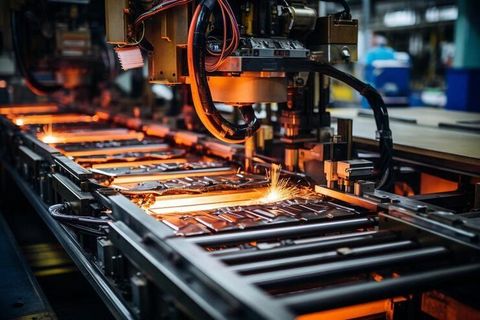
An optical fiber drawing tower is a tall production structure that transforms a cylindrical glass preform into a much thinner fiber. A preform is a specially manufactured glass rod containing the optical structure needed for the finished fiber. When its lower end is heated to a suitable temperature, the softened glass can be drawn downward into a continuous strand.
Automation coordinates the main production stages and helps maintain consistent fiber dimensions. Sensors measure important process conditions, while control systems adjust heating, drawing speed, and other operating parameters. The finished fiber is typically coated with protective polymer layers before being inspected and wound onto a reel.
Main Types of Optical Fiber
Optical fiber drawing systems can produce different fiber designs according to the preform and manufacturing specifications.
Single-mode fiber: Designed to carry light primarily through one propagation mode, making it suitable for many long-distance communication links.
Multimode fiber: Supports multiple light propagation modes and is commonly used in shorter-distance communication systems.
Specialty optical fiber: Developed for particular applications, including sensing, laser systems, scientific instruments, and certain medical technologies.
The fiber's optical properties depend on its glass composition, refractive-index profile, geometry, and manufacturing quality. The drawing tower must preserve the required structure while reducing the preform to the dimensions specified for the finished product.
Importance
Automated optical fiber drawing towers are important because communication networks depend on reliable optical transmission. Fiber links carry large volumes of digital information between cities, buildings, data centers, and communication facilities. Manufacturing consistency helps ensure that fibers meet the dimensional and optical requirements of the systems in which they are installed.
Automation also addresses practical production challenges. Small changes in glass temperature, drawing tension, or fiber diameter can affect manufacturing stability and product quality. Continuous monitoring helps operators identify variations and respond before they create larger production problems.
Industrial Problems Addressed by Automation
Automated drawing systems help manage several technical requirements:
Dimensional consistency: Laser-based gauges and other measurement devices monitor fiber diameter during production.
Process stability: Temperature and speed controls help maintain steady drawing conditions.
Surface protection: Automated coating units apply protective layers that reduce damage from handling and environmental exposure.
Production monitoring: Control software records operating conditions and identifies unusual process behavior.
Material efficiency: Monitoring can help identify unstable production periods and reduce avoidable material loss.
Automation does not eliminate the need for skilled operators or maintenance personnel. Equipment alignment, preform quality, furnace condition, coating performance, and calibration remain important factors in manufacturing results.
Main Components of a Drawing Tower
A drawing tower consists of connected systems arranged along a vertical production line. Each component has a specific role in transforming the preform into finished fiber.
| Component | Main function | Important operating factor |
|---|---|---|
| Preform feeding unit | Positions and advances the glass preform | Alignment and feed stability |
| Heating furnace | Softens the glass for drawing | Temperature uniformity |
| Drawing mechanism | Pulls the softened glass into a thin strand | Drawing speed and tension |
| Diameter gauge | Measures the fiber during production | Measurement accuracy |
| Coating applicator | Adds protective polymer layers | Coating thickness and uniformity |
| Curing unit | Hardens the applied coating | Curing conditions |
| Capstan or pulling system | Controls fiber movement | Speed stability and traction |
| Take-up reel | Collects the finished fiber | Winding tension and alignment |
| Control system | Coordinates equipment and process settings | Sensor reliability and control accuracy |
The exact arrangement varies by manufacturer, fiber type, production capacity, and process requirements. Some systems include additional equipment for tension monitoring, concentricity measurement, surface inspection, and automated fault detection.
Recent Updates
Developments in optical fiber drawing towers increasingly focus on process monitoring, production data, energy management, and integration with broader factory automation. Between 2024 and 2026, these areas have remained relevant as telecommunications networks, cloud computing, and artificial intelligence infrastructure require substantial optical connectivity. Specific equipment capabilities vary, and not every facility uses the same level of automation.
Digital Monitoring and Process Control
Modern industrial control systems can collect information from temperature sensors, diameter gauges, tension monitors, and coating inspection equipment. Software can display operating trends and alert operators when measurements move outside configured limits. This information supports process adjustments, maintenance planning, and investigation of manufacturing defects.
Some manufacturing environments also use machine-learning methods to examine process data and identify patterns associated with equipment variation. These methods depend on the quality of the collected data and require validation against actual production conditions. Automated analysis supports human oversight rather than replacing every engineering decision.
Energy Management and Manufacturing Integration
Heating glass to drawing temperatures requires careful energy management. Equipment designers and plant operators may examine furnace insulation, heating control, operating schedules, and production-line efficiency to understand energy use. The results depend on furnace design, throughput, maintenance, and the type of glass being processed.
Drawing towers can also exchange data with manufacturing execution systems and factory monitoring platforms. Integration helps connect production measurements with batch records, maintenance history, and quality documentation. These arrangements can make it easier to trace manufacturing conditions when a finished fiber does not meet its specified requirements.
Demand for Different Fiber Designs
Communication networks continue to use single-mode and multimode fibers for different transmission requirements, while specialty fibers support sensing and other technical applications. Research into higher-capacity optical communication and advanced fiber structures can influence preform design and drawing requirements. However, a tower's ability to manufacture a particular fiber depends on its heating system, measurement equipment, control range, and compatible production processes.
Laws or Policies
Optical fiber drawing towers are affected by industrial safety requirements, electrical standards, environmental regulations, and product specifications. The applicable rules depend on the country, the factory's location, the equipment design, and the materials used. In India, manufacturers and plant operators may need to consider national standards alongside state-level and local requirements.
Industrial Safety and Equipment Standards in India
Factories must comply with applicable occupational safety and factory legislation. India's Occupational Safety, Health and Working Conditions Code, 2020, forms part of the country's consolidated framework for workplace safety and working conditions; its practical application depends on commencement notifications, rules, and relevant provisions in force. Factory operators should verify the current legal requirements that apply to their establishment.
Electrical installations, control panels, lifting equipment, and hot processing areas may also require suitable safeguards, inspections, and maintenance procedures. Relevant technical standards can help establish requirements for electrical safety, machinery protection, and measurement equipment. The precise standards depend on the system and its intended use.
Environmental and Product Requirements
Glass manufacturing processes may involve energy consumption, cooling systems, cleaning materials, and industrial waste. Facilities must follow applicable environmental permissions and pollution-control requirements, including relevant provisions administered by the Central Pollution Control Board and state pollution control boards.
Finished optical fibers may need to meet customer specifications or applicable technical standards for attenuation, geometry, coating integrity, and mechanical performance. Standards published by organizations such as the International Electrotechnical Commission and the International Telecommunication Union provide technical guidance for optical fiber characteristics and testing. Compliance with a particular standard depends on the fiber category and the requirements of the intended application.
Tools and Resources
Engineering tools and technical references help manufacturers understand drawing-tower operation, monitor production, and evaluate fiber quality. Their suitability depends on the equipment configuration and the level of detail required.
Measurement and Control Tools
Common tools used in optical fiber production include:
Laser diameter gauges: Measure fiber diameter without requiring direct contact with the moving strand.
Temperature monitoring systems: Track furnace and process temperatures.
Tension sensors: Monitor forces acting on the fiber during drawing.
Optical inspection equipment: Examines surface defects and certain geometric characteristics.
Industrial control software: Displays process data, records alarms, and manages operating settings.
Quality management systems: Store inspection results, batch records, and production documentation.
These tools measure different aspects of manufacturing. A diameter reading alone, for example, does not establish whether a fiber meets all optical transmission or mechanical requirements.
Technical References and Calculations
The International Electrotechnical Commission, International Telecommunication Union, and relevant standards organizations publish documents concerning optical fiber characteristics, measurement methods, and communication systems. Manufacturer manuals and technical data sheets provide equipment-specific information about furnace operation, drawing speed ranges, coating systems, and maintenance procedures.
Engineers may also use spreadsheets or process-control software to review diameter trends, production speed, material usage, and equipment downtime. Such calculations are useful only when measurement units, sensor calibration, and recorded operating conditions are understood.
FAQs
How does an automated optical fiber drawing tower work?
The tower heats the end of a glass preform until it softens, then draws the material downward into a thin fiber. Sensors and control systems monitor diameter, speed, and other process conditions while coating equipment applies protective layers.
What are the main components of an optical fiber drawing tower?
Major components include the preform feeding unit, heating furnace, drawing mechanism, diameter gauge, coating applicator, curing unit, pulling system, take-up reel, and automated control system.
What is the role of automation in optical fiber drawing?
Automation coordinates equipment, monitors process measurements, records production data, and helps maintain stable operating conditions. Operators remain responsible for supervision, maintenance, and decisions about process adjustments.
Which industries use optical fibers manufactured by drawing towers?
Optical fibers are used in telecommunications, internet infrastructure, data centers, industrial sensing, medical equipment, scientific instruments, and selected laser applications. The required fiber design depends on the intended use.
Which standards apply to optical fiber drawing tower production in India?
Applicable requirements may include workplace safety legislation, electrical and machinery standards, environmental regulations, and relevant optical fiber specifications. The exact requirements depend on the facility, equipment, product, and laws currently in force.
Conclusion
Automated optical fiber drawing towers transform glass preforms into thin fibers through controlled heating, drawing, measurement, coating, and winding. Their components work together to maintain dimensional consistency and support the production of different optical fiber designs. Digital monitoring, manufacturing integration, and energy management continue to shape developments in this equipment. Industrial safety rules, environmental requirements, and technical standards influence how drawing towers are operated and how finished fibers are evaluated.