Automated Greenhouse Climate Control Basics With Smart Farming Technology and Applications
Automated greenhouse climate control is an important part of modern agriculture, combining environmental monitoring, automation, and smart farming technology to create suitable growing conditions for plants.
A greenhouse is a protected growing structure that helps manage temperature, humidity, sunlight, airflow, and other environmental factors. Automated systems improve this process by using sensors, controllers, and mechanical equipment to monitor and adjust internal conditions.
Traditional greenhouse management often depends on manual observations and adjustments. Farmers regularly check temperatures, operate ventilation systems, manage irrigation, and monitor humidity. However, changing outdoor weather conditions can make these activities difficult to manage consistently, particularly in large agricultural facilities.
Automated greenhouse climate control developed to address these challenges through connected equipment and digital monitoring. Modern installations can combine Internet of Things (IoT) sensors, programmable controllers, artificial intelligence (AI), automated ventilation, heating, cooling, and irrigation systems.
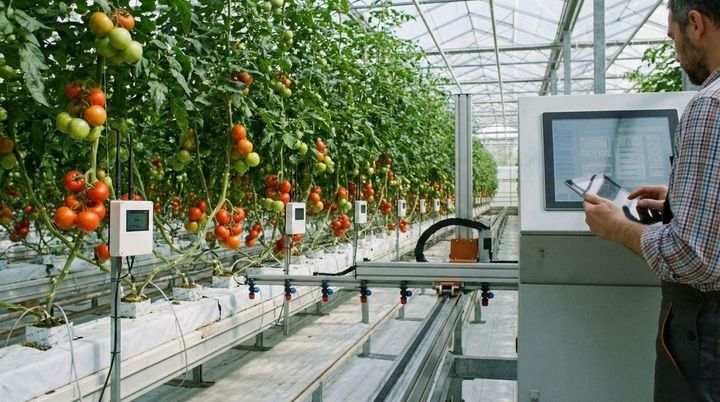
Smart farming technology also makes it possible to monitor greenhouse conditions remotely. Environmental information can be collected continuously and displayed through computer dashboards or mobile applications, helping agricultural operators understand how growing conditions change throughout the day.
Main Components of Automated Greenhouse Systems
Several technologies work together to maintain greenhouse conditions:
Temperature sensors measure indoor and outdoor temperatures.
Humidity sensors monitor moisture levels in the surrounding air.
Light sensors measure sunlight intensity and artificial lighting conditions.
Soil moisture sensors monitor water availability around plant roots.
Carbon dioxide sensors measure CO2 concentration inside the growing environment.
Automated controllers process sensor readings and activate connected equipment.
Communication devices transmit environmental information to monitoring platforms.
These components create an integrated system that supports continuous greenhouse climate management.
Importance
Automated greenhouse climate control matters because agricultural production is increasingly affected by changing weather patterns, water availability, and environmental conditions. Excessive heat, insufficient ventilation, high humidity, and irregular irrigation can affect plant development and increase the possibility of crop-related problems.
Greenhouse automation helps manage these conditions through continuous monitoring and programmed adjustments. Instead of relying entirely on manual measurements, operators can use environmental data to understand changing conditions and respond more consistently.
Who Benefits From Greenhouse Automation?
Different agricultural groups can benefit from smart greenhouse technology.
Commercial farmers use automated systems to manage larger growing areas and monitor multiple environmental conditions.
Horticulture producers use climate management equipment for vegetables, flowers, fruits, and ornamental plants.
Agricultural research institutions use controlled environments for plant experiments and crop development.
Nursery operators monitor temperature, humidity, and irrigation to maintain suitable growing conditions.
Educational institutions use greenhouse automation to demonstrate modern agricultural engineering and smart farming concepts.
Problems Addressed by Climate Control Technology
Automated greenhouse systems address several common agricultural challenges.
Temperature fluctuations can affect plant growth, particularly when greenhouse interiors become excessively warm or cold. Automated ventilation, heating, and cooling equipment helps regulate these changes.
High humidity can create favorable conditions for certain plant diseases. Humidity sensors and ventilation controls help operators identify moisture-related concerns and manage air circulation.
Water management is another important application. Automated irrigation systems use soil moisture readings and programmed schedules to manage water distribution according to growing requirements.
Insufficient natural light can also affect plant development. Light monitoring and supplementary lighting systems help maintain suitable illumination when outdoor conditions change.
Common Greenhouse Climate Control Functions
| Function | Equipment or Technology | Main Purpose |
|---|---|---|
| Temperature regulation | Heating and cooling units | Manage indoor temperature |
| Air circulation | Fans and ventilation equipment | Improve airflow |
| Humidity management | Humidifiers and dehumidifiers | Regulate moisture |
| Light management | Sensors and LED lighting | Monitor and supplement illumination |
| Irrigation | Automated pumps and valves | Manage water distribution |
| CO2 monitoring | Gas sensors | Monitor atmospheric concentration |
The combination of these functions supports a more controlled growing environment.
Recent Updates
Developments in greenhouse climate control increasingly focus on artificial intelligence, connected sensors, predictive monitoring, and resource management. Recent agricultural technology research from 2024–2026 shows growing interest in integrating multiple digital systems rather than operating individual greenhouse components separately.
Artificial Intelligence in Climate Management
AI-based greenhouse management uses historical and real-time environmental information to identify patterns and support operational decisions. Machine learning models can analyze temperature, humidity, sunlight, and other measurements to estimate changing greenhouse conditions.
Predictive systems can help identify when ventilation, heating, or irrigation adjustments may become necessary. However, their accuracy depends on sensor quality, available data, crop characteristics, and local environmental conditions.
Internet of Things Sensor Networks
IoT technology connects environmental sensors, controllers, and monitoring platforms through communication networks. This allows greenhouse operators to access information from different sections of a growing facility.
Wireless technologies such as Wi-Fi, Zigbee, and LoRaWAN support communication between connected devices. These technologies are particularly relevant when monitoring multiple greenhouse zones.
Smart Irrigation and Water Monitoring
Automated irrigation increasingly uses soil moisture sensors, water flow meters, and digital controllers. These components help regulate irrigation according to observed moisture conditions and programmed crop requirements.
Some systems also combine weather information with greenhouse measurements to support irrigation planning and reduce unnecessary water application.
Computer Vision and Predictive Monitoring
Camera-based monitoring and image recognition are developing applications in smart greenhouse management. Computer vision systems can examine plant appearance, identify visible changes, and support the monitoring of crop development.
Multispectral and thermal imaging technologies are also being studied for crop health assessment and environmental analysis.
Energy Management and Digital Integration
Modern greenhouse systems increasingly combine climate automation with energy monitoring. Solar photovoltaic systems, thermal storage, and intelligent controllers are being explored to coordinate energy generation, storage, and greenhouse heating or cooling requirements.
Digital dashboards and integrated platforms also allow operators to review environmental records, equipment conditions, and irrigation information in one interface.
Despite these developments, challenges remain. Sensor calibration, communication reliability, equipment compatibility, data security, and the ability of AI models to perform across different climates continue to influence practical adoption.
Laws or Policies
Greenhouse climate control is influenced by agricultural, environmental, electrical safety, water management, and building-related regulations. Requirements differ between countries and regions, depending on the greenhouse structure, equipment, crop type, and scale of agricultural operations.
There is no single international regulation covering every aspect of automated greenhouse management. Instead, agricultural operators generally need to consider several regulatory areas.
Agricultural and Environmental Requirements
Agricultural policies may address water conservation, chemical handling, waste management, and sustainable production practices. Greenhouse operations may also need to follow requirements concerning fertilizer application, pesticide use, and agricultural runoff.
Environmental regulations can influence ventilation equipment, energy consumption, wastewater disposal, and greenhouse construction.
Electrical and Equipment Safety
Automated greenhouse installations contain electrical controllers, sensors, pumps, heating equipment, and mechanical ventilation systems. Applicable electrical safety and machinery requirements may cover equipment installation, protective systems, wiring, and maintenance.
Operators should consider relevant technical standards and local building requirements when installing automated equipment.
Water and Energy Management Policies
Water management policies may establish requirements for groundwater extraction, irrigation practices, and water discharge. Energy-related programs in some regions also encourage renewable energy integration and efficient agricultural equipment.
Government agricultural development programs may support protected cultivation, greenhouse infrastructure, precision irrigation, and digital farming adoption. Eligibility and implementation requirements vary by location.
Tools and Resources
Several digital tools and technical resources help operators plan, monitor, and manage automated greenhouse climate control systems.
Environmental Monitoring Platforms
IoT monitoring platforms collect information from connected sensors and display environmental measurements through dashboards. Operators can examine temperature, humidity, light intensity, soil moisture, and other readings.
Common platform technologies include:
Blynk for connected-device monitoring and control interfaces.
ThingsBoard for IoT device management and environmental dashboards.
Node-RED for connecting sensors, controllers, and automation workflows.
Arduino and ESP32 development environments for building sensor-based monitoring systems.
The suitability of each platform depends on system requirements, technical knowledge, connectivity, and equipment compatibility.
Greenhouse Climate Management Software
Specialized greenhouse software helps manage environmental settings, irrigation schedules, equipment operation, and historical measurements. Some platforms also include alerts, remote access, and automated control functions.
These systems can be useful when managing multiple greenhouse zones or coordinating different environmental processes.
Agricultural Weather and Planning Resources
Weather monitoring platforms provide information about outside temperature, humidity, rainfall, sunlight, and wind conditions. This information can complement greenhouse sensor readings and support environmental planning.
Agricultural calculators and planning tools can also help estimate irrigation requirements, ventilation capacity, lighting needs, and greenhouse environmental loads.
Important Measurements to Monitor
| Measurement | Unit | Application |
|---|---|---|
| Air temperature | °C | Temperature management |
| Relative humidity | % | Moisture monitoring |
| Light intensity | Lux or PPFD | Lighting assessment |
| Soil moisture | % or sensor units | Irrigation planning |
| CO2 concentration | ppm | Atmospheric monitoring |
| Airflow | m/s | Ventilation assessment |
| Water flow | L/min | Irrigation monitoring |
Measurement requirements vary according to crop species, growth stage, greenhouse design, and local climate.
FAQs
What Is Automated Greenhouse Climate Control?
Automated greenhouse climate control uses sensors, controllers, and connected equipment to monitor and regulate temperature, humidity, ventilation, lighting, and other growing conditions.
How Does Smart Farming Technology Improve Greenhouse Management?
Smart farming technology uses IoT sensors, automation platforms, and digital monitoring to collect environmental information. These technologies support more consistent climate management and informed agricultural decisions.
Which Sensors Are Used in Automated Greenhouse Systems?
Common sensors include temperature sensors, humidity sensors, soil moisture sensors, light sensors, CO2 sensors, and water flow sensors. The selection depends on the greenhouse design and crop requirements.
What Is the Role of AI in Greenhouse Climate Control?
Artificial intelligence analyzes environmental measurements and historical information to identify patterns, forecast changing conditions, and support automated climate management decisions.
Can Greenhouse Climate Control Systems Operate Remotely?
Yes. Connected greenhouse systems can transmit sensor information to mobile applications and computer dashboards. Depending on equipment configuration, operators can monitor conditions, receive alerts, and adjust selected controls remotely.
Conclusion
Automated greenhouse climate control combines sensors, connected equipment, and intelligent software to manage important growing conditions. Smart farming technologies such as IoT, artificial intelligence, predictive monitoring, and automated irrigation are expanding the capabilities of modern greenhouse operations. Their applications cover temperature regulation, humidity management, ventilation, lighting, and water monitoring. Equipment reliability, environmental requirements, and appropriate system configuration remain important considerations in greenhouse automation.