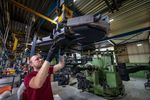
Turret Milling Machines Explained: Precision Manufacturing and Automation
A turret milling machine is a machine tool designed to remove material from a workpiece using a rotating cutting tool. It is widely used for producing slots, holes, flat surfaces, steps, grooves, and other accurately machined features.
The name comes from its turret-style milling head, which can usually be adjusted to support different cutting positions and machining operations. Many machines also allow the head to move or tilt, giving operators greater flexibility when working on complex parts.
Turret milling machines are commonly associated with metalworking, but their operating principles can also be applied to suitable plastics and other engineering materials. They are found in manufacturing plants, tool rooms, maintenance workshops, educational facilities, and precision engineering environments.
A typical machine includes several important components:
- Milling head and spindle
- Turret or swivel head
- Worktable
- Saddle and knee
- Column
- Spindle motor
- Tool holder
- Workholding device
- Feed mechanisms
- Control system
- Lubrication and cooling arrangements
The machine works by rotating a cutter while the workpiece is securely positioned on the table. Controlled movement between the cutter and workpiece creates the required shape or feature.
Turret milling machines can be operated manually or equipped with additional digital controls and automation technologies. This makes them relevant to both traditional machining and modern manufacturing environments.
Why Turret Milling Machines Matter in Modern Manufacturing
Precision machining remains important because many industrial components must fit together within defined dimensional limits. Even a small dimensional error can affect assembly, performance, or product reliability.
Turret milling machines help address these requirements by providing controlled movement across multiple axes. Depending on the machine configuration, an operator can adjust the table, workpiece, spindle, and milling head to perform different operations.
They are particularly useful for low- and medium-volume production, prototyping, maintenance work, tooling, and component development.
Key advantages include:
- Flexible machining operations
- Accurate cutting and shaping
- Multiple tooling possibilities
- Adjustable milling-head positions
- Suitable access to different workpiece surfaces
- Practical operation for prototypes and custom components
- Compatibility with measurement equipment
- Potential integration with digital controls
Common applications include manufacturing machine components, brackets, fixtures, molds, tooling parts, gears, housings, and engineering prototypes.
Precision Manufacturing Applications
Turret milling machines can perform a wide range of machining operations. These may include face milling, end milling, slot milling, drilling, boring, chamfering, and contour-related operations.
The exact capability depends on the machine design, spindle arrangement, tooling, workholding system, and operator technique.
Material selection is also important. Aluminum, steel, cast iron, brass, and engineering plastics may require different cutting parameters and tooling approaches.
Important machining variables include:
- Spindle speed
- Feed rate
- Cutting depth
- Cutter diameter
- Tool material
- Workpiece material
- Coolant or lubrication requirements
- Workholding stability
Correct parameter selection helps balance machining accuracy, tool life, surface finish, and production efficiency.
Turret Milling Machine Types and Configurations
Turret milling machines are available in different configurations to meet varying machining requirements.
Manual Turret Milling Machines
Manual machines rely heavily on operator control. The operator adjusts table movement, spindle operation, cutting depth, and other machining parameters.
They remain useful for training, repair work, prototypes, maintenance operations, and smaller production requirements.
CNC Turret Milling Machines
CNC technology adds computerized control to machining movements. Programs can control tool paths, feeds, spindle operation, and other machining functions.
CNC milling can improve repeatability when the machine, tooling, programming, workholding, and measurement processes are properly controlled.
Vertical Turret Milling Machines
Vertical configurations position the spindle vertically relative to the worktable. They are widely used for general-purpose milling operations.
Automated Configurations
Modern machine-tool environments can incorporate digital readouts, programmable controls, tool management, sensors, automated measurement, and production monitoring.
Automation does not eliminate the need for proper setup and supervision. Instead, it can reduce repetitive manual activities and provide more consistent process control.
Recent Trends in Milling Technology
During 2025 and 2026, industrial machining has continued moving toward greater digitalization, automation, measurement, and data-based process control.
One important trend is the increased use of connected manufacturing systems. Machine tools can increasingly interact with production-monitoring platforms and digital manufacturing systems.
Another development is greater attention to automated inspection. Measurement technologies can help identify dimensional deviations during or after machining.
Artificial intelligence and machine learning are also being explored for applications such as predictive maintenance, anomaly detection, tool-condition monitoring, and process optimization. These applications vary considerably by machine and production environment, so they should not be treated as universal capabilities.
Energy efficiency is another consideration in modern machine-tool planning. Manufacturers are examining spindle efficiency, standby energy consumption, coolant management, and production-cycle optimization.
The European Union is also moving toward a new machinery regulatory framework. Regulation (EU) 2023/1230 is scheduled to apply from 20 January 2027, replacing the existing Machinery Directive framework, with some provisions already applicable earlier.
These developments show why modern milling technology increasingly combines mechanical engineering with CNC control, industrial automation, sensors, software, and measurement systems.
Laws, Regulations, and Machine Safety
Machine safety requirements vary according to the country, machine configuration, workplace, and intended application. Operators and organizations should therefore check the rules applicable in their jurisdiction.
In the United States, OSHA's machine-guarding requirements address hazards from rotating parts, flying chips, sparks, and points of operation. OSHA specifically identifies milling machines among machines that generally require point-of-operation guarding.
Relevant safety practices can include:
- Appropriate machine guarding
- Emergency stopping arrangements
- Secure workholding
- Eye and face protection
- Safe chip removal procedures
- Proper operator training
- Lockout/tagout procedures where applicable
- Regular inspection of safety equipment
- Correct machine anchoring
- Safe handling of cutting tools
For example, OSHA guidance emphasizes that guards should protect workers from hazards while avoiding the creation of additional hazards.
In Europe, Regulation (EU) 2023/1230 establishes health and safety requirements for machinery and related products. Its main application date is 20 January 2027.
Machine-tool safety standards can also provide additional technical guidance. OSHA's machine-guarding resources reference the ANSI B11 series, including B11.8 for manual milling, drilling, and boring machines.
Regulatory compliance should always be evaluated using the latest rules applicable to the specific country and machine.
Key Parameters for Precision Milling
Selecting suitable machining parameters is an important part of precision manufacturing.
| Parameter | General Purpose |
|---|---|
| Spindle speed | Controls cutter rotation |
| Feed rate | Controls cutting movement |
| Cutting depth | Determines material removal per pass |
| Cutter diameter | Influences cutting conditions |
| Tool material | Affects durability and machining performance |
| Workholding | Keeps the workpiece stable |
| Coolant | Can help manage heat and cutting conditions |
| Measurement | Verifies dimensional accuracy |
These parameters should not be selected independently. Material properties, cutter geometry, machine rigidity, workpiece shape, and required surface finish all influence the appropriate settings.
Tools and Resources for Milling Operations
A variety of tools can support turret milling and precision manufacturing without replacing proper engineering judgment.
Useful resources include:
- Cutting-speed and feed-rate calculators
- Spindle-speed calculators
- Machining parameter charts
- Digital calipers and micrometers
- Dial indicators
- Height gauges
- Coordinate measuring equipment
- Tool-condition inspection systems
- CNC programming simulators
- CAD software
- CAM software
- Preventive-maintenance checklists
- Machine-safety inspection templates
- Technical machining manuals
- Operator training materials
CAD and CAM systems are particularly useful when a component requires complex geometry. CAD can help develop the part design, while CAM can assist with generating machining toolpaths for compatible CNC equipment.
Digital measurement tools can also help verify dimensions after machining. However, measurement accuracy depends on instrument quality, calibration, environmental conditions, and correct measurement technique.
Frequently Asked Questions
What is a turret milling machine?
A turret milling machine is a milling machine with an adjustable milling head that provides flexibility for machining different surfaces and features. It can be used for operations such as milling, drilling, boring, and slotting.
What materials can be machined?
Depending on the machine and tooling, turret milling machines can process materials such as steel, aluminum, cast iron, brass, and selected engineering plastics. Cutting parameters should be matched to the material and tool.
Is a turret milling machine the same as a CNC milling machine?
Not necessarily. A turret milling machine describes a particular machine configuration, while CNC describes computerized control. A turret milling machine can be manual, digitally assisted, or configured with CNC capabilities.
What are the main safety concerns?
Major hazards can include rotating cutters, moving machine components, flying chips, unsecured workpieces, and incorrect tool handling. Proper guarding, workholding, protective equipment, training, and safe operating procedures are important.
How does automation affect turret milling?
Automation can support programmed machining, digital measurement, tool monitoring, production tracking, and other processes. Its usefulness depends on the machine configuration and manufacturing requirements.
Conclusion
Turret milling machines remain important tools in precision manufacturing because they combine flexible machining capabilities with controlled material removal. Their adjustable milling heads and versatile worktables make them suitable for a wide range of engineering operations.