Advanced Industrial Waterjet Machines: Manufacturing Technology Insights
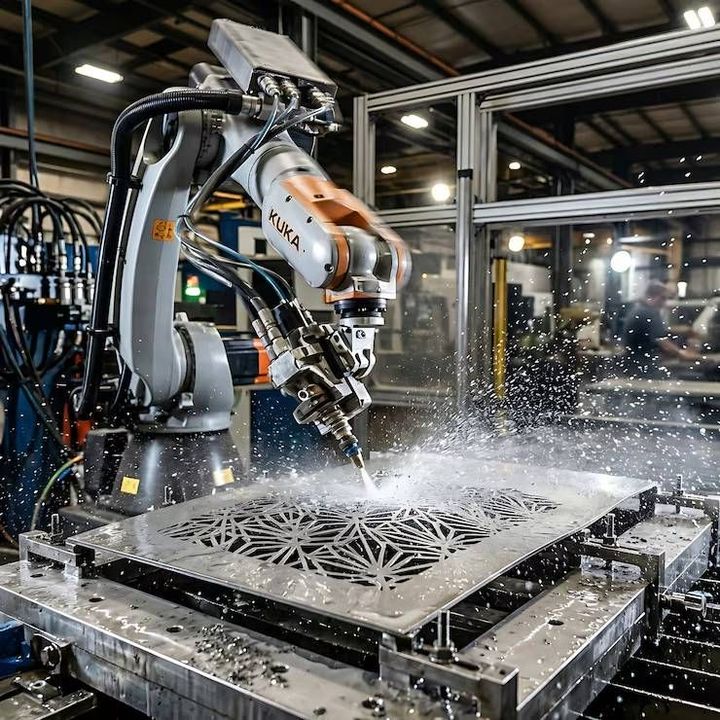
Advanced industrial waterjet machines are manufacturing systems that cut materials using a high-pressure stream of water. Depending on the material and the required cutting result, the stream may contain abrasive particles that help cut hard substances such as metals, stone, ceramics, and composites.
These machines are used in modern manufacturing because they can cut complex shapes without relying on a conventional cutting blade. Their operation combines fluid pressure, motion control, specialized cutting heads, and computer-guided machining programs.
Waterjet technology developed from early industrial applications of high-pressure water for material removal. Over time, improvements in pump design, abrasive delivery, machine controls, and cutting-head technology made waterjet systems suitable for more demanding industrial tasks.
There are two main types of industrial waterjet cutting.
Pure waterjet cutting: Uses a focused stream of water to cut softer materials such as rubber, foam, paper, textiles, and certain food products.
Abrasive waterjet cutting: Mixes water with fine abrasive particles to cut harder materials, including steel, aluminum, glass, stone, and advanced composites.
A typical industrial waterjet system includes a high-pressure pump, water filtration equipment, a cutting head, a motion-control system, a worktable, and a collection tank. Abrasive systems also include equipment that stores and feeds abrasive material.
Computer numerical control (CNC) allows operators to program cutting paths and produce detailed shapes with consistent movement. This makes waterjet technology useful for prototypes, custom components, and repeated manufacturing operations.
Importance of Waterjet Technology in Modern Manufacturing
Industrial waterjet cutting is important because manufacturers often need to process materials with different thicknesses, shapes, and physical properties. Traditional methods may create heat, mechanical stress, tool wear, or unwanted deformation.
Waterjet machines address several of these challenges by using a cutting process that does not depend on a heated cutting edge.
Reduced Heat-Affected Areas
Waterjet cutting is generally considered a cold-cutting process. Unlike laser or plasma cutting, it does not intentionally melt the material to create the cut.
This can help reduce heat-related changes, discoloration, and thermal distortion. It is particularly useful for heat-sensitive materials and components that require careful dimensional control.
However, waterjet cutting can still introduce mechanical stresses, surface variations, or edge-quality differences depending on the material and cutting settings.
Processing Different Materials
A single abrasive waterjet platform can often process several material categories with suitable operating settings and tooling.
Common applications include:
Cutting stainless steel, aluminum, and other industrial metals.
Shaping stone, ceramic tiles, and glass.
Trimming carbon-fiber and other composite panels.
Producing gaskets, rubber parts, and foam components.
Manufacturing patterns, prototypes, and custom machine parts.
Material thickness, hardness, brittleness, and the required edge finish determine whether waterjet cutting is an appropriate method.
Supporting Complex Designs
CNC-controlled waterjet machines can follow curved paths, internal openings, and detailed geometric patterns. This capability helps manufacturers process components that would be difficult to produce using simple mechanical cutting equipment.
Digital design files can be converted into machine instructions, allowing a programmed cutting path to be repeated with controlled movement.
Manufacturing Accuracy and Production Planning
Waterjet cutting can support precision manufacturing, but actual accuracy depends on machine condition, nozzle wear, pressure stability, cutting speed, material properties, and calibration.
Manufacturers must also consider abrasive use, water consumption, maintenance requirements, and waste handling when evaluating the overall performance of a waterjet system.
Recent Updates and Emerging Waterjet Manufacturing Trends
Industrial waterjet technology continues to develop as manufacturers seek better cutting accuracy, improved automation, and more efficient use of materials. Developments during 2025 and 2026 show growing attention to digital controls, multi-axis machining, and resource management.
Traditional two-axis machines move the cutting head along the horizontal plane. Three-axis systems add controlled vertical positioning, while five-axis systems can tilt and rotate the cutting head to create bevels and complex shapes.
Multi-axis technology is useful for aerospace components, automotive parts, specialized metal fabrication, and three-dimensional product designs. Its suitability depends on part geometry, required tolerances, programming capability, and operator experience.
Intelligent CNC Controls and Automation
Modern waterjet systems increasingly combine computer-aided design (CAD), computer-aided manufacturing (CAM), automated toolpath generation, and machine monitoring.
These features can help operators:
Prepare cutting programs from digital drawings.
Arrange multiple parts on a sheet to reduce unused material.
Monitor pressure, motion, and abrasive delivery.
Identify operating conditions that may require inspection.
Maintain production records for quality control.
Automation can improve repeatability, but the final results still depend on correct programming, calibration, material setup, and operator supervision.
Pump Efficiency and Abrasive Recovery
Pump technology is another important development area. Manufacturers are exploring improved pressure control, variable-speed operation, and hybrid drive systems to match machine output with cutting requirements. A 2025 industry development in hybrid intensifier technology highlighted the role of electric drive control in pressure management and energy use.
Abrasive recovery and water-recirculation systems are also receiving attention. Depending on the design, these systems can reduce the amount of fresh abrasive or water required for particular operations. Recovered materials must be assessed for contamination and suitability before reuse.
Technology Trends at a Glance
Technology trend | Main purpose | Potential benefit |
|---|---|---|
Five-axis cutting | Process angled and complex shapes | Greater geometric flexibility |
Digital CNC programming | Control the cutting path | Repeatable part production |
Machine sensors | Monitor operating conditions | Earlier identification of irregularities |
Hybrid pump systems | Adjust pressure generation | Potential improvements in energy use |
Water recirculation | Reuse suitable process water | Reduced fresh-water demand |
Automated nesting | Arrange parts on sheet material | Better material utilization |
These developments do not guarantee the same results in every factory. Manufacturers should evaluate performance using actual materials, production requirements, maintenance records, and measured operating data.
Laws, Safety Standards, and Environmental Policies
Industrial waterjet machines use extremely high pressure. A damaged hose, failed connection, or accidental exposure to the jet can cause severe injury. Safety planning must therefore cover machine design, installation, operation, inspection, and maintenance.
Applicable requirements depend on the machine's intended use and the country where it operates.
International Machinery Safety Standards
A notable development occurred on 23 March 2026, when IEC 63458-1:2026 was published. This international standard addresses safety requirements for high-pressure waterjet units used in applications that include cutting, surface preparation, and material removal.
Relevant safety considerations include:
Pressure protection devices and reliable pressure indicators.
Suitable hoses, fittings, pipes, and pressure-rated components.
Emergency stops and protective enclosures where required.
Clear operating instructions and hazard warnings.
Safe procedures for depressurization, inspection, and maintenance.
Appropriate operator training and personal protective equipment.
Standards are not automatically legal requirements in every country. Their legal status depends on the applicable regulations, adopted national standards, contracts, and product-compliance framework.
Safety and Environmental Requirements in India
In India, industrial facilities should assess the Occupational Safety, Health and Working Conditions Code, 2020, its implementation status, applicable rules, and relevant state-level requirements when determining their workplace obligations. Other applicable factory and machinery provisions may depend on the facility and its legal circumstances.
Environmental requirements may also apply to wastewater discharge, abrasive residue, sludge, and contaminated process materials. Facilities should determine which permissions, treatment arrangements, and disposal procedures apply to their location and operations.
For international manufacturing, additional requirements may apply under regional machinery, electrical safety, pressure-equipment, or environmental frameworks. A qualified safety professional should confirm the applicable rules before a machine is installed or modified.
Tools and Resources for Waterjet Cutting Operations
Selecting and operating advanced industrial waterjet machines requires a combination of engineering tools, planning methods, maintenance procedures, and technical knowledge. General-purpose resources can help manufacturers understand the process and make informed decisions.
CAD and CAM Software
CAD tools are used to create two-dimensional drawings and three-dimensional models. CAM software converts suitable designs into machine instructions and cutting paths.
Useful functions include:
Drawing and editing part geometry.
Importing common design file formats.
Creating cutting paths and bevel instructions.
Arranging multiple components on sheet material.
Estimating cutting time from programmed parameters.
Operators should verify that the software supports the machine's controller and cutting-head configuration.
Cutting Parameter Calculators
Engineering calculators can help estimate operating requirements before production begins. Depending on the available inputs, they may support calculations for cutting speed, material thickness, pump power, water flow, and production time.
A useful planning worksheet should record the following information:
Parameter | What to record |
|---|---|
Material | Type, grade, and thickness |
Cutting method | Pure waterjet or abrasive waterjet |
Pressure | Approved operating pressure |
Nozzle setup | Orifice and focusing tube specifications |
Cutting speed | Tested speed for the selected material |
Edge quality | Required finish and dimensional tolerance |
Water use | Estimated consumption per operating period |
Abrasive use | Type and quantity used during cutting |
Calculator outputs are estimates, not guarantees. Production settings should be verified through material tests and the machine manufacturer's operating instructions.
Preventive Maintenance Checklists
A maintenance checklist helps operators identify wear and prevent avoidable interruptions. Typical inspection items include:
High-pressure seals, hoses, fittings, and connections.
Pump performance and pressure stability.
Cutting nozzle and focusing tube wear.
Abrasive delivery and filtration equipment.
CNC motion components, guards, and emergency stops.
Water quality and collection-tank condition.
Only trained and authorized personnel should carry out maintenance on high-pressure equipment. The machine must be isolated and safely depressurized according to its documented procedure before relevant components are inspected.
Training and Technical Documentation
General manufacturing handbooks, engineering textbooks, machine manuals, materials data sheets, and occupational safety guidance can help operators understand the process. Training should cover cutting principles, machine programming, material handling, emergency procedures, and waste management.
Manufacturers can also use a standard production log to record material batches, cutting settings, inspection results, abrasive consumption, and maintenance events. These records support troubleshooting and continuous improvement.
Frequently Asked Questions About Industrial Waterjet Machines
What materials can advanced waterjet machines cut?
Abrasive waterjet machines can cut many metals, stone, glass, ceramics, and composite materials. Pure waterjet systems are commonly used for softer materials such as foam, rubber, and textiles. The suitable method depends on material properties, thickness, and the required cutting quality.
How does waterjet cutting differ from laser cutting?
Waterjet cutting removes material through a high-pressure water stream, sometimes combined with abrasive particles. Laser cutting uses concentrated light energy. Waterjet cutting generally avoids the heat-affected zones associated with thermal cutting, while laser systems may provide faster processing for certain thin materials. The appropriate method depends on the application.
Are CNC waterjet machines suitable for precision manufacturing?
Yes, they can produce accurate components and complex profiles when properly configured. Actual performance depends on machine rigidity, calibration, nozzle condition, cutting speed, material characteristics, and programming. Critical parts should undergo dimensional inspection.
What maintenance do industrial waterjet machines require?
Common maintenance tasks include checking seals, inspecting pressure lines, monitoring pump performance, replacing worn cutting components, and maintaining filtration and abrasive delivery systems. Maintenance intervals should follow the manufacturer's instructions and be adjusted when inspection records indicate a need.
Are waterjet machines environmentally friendly?
Waterjet cutting can reduce heat-related material damage and may limit some secondary finishing operations. However, it consumes electricity and water, and abrasive cutting generates waste that may require appropriate handling. Water recirculation, careful abrasive management, and responsible waste treatment can improve environmental performance.
Conclusion
Advanced industrial waterjet machines are an important part of modern manufacturing because they can process diverse materials, create complex shapes, and reduce thermal effects associated with conventional hot-cutting methods. Their applications range from metal fabrication and automotive components to aerospace structures, ceramics, and composite materials.