Smart Warehouse Robots Guide: Navigation Systems, Automation, Functions and Industrial Applications
A Smart Warehouse Robots Guide explains how robotic systems navigate storage facilities, move goods, support inventory operations, and work alongside people and other machines. Warehouse robotics developed from industrial automation technologies used in manufacturing, material handling, and repetitive transport tasks. As warehouses expanded and supply chains became more complex, automated systems began helping operators coordinate the movement, storage, and retrieval of products.
Context
A Smart Warehouse Robots Guide explains how robotic systems navigate storage facilities, move goods, support inventory operations, and work alongside people and other machines. Warehouse robotics developed from industrial automation technologies used in manufacturing, material handling, and repetitive transport tasks. As warehouses expanded and supply chains became more complex, automated systems began helping operators coordinate the movement, storage, and retrieval of products.
Smart warehouse robots combine mechanical equipment with sensors, software, navigation systems, and control technologies. Depending on their design, they can transport shelves, carry containers, move pallets, assist with picking, or support inventory checks. Their capabilities vary according to the warehouse layout, the types of goods handled, and the level of automation in place.
Types of Smart Warehouse Robots
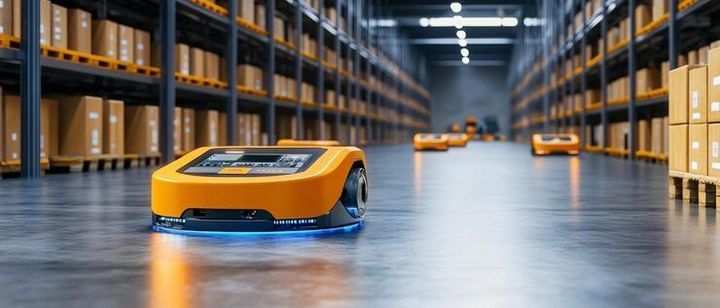
Several types of warehouse robots perform different functions. Automated guided vehicles (AGVs) generally follow predefined routes or guidance systems, while autonomous mobile robots (AMRs) can use sensor data and onboard software to navigate changing surroundings.
Other common systems include:
Goods-to-person robots: Move storage containers or shelves toward stationary picking workers.
Pallet-moving robots: Transport palletized loads between designated warehouse locations.
Picking robots: Use robotic arms, cameras, and grippers to identify and handle selected items.
Inventory robots: Scan labels or capture images to help check stock locations and quantities.
Sorting robots: Direct parcels or containers toward designated destinations within a facility.
These categories may overlap. A single warehouse can combine several robot types with conveyor belts, storage racks, barcode readers, and warehouse management software.
How Warehouse Robotics Developed
Traditional warehouses relied heavily on manual handling, forklifts, conveyors, and fixed automation. AGVs introduced automated transport along established routes, while advances in computing, sensing, mapping, and machine learning supported more flexible mobile robots.
Modern warehouse robotics often connects physical movement with digital inventory records and task-management systems. This connection allows warehouse operators to coordinate transport activities, monitor equipment status, and adjust workflows according to operational requirements.
Importance
Smart warehouse robots matter because warehouses must manage changing order volumes, varied product sizes, inventory accuracy, and delivery schedules. These demands affect retailers, manufacturers, logistics companies, warehouse workers, and customers who depend on reliable movement of goods.
Robots can handle repetitive transport tasks and reduce the need for people to move heavy items manually. However, automation does not eliminate every operational challenge. Facilities still require maintenance, supervision, safe traffic management, appropriate system design, and procedures for handling unusual situations.
Main Industrial Applications
Warehouse robots support a range of activities across different industries.
E-commerce fulfillment: Moving storage containers, retrieving products, and transporting completed orders.
Manufacturing warehouses: Delivering components and materials to production areas.
Food and beverage distribution: Moving suitable packaged products through storage and dispatch operations.
Pharmaceutical distribution: Supporting controlled inventory movement, subject to applicable handling and storage requirements.
Automotive logistics: Transporting components, tools, and prepared kits between storage and assembly areas.
Parcel distribution: Moving packages between sorting points and dispatch zones.
The suitability of a robot depends on the operating environment. Temperature, floor conditions, load dimensions, aisle width, product fragility, and hygiene requirements can all influence equipment selection.
Benefits and Operational Challenges
Robotic systems may improve the consistency of repetitive material movement and provide digital records of assigned tasks. They can also help warehouse teams organize workflows and reduce certain forms of manual handling.
Nevertheless, implementation introduces practical challenges, including:
Integration with existing warehouse management systems.
Navigation around people, forklifts, and temporary obstacles.
Battery charging, maintenance, and equipment downtime.
Handling items with unusual shapes or unstable loads.
Training workers to operate and supervise automated equipment.
Protecting warehouse networks and connected control systems.
Automation outcomes depend on the facility's design, the tasks selected, system reliability, and how effectively people and equipment work together.
Comparing Warehouse Robot Types
| Robot type | Main function | Common consideration |
|---|---|---|
| AGV | Follows established guidance routes | Route changes and guidance infrastructure |
| AMR | Navigates using sensor data and maps | Dynamic obstacles and traffic coordination |
| Picking robot | Identifies and handles items | Object recognition and gripping accuracy |
| Pallet robot | Moves palletized loads | Load weight and pallet condition |
| Inventory robot | Scans stock information | Label visibility and inventory-system accuracy |
| Sorting robot | Directs items to destinations | Package variety and throughput requirements |
These are general descriptions. Actual capabilities differ among models, software configurations, and warehouse environments.
Recent Updates
Warehouse robotics has continued to develop through improvements in navigation, machine vision, artificial intelligence, fleet coordination, and integration with warehouse software. During 2024–2026, a broader industry trend has been the development of more adaptable automation systems that can handle changing warehouse layouts and a wider range of tasks.
Advances in Navigation Systems
Warehouse navigation systems commonly combine several technologies. LiDAR measures distances using laser light, cameras capture visual information, and other sensors may detect nearby objects or measure movement. Software uses this information to estimate position, identify obstacles, and plan routes.
Some AMRs use simultaneous localization and mapping (SLAM) to build or update a representation of their surroundings while estimating their position within it. Depending on the system, navigation may also use floor markers, reflectors, QR codes, or predefined routes.
No navigation method works equally well in every environment. Reflective surfaces, poor lighting for certain camera systems, changing aisle arrangements, and crowded traffic can affect performance. Facilities therefore need testing under realistic operating conditions.
Artificial Intelligence and Fleet Coordination
Artificial intelligence can help robots recognize objects, interpret visual information, predict movement patterns, and support route planning. Improved perception may help some systems handle a greater variety of packages, although irregular objects and unfamiliar situations can remain difficult.
Fleet management software coordinates multiple robots by assigning tasks, managing routes, monitoring battery levels, and reducing traffic conflicts. Integration with warehouse management systems can connect robot tasks with inventory records and order-processing workflows.
Connected equipment also introduces cybersecurity considerations. Network access controls, software updates, monitoring, and separation of appropriate operational systems can help reduce risks. Human oversight remains important when robots encounter faults, unexpected obstacles, or situations outside their operating limits.
Laws or Policies
Warehouse robotics is shaped by occupational safety rules, machinery requirements, electrical standards, workplace procedures, and applicable data-protection and cybersecurity obligations. The relevant rules depend on the country, the type of equipment, its installation, and the activities performed at the facility.
Industrial Safety Requirements in India
In India, warehouse operators must consider applicable occupational safety and workplace legislation, including the Occupational Safety, Health and Working Conditions Code, 2020, as brought into force through the relevant commencement arrangements, along with applicable rules and requirements. The specific legal obligations depend on the establishment and the provisions in force.
Safety planning for robotic equipment generally includes separating pedestrian and vehicle routes where appropriate, assessing collision and crushing hazards, controlling access to dangerous areas, and establishing emergency-stop and isolation procedures. Equipment risk assessments should account for robot movement, carried loads, charging equipment, maintenance, and interactions with other machinery.
Relevant Indian Standards and international standards may provide technical guidance for industrial mobile robots and robot systems. ISO 3691-4 addresses safety requirements and verification for driverless industrial trucks and their systems, while ISO 10218 addresses industrial robot safety. The precise standard applicable depends on the equipment and its intended use.
Worker Training and Data Protection
Workers who operate, supervise, or maintain warehouse robots may require training appropriate to their responsibilities. Procedures should explain safe operating zones, fault reporting, emergency response, maintenance isolation, and how to respond when a robot stops unexpectedly.
Robots using cameras, location records, or connected software may also process information about workers and facility operations. Organizations should assess applicable privacy, data-protection, and cybersecurity requirements and limit access to information according to legitimate operational needs.
Tools and Resources
Several technical resources can help warehouse operators understand robot capabilities, evaluate facility requirements, and plan automation projects.
Navigation and Simulation Tools
Robot Operating System (ROS) provides software libraries and tools used in robotics development. ROS 2 documentation covers components that developers may use for robot communication, sensing, navigation, and system integration. Nav2 is a navigation framework commonly used with ROS 2-based mobile robots.
Simulation environments can help engineers test navigation, routes, obstacles, and robot behavior before deployment. Examples include Gazebo and NVIDIA Isaac Sim. Their usefulness depends on the development setup, hardware requirements, and the accuracy of the simulated warehouse environment.
Warehouse Planning and Evaluation Resources
Warehouse management system documentation explains how inventory, orders, storage locations, and fulfillment tasks are recorded and coordinated. Robot manufacturers may also publish technical specifications, payload limits, charging requirements, navigation capabilities, and integration documentation.
A warehouse evaluation spreadsheet can record:
Robot type, payload capacity, and operating speed.
Aisle width, floor condition, and turning space.
Estimated travel distances and task frequency.
Battery capacity, charging arrangements, and maintenance needs.
Safety zones, pedestrian crossings, and emergency procedures.
Software compatibility, network requirements, and system downtime.
Such records help teams compare technical requirements and identify limitations before introducing equipment into active operations.
FAQs
How do smart warehouse robots navigate?
Smart warehouse robots use sensors, software, and navigation methods to estimate their position and move through a facility. Depending on the design, they may follow predefined routes, use mapped environments, or apply SLAM to build and update maps.
What is the difference between AGVs and AMRs?
AGVs commonly follow established routes or guidance systems. AMRs generally use onboard sensing and software to navigate more flexibly around changing surroundings, although their capabilities depend on their specific design.
What are the main applications of warehouse automation robots?
Warehouse automation robots can transport pallets, move shelves, assist with item picking, scan inventory, sort parcels, and deliver materials to production areas. The appropriate application depends on load requirements and the facility layout.
Are smart warehouse robots safe to work around?
They can be used in workplaces designed with suitable safety measures, but risks remain. Appropriate risk assessments, protective systems, traffic management, maintenance procedures, and worker training are important for safe operation.
Which navigation systems are used in smart warehouse robots?
Common approaches include LiDAR-based navigation, camera-based perception, SLAM, predefined routes, and marker-based guidance. Some robots combine several methods to improve navigation in their intended environment.
Conclusion
Smart warehouse robots combine mechanical systems, navigation technology, sensors, and software to support material handling and inventory operations. Their applications include manufacturing, distribution, e-commerce, and parcel processing, with capabilities varying according to the robot type and operating environment. Safe deployment depends on suitable facility design, system integration, maintenance, worker training, and compliance with applicable requirements. Navigation and artificial intelligence continue to expand the range of warehouse tasks that automation can support, while human supervision remains an important part of operations.