Plastic Extrusion Lines Guide: Machinery, Materials, Production Stages and Selection Factors
A Plastic Extrusion Lines Guide explains the machinery, materials, production stages, and selection factors involved in manufacturing plastic products. Plastic extrusion is an industrial process in which plastic material is heated until it becomes soft enough to flow, then pushed through a shaped opening called a die. The resulting continuous product is cooled and cut, wound, or handled according to its intended use.
Context
A Plastic Extrusion Lines Guide explains the machinery, materials, production stages, and selection factors involved in manufacturing plastic products. Plastic extrusion is an industrial process in which plastic material is heated until it becomes soft enough to flow, then pushed through a shaped opening called a die. The resulting continuous product is cooled and cut, wound, or handled according to its intended use.
Plastic extrusion developed alongside advances in polymer chemistry and industrial machinery. Today, extrusion lines are used to manufacture pipes, tubes, films, sheets, window profiles, insulation materials, and packaging components. The process supports continuous production, making it suitable for products that require a consistent cross-sectional shape or thickness.
Understanding Plastic Extrusion Machinery
A plastic extrusion line consists of connected machines that move raw material through heating, shaping, cooling, and finishing stages. The exact equipment depends on the plastic type, product dimensions, production requirements, and intended application.
Common extrusion line components include:
Hopper: Holds and feeds plastic pellets, granules, or other prepared material into the machine.
Extruder barrel and screw: Heat, mix, compress, and move the material toward the die.
Heating and temperature controls: Maintain suitable processing conditions along the barrel.
Die: Shapes the softened plastic into the required profile.
Cooling equipment: Uses air, water, or other controlled methods to stabilize the extruded product.
Haul-off unit: Pulls the product through the line at a controlled speed.
Cutting or winding equipment: Produces fixed-length sections or winds continuous material into rolls.
These components operate together, and changes in one stage can affect the dimensions, appearance, and physical properties of the final product.
Importance
Plastic extrusion lines are important because they support the production of materials used in construction, agriculture, transportation, electronics, healthcare equipment, and packaging. Pipes carry water and other fluids, plastic films protect goods, and extruded profiles are used in doors, windows, and industrial structures.
Manufacturers must maintain suitable processing conditions to reduce defects and material waste. Temperature variations, inconsistent feeding, incorrect screw settings, and uneven cooling can cause changes in thickness, surface quality, strength, or dimensions. Understanding the process helps production teams identify possible causes of these problems.
Types of Plastic Extrusion Lines
Different products require different extrusion configurations.
Pipe extrusion lines: Produce plastic pipes for plumbing, irrigation, drainage, and industrial applications.
Film extrusion lines: Manufacture thin plastic films using processes such as blown-film or cast-film extrusion.
Sheet extrusion lines: Produce flat plastic sheets used in packaging, construction, and manufacturing.
Profile extrusion lines: Create continuous shapes such as window frames, channels, seals, and protective edges.
Tubing extrusion lines: Produce flexible or rigid tubes with specified internal and external dimensions.
Compounding extrusion lines: Mix polymers with additives, colorants, fillers, or reinforcing materials to create a controlled material formulation.
Each type requires suitable dies, cooling arrangements, material handling, and downstream equipment. A line designed for thin film production, for example, is not automatically suitable for manufacturing thick-walled pipes.
Materials Used in Plastic Extrusion
The material influences processing temperatures, screw design, cooling requirements, and product performance. Common polymers include polyethylene (PE), polypropylene (PP), polyvinyl chloride (PVC), polyethylene terephthalate (PET), and acrylonitrile butadiene styrene (ABS).
| Material | Common extrusion applications | Important considerations |
|---|---|---|
| PE | Pipes, films, tubing | Flexibility, melt behavior, and cooling |
| PP | Sheets, profiles, packaging | Heat sensitivity and dimensional stability |
| PVC | Pipes, window profiles, conduits | Temperature control and formulation |
| PET | Sheets, films, packaging | Moisture control and drying requirements |
| ABS | Profiles, technical components | Processing stability and surface finish |
These applications are examples rather than fixed rules. Material grades and formulations vary, and the selected polymer must meet the product's mechanical, chemical, temperature, and regulatory requirements.
Recent Updates
From 2024 through 2026, plastic extrusion manufacturing has continued to focus on process monitoring, automation, energy management, material efficiency, and recycling compatibility. The pace of adoption differs between manufacturers and production facilities, and not every extrusion line includes advanced digital systems.
Automation and Process Monitoring
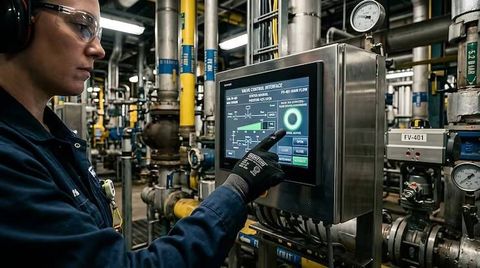
Modern extrusion equipment may use programmable logic controllers, touchscreen interfaces, sensors, and automated adjustment systems. These technologies help operators monitor barrel temperatures, motor loads, screw speed, line speed, and other operating conditions.
Some facilities also use production data systems to record machine performance and identify recurring defects. Inline measurement equipment can monitor dimensions or thickness while the product is being manufactured. Automated controls still require appropriate setup, calibration, maintenance, and operator oversight.
Recycled Plastics and Material Efficiency
Interest in recycled polymers has encouraged manufacturers to examine how recycled feedstock can be incorporated into extrusion processes. Mechanical recycling typically involves collecting, sorting, cleaning, and reprocessing plastic waste into usable material.
However, recycled feedstock may vary in composition, moisture content, contamination, and melt behavior. These differences can affect production stability and final product properties. Manufacturers may need additional filtration, drying, blending, or quality checks depending on the polymer and intended application.
Energy monitoring is another area of attention. Insulation, suitable heating controls, efficient motors, and reduced production interruptions can influence energy use. The results depend on machine design, operating conditions, material selection, and maintenance practices.
Laws or Policies
Plastic extrusion manufacturing is affected by machinery safety requirements, environmental regulations, worker protection rules, and product-specific standards. The exact requirements depend on the country, production location, material, and intended use of the finished product.
Plastic Manufacturing Rules in India
In India, plastic processors may need to comply with applicable requirements under environmental legislation, including the Environment (Protection) Act, 1986, and relevant rules issued under it. Manufacturing facilities may also be subject to state pollution control board requirements, including applicable consents to establish or operate.
The Plastic Waste Management Rules, 2016, as amended, establish requirements relating to plastic waste management and extended producer responsibility for specified categories of producers, importers, and brand owners. The obligations applicable to a particular business depend on its role, products, and current regulatory requirements.
Manufacturers should determine whether their operations involve regulated plastic packaging, recycled material, or other categories with specific compliance obligations. Requirements may differ from those applying to plastic pipes, industrial profiles, or other non-packaging products.
Machinery Safety and Product Standards
Extrusion equipment presents hazards involving hot surfaces, rotating screws, nip points, high-pressure molten plastic, and electrical systems. Appropriate guarding, emergency stops, lockout procedures, ventilation, training, and protective equipment form important parts of workplace safety.
Finished products may also need to comply with applicable Indian Standards or sector-specific requirements. For example, pipes used in water supply or construction may be subject to specifications relating to dimensions, material properties, testing, and intended use. Manufacturers should consult the relevant Bureau of Indian Standards publications and applicable regulations for their product category.
Tools and Resources
Technical resources help manufacturers understand extrusion machinery, calculate production requirements, and monitor product quality. The appropriate tools depend on the product, polymer, production volume, and required tolerances.
Production and Material Calculators
A production planning spreadsheet can estimate output using line speed, product dimensions, material density, and operating time. For a uniform solid profile, an approximate mass flow rate can be calculated from its cross-sectional area, material density, and extrusion speed.
The calculation requires consistent units and may need adjustment for hollow profiles, films, variable thicknesses, or multiple production streams. Actual output should be checked against measured production data because startup losses, downtime, material variation, and rejected products affect usable output.
Monitoring and Quality Control Equipment
Common tools include digital thermometers, pressure sensors, dimensional gauges, thickness measurement systems, weighing equipment, and laboratory testing instruments. Depending on the application, manufacturers may assess tensile properties, impact resistance, melt flow characteristics, or dimensional stability.
Supplier manuals and polymer technical data sheets provide information about recommended processing ranges and material handling. The American Society for Testing and Materials (ASTM International) and the Bureau of Indian Standards publish standards relevant to certain plastics, testing methods, and finished products.
Factors for Selecting a Plastic Extrusion Line
Selection involves matching the machinery to the required product and operating environment. Important considerations include:
Product dimensions: Required diameter, width, thickness, profile shape, and tolerances.
Material compatibility: Polymer type, grade, additives, moisture sensitivity, and recycled content.
Production capacity: Required output per hour and expected operating schedule.
Process control: Temperature stability, pressure monitoring, speed control, and dimensional measurement.
Space and utilities: Factory layout, electrical supply, cooling water, ventilation, and material storage.
Maintenance requirements: Spare parts, cleaning procedures, access to machine components, and operator training.
Compliance: Applicable safety, environmental, and product-quality requirements.
A selection assessment should also consider the complete production line rather than the extruder alone. Die design, cooling capacity, haul-off speed, cutting equipment, and inspection systems must operate together to achieve the required product specifications.
FAQs
What is a plastic extrusion line?
A plastic extrusion line is a connected set of machines that heats plastic material, pushes it through a shaped die, cools the product, and prepares it for further handling or use.
What materials are used in plastic extrusion machinery?
Common materials include PE, PP, PVC, PET, and ABS. Material selection depends on the product's intended use, required properties, processing conditions, and applicable regulations.
What are the main types of plastic extrusion lines?
Common types include pipe, film, sheet, tubing, profile, and compounding extrusion lines. Each type uses equipment configured for its specific product geometry and production requirements.
How is plastic extrusion line production capacity calculated?
For a uniform product, approximate output can be estimated from the product's cross-sectional area, material density, and extrusion speed. Actual usable production also depends on downtime, startup waste, and quality requirements.
What should manufacturers consider when selecting a plastic extrusion line?
Manufacturers should assess product dimensions, polymer compatibility, required output, process controls, factory utilities, maintenance needs, worker safety, and applicable product standards.
Conclusion
Plastic extrusion lines combine material feeding, heating, shaping, cooling, and finishing equipment to produce a wide range of continuous plastic products. Machinery configuration, polymer properties, and operating conditions influence product quality and production efficiency. Automation, process monitoring, and recycled material use are important areas of ongoing development, although their suitability varies by application. Safety measures and relevant environmental and product regulations also form part of responsible extrusion manufacturing.