Industrial Packaging Systems Guide: Machinery, Materials, Processes and Packaging Methods
Industrial packaging systems are combinations of machinery, materials, and operating procedures used to prepare products for storage, transportation, distribution, and use. These systems are found in industries such as food processing, pharmaceuticals, electronics, chemicals, agriculture, and manufacturing. Their main purpose is to protect products, contain materials, provide identifying information, and support the movement of goods through supply chains.
Context
Industrial packaging systems are combinations of machinery, materials, and operating procedures used to prepare products for storage, transportation, distribution, and use. These systems are found in industries such as food processing, pharmaceuticals, electronics, chemicals, agriculture, and manufacturing. Their main purpose is to protect products, contain materials, provide identifying information, and support the movement of goods through supply chains.
Packaging has developed from simple containers, woven materials, wooden crates, and paper wrapping into organized production processes involving automated machines and specialized packaging materials. Modern industrial packaging systems may perform several tasks in sequence, including filling, wrapping, sealing, labeling, coding, and placing packages into shipping containers.
The type of system used depends on the product's physical properties, packaging requirements, production volume, storage conditions, and transportation method. A packaging line for liquid beverages, for example, differs considerably from one designed for metal components or powdered industrial materials.
Main Types of Industrial Packaging Systems
Industrial packaging systems can be grouped according to their purpose and the products they handle.
Primary packaging: Materials that directly contain a product, such as bottles, cans, pouches, cartons, or sealed bags.
Secondary packaging: Packaging that groups individual products, such as cartons holding several containers or boxes containing smaller packages.
Tertiary packaging: Packaging used to prepare grouped goods for storage and transportation, including pallets, stretch film, and protective shipping containers.
Protective packaging: Materials such as foam inserts, cushioning paper, molded supports, and protective films that reduce damage during handling.
Bulk packaging: Large containers, drums, sacks, bins, or intermediate bulk containers used for transporting or storing substantial quantities of materials.
Each category addresses different handling and protection requirements. Some products require several packaging layers, while others can be transported safely in a single suitable container.
Importance
Industrial packaging systems play an important role in manufacturing, distribution, retail, and international trade. Packaging protects products from moisture, dust, contamination, impact, and other environmental conditions that may affect their quality during storage or transportation.
Packaging machinery also helps manufacturers organize repetitive tasks and maintain consistent packaging procedures. When operations are planned properly, filling, sealing, labeling, and case packing can be coordinated with production equipment to reduce handling interruptions and support predictable output.
Problems Addressed by Industrial Packaging
Different industries face different packaging challenges. Food manufacturers must consider hygiene and product freshness, electronics producers may need protection against impact and electrostatic discharge, and chemical manufacturers must account for material compatibility and containment.
Industrial packaging systems can help address these challenges through:
Product protection: Containers, seals, and cushioning materials help limit physical damage and environmental exposure.
Operational consistency: Automated equipment can repeat filling, wrapping, and sealing movements according to configured settings.
Product identification: Labels and printed codes can communicate batch numbers, handling instructions, ingredients, or other required information.
Storage efficiency: Standardized package dimensions can support organized stacking, palletizing, and warehouse handling.
Traceability: Barcodes, lot numbers, and other identifiers can help connect packaged products with production and distribution records.
Material management: Packaging designs can be evaluated to reduce unnecessary material use while retaining required protection.
Packaging does not eliminate every risk. Incorrect machine settings, unsuitable materials, damaged seals, or poor handling can still lead to product loss and packaging failures.
Common Industrial Packaging Machinery
Different machines perform specific tasks within a packaging line. Some operate independently, while others are connected through conveyors, sensors, control systems, and material-handling equipment.
| Machinery type | Main function | Typical applications |
|---|---|---|
| Filling machine | Measures and dispenses products into containers | Liquids, powders, grains |
| Form-fill-seal machine | Forms packaging, fills it, and seals it | Food pouches, sachets, selected industrial products |
| Cartoning machine | Places products into cartons | Consumer goods, packaged components |
| Wrapping machine | Applies film or other wrapping materials | Bundles, pallets, manufactured goods |
| Labeling machine | Applies labels to products or containers | Bottles, boxes, jars |
| Coding and marking machine | Prints identification or production information | Batch codes, dates, tracking marks |
| Case packing machine | Arranges products inside shipping cases | Bottles, cartons, packaged goods |
| Palletizing system | Arranges cases or packages on pallets | Warehouses and distribution centers |
The appropriate machinery depends on package dimensions, product characteristics, required production speed, changeover needs, and the available workspace. Equipment compatibility is important because a mismatch between machines can interrupt the entire line.
Recent Updates
Industrial packaging systems have continued to develop through automation, digital monitoring, improved material design, and greater attention to resource efficiency. From 2024 through 2026, manufacturers have increasingly examined how connected machinery, inspection technology, and packaging data can improve production visibility and material management. The extent of adoption varies by industry, investment level, and operational requirements.
Automation and Smart Packaging Lines
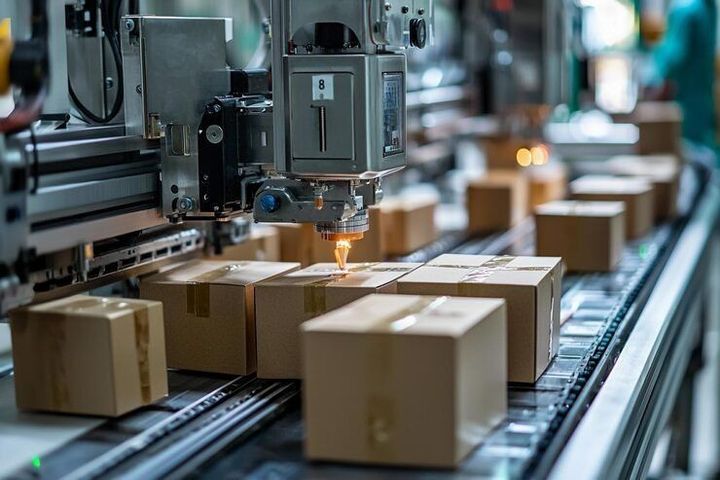
Automated packaging lines can combine conveyors, sensors, programmable logic controllers, robotic equipment, and machine-vision systems. These technologies coordinate tasks such as detecting container positions, checking package alignment, verifying labels, and identifying certain visible defects.
Connected equipment can also record operating information, including machine stops, production counts, and fault conditions. Such data can help maintenance teams identify recurring interruptions and understand equipment performance. However, automation requires appropriate setup, maintenance, operator training, and safeguards.
Robotic systems are increasingly used for tasks such as case packing, sorting, palletizing, and handling packages of different sizes. Their suitability depends on product weight, required movement accuracy, available space, and the complexity of the production process.
Sustainable Packaging Materials
Manufacturers are evaluating packaging designs that use less material, contain recycled content, or can be recovered through established recycling systems. Paper-based packaging, recyclable plastics, reusable transport containers, and lightweight designs are among the approaches being considered.
Material changes must account for product safety, strength, moisture resistance, shelf life, and compatibility with existing machinery. A material that reduces packaging weight may require changes to sealing temperatures, wrapping tension, or filling procedures.
Inspection and Digital Traceability
Machine vision and automated inspection tools can examine package appearance, label placement, selected dimensions, and other measurable characteristics. Depending on the equipment, inspection systems may also identify missing components or certain sealing defects.
Digital identification technologies, including barcodes and selected radio-frequency identification systems, can connect packages with production records and warehouse systems. Their usefulness depends on accurate data, compatible equipment, and consistent procedures throughout the supply chain.
Laws or Policies
Industrial packaging is shaped by regulations covering product safety, labeling, environmental management, worker protection, and the transportation of particular materials. The exact requirements depend on the product, packaging material, industry, destination market, and intended use.
Packaging Regulations in India
In India, the Legal Metrology Act, 2009, and the Legal Metrology (Packaged Commodities) Rules, 2011, establish requirements for specified packaged commodities. Depending on the product and circumstances, declarations may include details such as the manufacturer's identity, quantity, and other prescribed information. Applicability differs according to the type of package, commodity, and relevant exemptions.
Food packaging is also governed by applicable provisions of the Food Safety and Standards Act, 2006, and associated regulations. Packaging materials that come into contact with food must meet relevant safety requirements, while labeling and product information are subject to applicable food regulations.
Environmental requirements are another important consideration. India's Plastic Waste Management Rules, 2016, as amended, establish provisions concerning plastic waste management and extended producer responsibility for specified producers, importers, and brand owners. Applicable obligations depend on the business and packaging category.
Worker Safety and Equipment Compliance
Packaging machinery can involve moving conveyors, cutting tools, heat-sealing elements, pneumatic systems, and robotic arms. Risk controls may include physical guards, emergency stops, appropriate electrical protection, lockout procedures during maintenance, and operator training.
Factories must follow applicable occupational safety and factory requirements, including relevant central and state rules. Businesses should determine which legal provisions apply to their facilities, machinery, workforce, and industry rather than assuming that one standard covers every packaging operation.
Exporters may also need to meet destination-market rules relating to packaging materials, product labeling, recycling, and restricted substances. For dangerous goods, packaging and marking requirements can depend on the substance and the applicable transport regulations.
Tools and Resources
Industrial packaging planning involves selecting machinery, evaluating materials, checking package dimensions, and organizing production processes. Technical documentation and measurement tools help teams assess whether a proposed packaging system fits the product and operating environment.
Packaging Design and Machinery Selection Tools
Computer-aided design software can help engineers create package layouts, examine dimensions, and plan how containers fit into cartons or shipping cases. Packaging suppliers and machinery manufacturers often publish equipment specifications, operating manuals, material compatibility information, and maintenance instructions.
Packaging calculations may include container volume, carton dimensions, pallet loading patterns, film usage, and estimated production throughput. These calculations depend on accurate measurements and operating assumptions, so calculated results should be checked against actual production conditions.
Quality Control and Production Monitoring
Quality-control checklists can record seal integrity, fill quantity, label accuracy, package condition, and other relevant inspection results. For regulated products, inspection procedures should reflect the applicable technical requirements and documented quality controls.
Manufacturing execution systems and warehouse management platforms can help coordinate production records, inventory, packaging materials, and shipment identification. Barcode scanners and machine-monitoring dashboards may provide additional information about package movement and equipment performance.
Practical Packaging System Checklist
Before a packaging line is installed or modified, planners generally examine:
Product dimensions, weight, physical form, and handling sensitivity.
Packaging material compatibility and required protective properties.
Machine capacity, package format, and production-line layout.
Cleaning, maintenance, changeover, and operator safety requirements.
Labeling, traceability, and regulatory documentation.
Waste handling, material recovery, and storage arrangements.
These factors help define the system's technical requirements and identify potential issues before routine production begins.
FAQs
What are industrial packaging systems?
Industrial packaging systems combine machinery, materials, and processes used to contain, protect, identify, and prepare products for storage or transportation. They may include filling, sealing, labeling, wrapping, case packing, and palletizing equipment.
What machinery is used in industrial packaging systems?
Common equipment includes filling machines, form-fill-seal machines, cartoners, wrappers, labeling machines, coding systems, case packers, and palletizers. The equipment depends on the product, package design, and production requirements.
Which materials are used in industrial packaging?
Common materials include paperboard, corrugated cardboard, plastics, glass, metals, flexible films, and cushioning materials. Selection depends on product compatibility, protection requirements, transportation conditions, and applicable regulations.
How does automated packaging machinery work?
Automated packaging machinery uses configured controls, sensors, conveyors, and mechanical or robotic components to perform repetitive packaging tasks. Inspection systems may check selected package characteristics, while monitoring tools record production activity and equipment faults.
What regulations affect industrial packaging in India?
Relevant requirements may include Legal Metrology rules, food packaging regulations, plastic waste management provisions, and workplace safety requirements. The applicable rules depend on the product, material, packaging activity, and business responsibilities.
Conclusion
Industrial packaging systems combine machinery, materials, and coordinated processes to protect products and prepare them for storage and distribution. Automation, inspection technologies, and digital traceability are influencing how packaging lines operate, while material selection and waste management remain important considerations. Indian regulations may affect packaging declarations, food-contact materials, plastic waste obligations, and worker safety. System requirements ultimately depend on the product, production environment, packaging design, and applicable rules.