Industrial Blending Machines: Explore Automation and Mixing Technology
Industrial blending machines are mechanical systems designed to combine two or more materials into a consistent mixture. They are used across industries where uniform composition, controlled processing, and repeatable production are important.
The materials may be powders, granules, liquids, pastes, fibers, or combinations of different physical forms. Depending on the application, a blending system may use rotating blades, paddles, ribbons, screws, drums, high-speed impellers, or other mixing mechanisms.
The basic purpose is straightforward: materials enter the mixing chamber, mechanical energy creates movement, and the components are distributed throughout the mixture.
Industrial blending equipment exists because manual or uncontrolled mixing can become difficult when production volumes increase. Large-scale manufacturing requires repeatable processes that can maintain similar results from one batch to another.
Common applications include:
- Food and beverage processing
- Pharmaceutical manufacturing
- Chemical processing
- Plastics and polymers
- Construction materials
- Agricultural products
- Cosmetics and personal-care production
- Mineral and powder processing
- Battery-material manufacturing
- Specialty chemical production
The machine configuration depends heavily on the material characteristics. Particle size, moisture, density, viscosity, temperature, and flow behavior can all influence the blending process.
Why Industrial Blending Technology Matters Today
Modern manufacturing increasingly focuses on consistency, process control, traceability, energy management, and workplace safety. Industrial blending machines can contribute to these objectives when correctly designed and integrated into a production system.
A controlled mixing process can reduce variation between batches. This is particularly important when the final product depends on accurate distribution of ingredients or components.
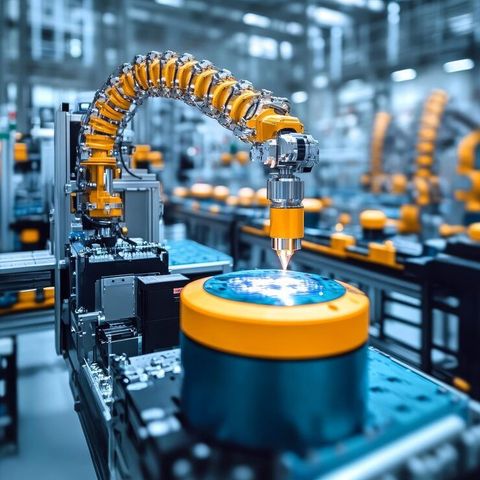
Automation also changes how operators interact with blending equipment. Instead of manually controlling every stage, modern systems can use sensors, programmable controllers, variable-speed drives, and automated sequences.
Important benefits of controlled blending include:
- More consistent material distribution
- Repeatable processing conditions
- Better control of mixing time
- Automated speed adjustment
- Reduced manual intervention
- Easier process monitoring
- Improved batch documentation
- Integration with wider production systems
The importance of blending extends beyond the machine itself. A mixer can become part of a larger manufacturing line involving material feeding, weighing, conveying, heating, cooling, filling, packaging, and quality inspection.
For this reason, industrial automation and process control are increasingly connected with mixing technology.
Types of Industrial Blending Machines
Different materials require different mixing principles. There is no single machine design suitable for every application.
Ribbon Blenders
Ribbon blenders use helical blades positioned around a horizontal shaft. They are commonly associated with powders and dry materials. The ribbons move material through different areas of the chamber to promote distribution.
Paddle Blenders
Paddle systems use paddle-shaped mixing elements. Their design can provide controlled movement for powders, granules, and other materials.
High-Shear Mixers
High-shear systems generate stronger mechanical forces and are commonly considered when intensive dispersion or particle-size reduction is required.
Planetary Mixers
Planetary mixers use rotating mixing tools that move around the vessel while also rotating around their own axes. They can be useful for materials with higher viscosity.
Drum and Tumble Blenders
These systems rotate the container itself. They are often used where gentle blending is preferred.
Liquid Blending Systems
Liquid mixers use impellers or other mixing elements to circulate fluids. The design depends on viscosity, density, temperature, and the desired degree of dispersion.
| Machine Type | Common Material | Typical Mixing Approach |
|---|---|---|
| Ribbon blender | Dry powders | Horizontal ribbon movement |
| Paddle blender | Powders and granules | Paddle circulation |
| High-shear mixer | Dispersions and intensive mixtures | High mechanical energy |
| Planetary mixer | Viscous materials | Planetary movement |
| Drum blender | Dry materials | Container rotation |
| Liquid mixer | Liquids | Impeller circulation |
Automation in Industrial Mixing Systems
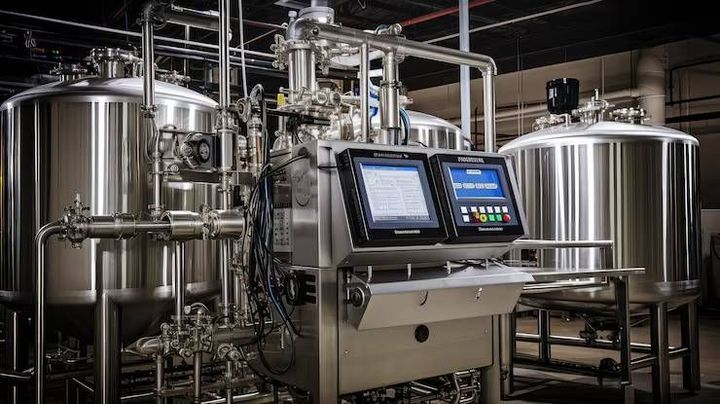
Automation is becoming an important part of modern industrial mixing technology. A blending machine can be connected to sensors and control systems that monitor operating conditions during production.
A programmable logic controller can coordinate sequences such as material loading, mixing, discharge, and cleaning cycles. Sensors can monitor parameters such as temperature, pressure, speed, level, or other process conditions.
Variable-frequency drives can also allow motor speed to be adjusted according to process requirements.
Modern automation may include:
- Programmable logic controllers
- Human-machine interfaces
- Variable-frequency drives
- Load cells
- Temperature sensors
- Level sensors
- Flow measurement
- Automated batch controls
- Data logging
- Remote monitoring
- Digital process dashboards
Recent industrial automation discussions have placed greater emphasis on interoperable control systems, digital twins, cybersecurity, and AI-supported decision-making. A January 2026 analysis identified digital twins and integration of AI with existing industrial workflows among notable automation developments for 2026.
For blending operations, these technologies can help engineers analyze process conditions and test control changes before implementing them on physical equipment.
Recent Developments in Mixing and Automation
During 2025 and 2026, industrial automation has increasingly focused on connecting established production equipment with newer digital technologies.
One notable development is the use of digital twins. A digital representation of equipment or a process can help engineers study operating conditions and evaluate possible changes in a controlled environment.
Another trend is modular automation. Instead of replacing an entire production system, manufacturers can gradually introduce newer control, monitoring, and analytics technologies.
Cybersecurity is also becoming more relevant as industrial machines become connected to plant networks. Modern automation architectures increasingly consider network segmentation, secure communication, and controlled access.
The broader direction is toward connected manufacturing rather than isolated machines.
For industrial blending equipment, this can mean greater visibility into:
- Mixing duration
- Motor performance
- Temperature changes
- Material loading
- Batch sequence
- Equipment status
- Maintenance indicators
- Process deviations
These developments do not eliminate the need for skilled human oversight. Instead, digital tools are increasingly intended to provide better information for operators and engineers.
Laws, Standards, and Machinery Safety
Industrial blending equipment is affected by machinery safety, electrical safety, workplace protection, environmental requirements, and industry-specific regulations. Exact requirements depend on the country, material being processed, machine configuration, and workplace.
In India, machinery safety is supported by standards and regulatory frameworks administered through relevant government bodies. The Bureau of Indian Standards maintains machinery safety standards covering areas such as risk assessment, protective devices, electrical equipment, and machine controls.
BIS also maintains Scheme-X certification information for specified machinery and electrical equipment. Its current information includes machinery safety certification guidelines and registration processes.
A 2025 BIS draft for IS 15296:2025, aligned with ISO 11161:2025, addressed safety requirements for integrated manufacturing systems and included additions concerning risk assessment, task zones, design measures, and risk reduction.
Workplace safety requirements also matter. India's Ministry of Labour and Employment has described factory safety and occupational health requirements as important areas of industrial regulation, with state-level rules and factory inspectorates playing an enforcement role.
Before operating or integrating a blending machine, organizations should therefore examine the standards and regulations applicable to their specific equipment and industry.
Tools and Resources for Blending Technology
Several general tools can help engineers, operators, and students understand or manage industrial blending processes.
Process Calculation Tools
Calculators can help estimate batch quantities, material ratios, residence times, motor requirements, and related process parameters.
Process Simulation Software
Simulation platforms can model material movement, mixing behavior, heat transfer, and other process characteristics before physical implementation.
PLC Programming Tools
PLC development environments are commonly used to create automated sequences for loading, mixing, discharge, alarms, and interlocks.
HMI Design Tools
Human-machine interface software allows operators to monitor machine status, adjust permitted parameters, and review process information.
Maintenance Checklists
Digital or printed checklists can document inspections of bearings, seals, drives, blades, electrical components, guards, and other machine parts.
Standards Databases
Official standards databases can help users identify applicable machinery safety requirements. BIS provides a “Know Your Standard” facility that allows standards to be searched using an Indian Standard number or product-related keyword.
Frequently Asked Questions
What are industrial blending machines used for?
Industrial blending machines combine different materials to create a more uniform mixture. They are used for powders, granules, liquids, pastes, and other material combinations across multiple manufacturing industries.
How does automation improve blending processes?
Automation can control mixing sequences, monitor process conditions, regulate machine speed, record operating information, and manage safety-related interlocks. The exact capabilities depend on the machine and control architecture.
Which blending machine is suitable for powders?
Ribbon blenders, paddle blenders, tumble blenders, and other dry-mixing systems can be used for powders. The appropriate design depends on factors such as particle characteristics, density, moisture, batch size, and required mixing intensity.
Are industrial blending machines subject to safety standards?
Yes. Machinery can be subject to applicable safety, electrical, workplace, environmental, and industry-specific requirements. The exact rules depend on the country and application.
What is the role of sensors in automated mixing?
Sensors can provide information about conditions such as temperature, level, pressure, speed, weight, or flow. Control systems can use this information to monitor or adjust the process according to programmed requirements.
Conclusion
Industrial blending machines have developed from relatively simple mechanical mixers into increasingly connected components of modern manufacturing systems. Their primary purpose remains consistent: combining materials in a controlled and repeatable manner.