Forklift Equipment Details: Components, Mast Types, Functions and Operating Features
Forklifts are industrial vehicles designed to lift, move, position, and stack loads over relatively short distances. Forklift Equipment Details commonly include the machine's main components, mast configurations, lifting mechanism, steering system, power source, and operating features. These machines are widely used in warehouses, manufacturing facilities, distribution centers, construction areas, ports, and storage yards.
The basic concept of a forklift combines a powered vehicle with a vertical lifting structure. A hydraulic system raises and lowers the forks, while the mast provides vertical movement and support. Operators use controls to position loads at different heights and move them across designated work areas.
Different forklift models are designed for different environments and load requirements. Electric forklifts are commonly associated with indoor operations, while internal-combustion models can be used in outdoor areas where ventilation and operating conditions are appropriate. Specialized configurations are also available for narrow aisles, rough terrain, long materials, and high stacking applications.
Basic Forklift Structure
A conventional forklift consists of several interconnected systems. The chassis supports the major mechanical and electrical components, while the counterweight helps balance the load carried in front of the vehicle.
The front assembly contains the mast, carriage, and forks. Hydraulic cylinders provide lifting movement, and the operator uses controls to adjust the height and tilt of the load. Tires, axles, steering components, and braking systems allow the vehicle to travel and maneuver.
Importance
Forklifts play an important role in material handling because many industrial environments require loads to be moved repeatedly between storage, production, loading, and unloading areas. Manual movement may not be practical for heavy pallets, containers, machinery components, or other bulky materials.
Understanding forklift equipment is important for operators, supervisors, warehouse planners, maintenance personnel, and businesses that work with material-handling equipment. Knowledge of components and operating features can help people understand machine capabilities and recognize the importance of proper training and workplace procedures.
Common Forklift Applications
Forklifts can perform several material-handling functions, depending on their design and attachments. Common applications include:
- Moving palletized materials between locations.
- Loading and unloading trucks.
- Stacking materials in storage racks.
- Positioning loads at different elevations.
- Transporting containers and industrial materials.
- Handling materials with specialized attachments.
The machine's capacity, dimensions, mast configuration, and attachment type should correspond with the intended application. A forklift designed for indoor warehouse aisles may have different characteristics from a rough-terrain model intended for outdoor surfaces.
Key Forklift Components
Several components work together during lifting and travel operations.
Mast: The vertical assembly that guides the carriage during lifting and lowering.
Carriage: The structure attached to the mast that supports the forks or another attachment.
Forks: Horizontal arms positioned beneath a pallet or load to lift and transport it.
Hydraulic system: Uses pressurized fluid to operate lifting and tilting functions.
Counterweight: A weighted section at the rear that helps balance the vehicle when carrying a load.
Overhead guard: A protective structure positioned above the operator's area.
Power unit: Provides energy for movement and lifting. Depending on the model, this may be an electric battery system or an internal-combustion engine.
Steering and axle system: Allows the forklift to change direction and maintain stability while traveling.
Recent Updates
Electric Forklift Development
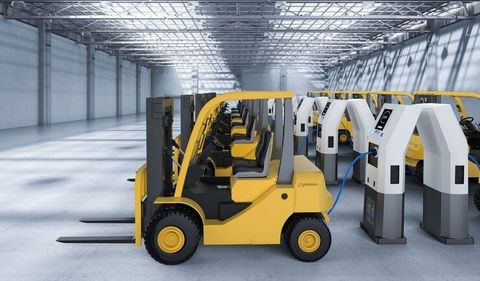
Electric forklifts have continued to gain attention as workplaces examine indoor air quality, noise levels, energy use, and operational efficiency. Improvements in battery technology and charging systems have expanded the range of applications for electrically powered material-handling equipment.
Lithium-ion batteries are increasingly used in some forklift applications because they can support opportunity charging and may require different maintenance procedures compared with traditional lead-acid batteries. The appropriate battery technology depends on the machine, operating schedule, facility infrastructure, and manufacturer specifications.
Connected Equipment
Modern forklift equipment can incorporate digital monitoring systems. Depending on the model, these systems may record operating hours, impact events, battery information, location data, or maintenance indicators.
Connected equipment can provide information that helps organizations understand how machines are being used. Data handling practices vary, so workplaces should understand the privacy and system-management requirements associated with connected equipment.
Operator Assistance Features
Newer forklifts may include technologies designed to provide information or assistance during operation. Examples can include load-weight indicators, speed management, proximity alerts, cameras, displays, and stability-related monitoring systems.
These technologies do not replace operator training or established workplace procedures. Their function depends on the equipment configuration and manufacturer specifications.
Energy and Emissions Considerations
Manufacturers continue to develop power systems that address energy efficiency and emissions requirements. Electric models are particularly relevant to enclosed facilities because they do not produce direct exhaust emissions during normal operation.
Internal-combustion forklifts remain relevant for various outdoor and demanding applications. Their suitability depends on factors such as ventilation, terrain, load requirements, fuel type, and applicable environmental rules.
Laws or Policies
Forklift operation is affected by workplace safety regulations, equipment standards, operator training requirements, and local environmental rules. The exact requirements vary by country and jurisdiction.
Operator Training
In many workplaces, forklift operators must receive appropriate training before operating powered industrial trucks. Training generally covers machine controls, load handling, workplace hazards, stability principles, inspection procedures, and safe operating practices.
Employers may also need to provide workplace-specific instruction because hazards can differ between warehouses, factories, construction areas, and loading yards.
Load Capacity and Stability
Forklifts are designed to operate within specified load limits. The rated capacity depends on factors such as load weight, load center, mast height, attachment configuration, and machine design.
A load that is within the nominal capacity at one height or configuration may not have the same handling characteristics in another situation. Operators should therefore follow the capacity information provided on the equipment's identification plate and in the manufacturer's documentation.
Inspection Requirements
Regular inspections can help identify mechanical or structural problems before equipment is used. Inspection procedures may include checking tires, forks, chains, hydraulic components, brakes, steering, warning devices, and other relevant systems.
Damaged or malfunctioning equipment should be handled according to the workplace's established safety procedures and applicable regulations.
Workplace Conditions
Operating areas should account for pedestrian movement, floor conditions, visibility, aisle width, overhead clearance, ramps, loading areas, and other hazards. Separate pedestrian and forklift routes may be used where appropriate.
Local regulations and workplace policies should always be considered because requirements differ between jurisdictions and industries.
Tools and Resources
Several resources can help people understand forklift equipment and its operating characteristics.
Capacity Plates and Manuals
The manufacturer's data plate provides important information about rated capacity and configuration. Operator manuals can explain controls, inspection procedures, limitations, maintenance requirements, and equipment-specific instructions.
These documents should be associated with the exact forklift model because specifications can differ between machines.
Load-Capacity Calculations
Load capacity depends on more than the total weight of an object. Load center and lifting height can affect the machine's stability and rated capacity.
A basic planning process can consider:
- Total load weight.
- Load dimensions.
- Load center.
- Required lifting height.
- Attachment type.
- Travel surface.
- Mast configuration.
For unusual or complex loads, the manufacturer's specifications and qualified technical guidance should be followed rather than relying on a simple calculation.
Maintenance Records
Maintenance records can document inspections, repairs, component replacements, battery checks, fluid checks, and operating hours. Digital fleet-management systems may also organize information across multiple machines.
Accurate records can help maintenance teams identify recurring issues and establish inspection schedules appropriate to the equipment.
Operator Checklists
A daily or pre-shift checklist can provide a structured way to examine a forklift before operation. Typical inspection points include:
- Forks and carriage.
- Mast and lifting chains.
- Hydraulic hoses and cylinders.
- Tires and wheels.
- Brakes and steering.
- Horn and warning devices.
- Seat and restraint system.
- Battery or engine condition.
- Visible leaks or structural damage.
The exact checklist should reflect the manufacturer's instructions and workplace requirements.
FAQs
What are the main components of forklift equipment?
The primary components include the mast, carriage, forks, hydraulic system, counterweight, power unit, overhead guard, steering system, braking system, and chassis. The exact configuration varies by forklift type.
What are the main forklift mast types?
Common mast configurations include simplex, duplex, and triplex designs. They differ in the number of vertical sections and the lifting height they can provide. The appropriate configuration depends on rack height, available overhead clearance, and the intended application.
What is the function of a forklift mast?
The mast guides the carriage and forks during vertical movement. It uses hydraulic mechanisms and related components to raise, lower, and tilt loads according to the forklift's design.
How does forklift equipment capacity work?
Forklift capacity is influenced by load weight, load center, lifting height, attachment configuration, and machine design. Operators should use the capacity information supplied by the manufacturer rather than estimating capacity from vehicle size alone.
What operating features can modern forklifts have?
Depending on the model, operating features may include adjustable speed controls, load indicators, cameras, proximity alerts, digital displays, stability-related systems, battery monitoring, and connected fleet-management functions. Availability varies by manufacturer and equipment configuration.
Conclusion
Forklift equipment combines lifting, hydraulic, power, steering, braking, and load-support systems into a single material-handling vehicle. Mast configuration, rated capacity, attachments, power source, and operating environment influence how a forklift can be used. Modern models increasingly incorporate electric power systems, digital monitoring, and operator-assistance technologies. Proper training, equipment inspection, manufacturer specifications, and applicable workplace regulations remain important parts of forklift operation.