Food Mixing Machines Guide: Mixing Methods, Equipment Types, Uses and Selection Factors
Food mixing machines are widely used in food processing, commercial kitchens, bakeries, restaurants, and food manufacturing facilities. These machines combine ingredients to create a consistent mixture for products such as bread dough, cake batter, sauces, dairy products, seasonings, and prepared foods. A food mixing machines guide explains the main mixing methods, equipment types, applications, and selection factors that influence how ingredients are processed.
Context
Food mixing machines are widely used in food processing, commercial kitchens, bakeries, restaurants, and food manufacturing facilities. These machines combine ingredients to create a consistent mixture for products such as bread dough, cake batter, sauces, dairy products, seasonings, and prepared foods. A food mixing machines guide explains the main mixing methods, equipment types, applications, and selection factors that influence how ingredients are processed.
Mixing has been part of food preparation for centuries, originally relying on hand tools, wooden paddles, and manual stirring. As food production expanded, mechanical mixers were developed to handle larger batches, reduce repetitive manual work, and provide more controlled mixing conditions. Modern food mixing equipment ranges from compact countertop appliances to industrial systems designed for continuous or large-batch production.
How Food Mixing Machines Work
A food mixer uses moving parts, such as beaters, blades, paddles, or rotating containers, to combine ingredients. The movement distributes components throughout a mixture and can also introduce air, develop dough structure, break up small lumps, or help disperse liquids.
The appropriate mixing action depends on the ingredients and the desired result. Flour and water require a different approach from liquid sauces, powdered seasonings, or thick food pastes. Factors such as viscosity, temperature, moisture content, batch size, and mixing time influence the final texture and consistency.
Common Mixing Methods
Food processing uses several mixing methods according to the properties of the ingredients.
Agitation: Movement of liquids to distribute ingredients throughout a container, commonly used for beverages, sauces, and liquid food preparations.
Kneading: Repeated stretching and folding of dough to develop its structure, particularly in bread and other baked products.
Whipping: Rapid movement that incorporates air into ingredients such as cream or egg mixtures.
Blending: Combining ingredients into a more uniform mixture, often using blades or high-speed rotating components.
Dry mixing: Distributing powdered or granular ingredients, such as flour, spices, salt, or seasoning blends.
Emulsifying: Dispersing one liquid into another that does not normally mix with it, as in certain dressings and sauces.
These methods are not interchangeable in every situation. A process designed for dry powders may not distribute a thick paste effectively, while a high-speed blender may change a food's texture more than a gentle paddle mixer.
Importance
Food mixing machines help food producers manage consistency, production volume, hygiene, and processing time. They are relevant to small bakeries, catering kitchens, packaged-food manufacturers, dairy processors, and businesses preparing ingredients for further production.
Manual mixing can become difficult when batches grow larger or ingredients require precise distribution. Uneven mixing may create differences in flavor, texture, color, or ingredient concentration. Appropriate equipment helps control these variations, although the result still depends on ingredient preparation, machine settings, maintenance, and operating procedures.
Benefits and Practical Challenges
Mechanical mixing can support repeatable preparation and reduce some physically demanding tasks. It can also help distribute minor ingredients, such as spices or stabilizers, throughout a batch when the equipment and process are suitable.
However, food mixing machines require careful operation. Excessive mixing can damage delicate ingredients, introduce unwanted air, warm temperature-sensitive mixtures, or change dough structure. Poorly designed cleaning procedures may also leave food residues in difficult-to-reach areas.
Comparing Food Mixing Equipment
Different machines are designed for different materials and production needs.
| Equipment type | Main mixing action | Typical applications |
|---|---|---|
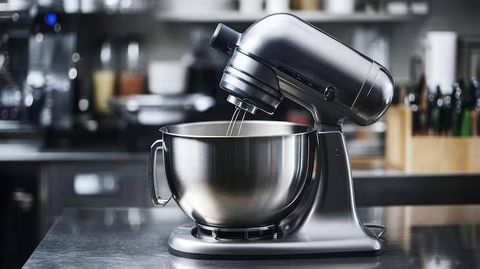
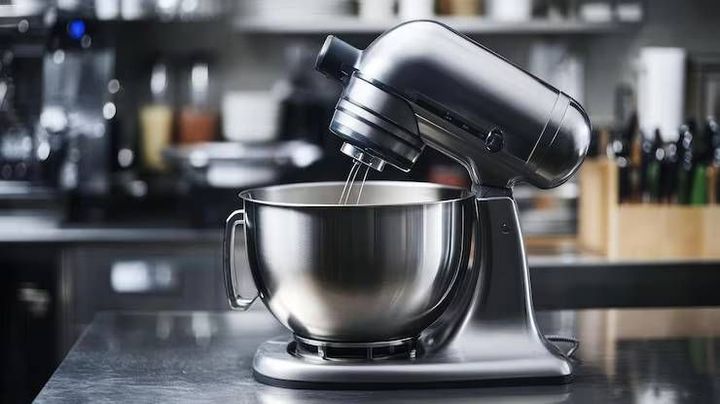
| Planetary mixer | Tool rotates while moving around the bowl | Cake batter, cream, dough, fillings |
| Spiral mixer | Spiral tool works dough within a bowl | Bread and pizza dough |
| Ribbon blender | Internal ribbons move dry materials | Flour blends, seasonings, powdered ingredients |
| Paddle mixer | Paddles fold or move ingredients | Salads, fillings, minced food mixtures |
| High-shear mixer | Fast-moving components create intense mixing | Sauces, emulsions, dispersions |
| Industrial tank agitator | Rotating impeller circulates liquid | Beverages, liquid sauces, dairy mixtures |
| Continuous mixer | Ingredients enter and leave during operation | Large-scale food production processes |
Equipment names can vary between manufacturers, and some machines support several mixing actions. The actual working mechanism, permitted ingredients, and operating range are more important than the name alone.
Recent Updates
Food mixing equipment has increasingly incorporated automation, digital monitoring, hygienic design, and energy-management features. Developments during 2024–2026 reflect wider changes in food manufacturing, including demand for repeatable production, better process records, reduced material waste, and more efficient use of equipment. The availability of individual features depends on the machine, manufacturer, and production environment.
Automation and Digital Process Monitoring
Some modern industrial mixers use programmable controls to manage mixing speed, operating time, temperature, and other process settings. Sensors can monitor selected operating conditions and help operators identify deviations from a defined production process.
Automated controls may also support repeatable recipes and production records. However, automation does not automatically ensure food quality or safety. Settings must be validated for the ingredients and process, and equipment still requires inspection, cleaning, and appropriate operator supervision.
Hygienic Design and Energy Management
Food equipment design increasingly considers cleanability, corrosion resistance, drainage, and access to surfaces that contact food. Stainless steel is commonly used for food-contact components because suitable grades can resist corrosion and tolerate many cleaning procedures. Material selection must still account for the ingredients, chemicals, temperature, and operating conditions involved.
Manufacturers also consider motor efficiency, variable-speed drives, and mixing-cycle optimization. These features may help control energy use, but actual performance depends on batch size, product thickness, machine design, and operating practices. There is no single improvement that applies equally to every food production process.
Flexible Production Requirements
Food manufacturers may need to process different recipes using the same equipment. Adjustable mixing speeds, interchangeable tools, and adaptable batch sizes can help accommodate changes in product requirements.
Nevertheless, changing recipes may require new mixing parameters, cleaning procedures, and checks for allergen cross-contact. A machine suitable for one product should not automatically be assumed suitable for every other ingredient or food mixture.
Laws or Policies
Food mixing machines used in India are affected by food safety requirements, machinery safety considerations, electrical standards, workplace rules, and applicable environmental regulations. The specific obligations depend on the equipment, its installation, the type of food being processed, and the scale of the operation.
Food Safety Requirements in India
The Food Safety and Standards Authority of India (FSSAI) establishes food safety requirements under the Food Safety and Standards Act, 2006, and associated regulations. Relevant provisions include requirements concerning sanitary and hygienic practices for food businesses and equipment used in food processing.
Food-contact surfaces should be suitable for their intended use, cleanable, and maintained in a condition that does not contaminate food. Food businesses must follow applicable licensing, registration, hygiene, and operating requirements based on their activities and regulatory classification.
Machinery Safety and Workplace Practices
Food processing equipment may also be subject to applicable electrical safety, industrial installation, occupational safety, and machinery-related requirements. Businesses should assess moving components, emergency stopping arrangements, electrical hazards, guarding, and safe cleaning procedures.
Operators should follow the equipment manufacturer's instructions and established workplace procedures. Machines should be isolated from their power source before maintenance or cleaning whenever required by the applicable safety procedure.
Hygiene, Allergens, and Records
Food producers must manage contamination risks relevant to their operations. This may include preventing cross-contact between allergens, separating raw and ready-to-eat ingredients, controlling cleaning chemicals, and maintaining suitable storage and handling practices.
Cleaning records, batch information, and maintenance logs can help document routine controls. Applicable legal obligations should be confirmed through current FSSAI regulations and relevant state or local authorities, since requirements may differ according to the operation.
Tools and Resources
Several technical resources can help food producers understand equipment specifications, mixing processes, and hygiene requirements before selecting a machine.
Equipment Specifications and Process Planning
Manufacturer manuals and technical data sheets typically describe bowl capacity, operating speed, motor rating, compatible mixing tools, material construction, cleaning procedures, and permitted operating conditions. These details help establish whether a machine is suitable for a particular recipe and production volume.
A batch-sizing spreadsheet can record ingredient quantities, expected output, mixing time, and production frequency. For example, a bakery can use a worksheet to compare daily dough requirements with the usable batch capacity of its mixer. Nominal bowl volume alone may not indicate the maximum workable quantity for a thick mixture.
Food Safety and Industry Resources
The following resources provide relevant technical or regulatory information:
FSSAI: Indian food safety regulations, licensing information, and hygiene guidance.
Bureau of Indian Standards (BIS): Relevant Indian standards for equipment, electrical safety, and other technical subjects.
Codex Alimentarius: International food hygiene principles and food safety guidance.
Manufacturer operating manuals: Machine-specific instructions for installation, operation, cleaning, and maintenance.
These resources address different aspects of food production. Applicable requirements should be checked against the exact machine and food-processing activity.
Equipment Selection Checklist
Before choosing food mixing equipment, operators can assess:
Ingredient type, viscosity, particle size, and sensitivity to heat.
Required batch capacity and expected production frequency.
Mixing action, speed range, and available attachments.
Food-contact materials and cleaning accessibility.
Electrical requirements, guarding, and operator safety.
Maintenance needs, spare parts, and technical documentation.
Compatibility with the intended recipe and production process.
A documented assessment can make equipment comparisons more consistent and help identify limitations before installation.
FAQs
What are food mixing machines used for?
Food mixing machines combine ingredients for products such as dough, batter, sauces, beverages, fillings, and seasoning blends. Their applications depend on the mixing action and the properties of the ingredients.
What are the main types of food mixing equipment?
Common types include planetary mixers, spiral mixers, ribbon blenders, paddle mixers, high-shear mixers, and tank agitators. Each is designed for particular materials and mixing requirements.
How do industrial food mixing machines differ from commercial mixers?
Industrial food mixing machines are generally designed for larger production volumes or integration into manufacturing processes. Commercial mixers often support smaller batches in bakeries, restaurants, and catering kitchens, although capacity varies by model.
Which factors matter when selecting a food mixing machine?
Important factors include ingredient characteristics, batch size, mixing speed, temperature control, hygiene, cleaning access, safety features, and production requirements. Compatibility with the intended recipe is essential.
What food safety rules apply to food mixing machines in India?
Food businesses must follow applicable FSSAI requirements and relevant hygiene practices. Depending on the installation and operation, electrical safety, workplace safety, and other technical rules may also apply.
Conclusion
Food mixing machines combine ingredients through methods such as agitation, kneading, whipping, dry mixing, and emulsifying. Equipment types vary according to ingredient characteristics, production capacity, hygiene requirements, and the desired texture of the finished mixture. Automation and improved process monitoring are influencing modern food manufacturing, while safe operation and effective cleaning remain essential. Equipment selection therefore depends on the specific recipe, production process, and applicable food safety requirements.