Electrolyzer Manufacturing Systems Guide With Hydrogen Production and Engineering Insights
Electrolyzer manufacturing systems are industrial production setups used to make electrolyzers, the equipment that separates water into hydrogen and oxygen using electricity. These systems combine precision manufacturing, electrical engineering, chemical processing, testing, quality control, and assembly.
An electrolyzer normally contains several important components, including electrodes, membranes or separators, bipolar plates, current collectors, seals, frames, electrical connections, and supporting structures. When electricity is applied, an electrochemical reaction takes place inside the electrolyzer, producing hydrogen at one electrode and oxygen at the other.
The basic concept of water electrolysis has existed for a long time, but modern electrolyzer manufacturing systems have developed considerably because of demand for larger production capacity, improved efficiency, automated assembly, and consistent product quality. Different technologies are used depending on the intended application, available electricity, operating conditions, and required hydrogen characteristics.
How electrolyzer manufacturing works
Electrolyzer manufacturing generally involves multiple stages rather than one machine or process. Materials are prepared, individual components are produced, components are assembled into cells, and cells can then be combined into larger stacks.
Typical manufacturing stages include:
- Material preparation for electrodes, membranes, plates, seals, and structural components
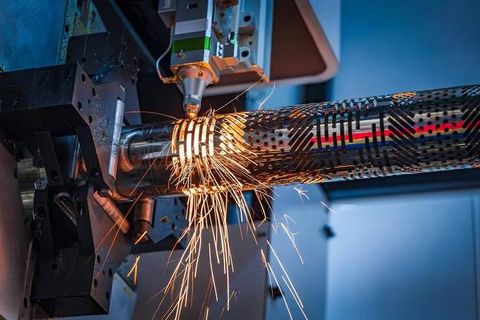
- Precision fabrication of individual parts
- Electrode and membrane preparation
- Cell assembly
- Stack assembly
- Electrical and mechanical connections
- Leak and pressure testing
- Performance testing
- Inspection and quality documentation
Automation can be integrated into several of these stages. Automated handling, robotic assembly, machine vision, dimensional inspection, and computerized testing can help manufacturers maintain consistency across large production volumes.
Major electrolyzer technologies
Electrolyzer manufacturing systems vary according to the technology being produced. Four major categories commonly discussed in hydrogen production are alkaline, proton exchange membrane, solid oxide, and anion exchange membrane systems.
| Technology | Main operating characteristic | Typical engineering focus |
|---|---|---|
| Alkaline | Uses an alkaline electrolyte | Large-scale operation and material durability |
| PEM | Uses a proton-conducting membrane | Compact design and dynamic operation |
| Solid oxide | Operates at elevated temperatures | Thermal management and high-temperature materials |
| AEM | Uses an anion-conducting membrane | Membrane development and system durability |
Each technology has different manufacturing requirements. Consequently, an electrolyzer manufacturing line cannot necessarily be transferred directly from one technology to another without changes to materials, assembly equipment, testing methods, and process controls.
Importance
Hydrogen production is relevant to several industrial sectors because hydrogen can be used as a chemical feedstock, an industrial reducing agent, and an energy carrier. Electrolyzers are particularly important when hydrogen is produced through water electrolysis using electricity.
The manufacturing side matters because electrolyzer performance depends not only on the underlying chemical reaction but also on the quality and consistency of the physical components. Small variations in membrane thickness, electrode structure, sealing, plate dimensions, or electrical connections can influence the behavior of an assembled system.
Who is affected
Electrolyzer manufacturing systems involve a wide range of industries and technical disciplines. Their development can influence:
- Hydrogen producers planning electrolysis facilities
- Equipment manufacturers developing electrolyzer stacks
- Component manufacturers producing membranes, plates, electrodes, and seals
- Engineering companies designing production facilities
- Researchers developing new electrochemical materials
- Industrial users evaluating hydrogen production technologies
- Energy planners studying electricity and hydrogen infrastructure
For the general public, the subject is relevant because hydrogen infrastructure can influence industrial energy systems, transportation technologies, chemical production, and long-term energy planning.
Why manufacturing scale matters
Producing a small number of electrolyzers for research is different from establishing a repeatable industrial manufacturing system. At larger production volumes, manufacturers need consistent component dimensions, controlled assembly pressure, reliable electrical connections, repeatable sealing, and automated inspection.
Manufacturing systems can therefore include production-line controls that monitor variables such as temperature, pressure, alignment, electrical resistance, torque, dimensions, and leakage. Data from these processes can be recorded to support quality analysis and traceability.
Engineering considerations
Several engineering factors influence electrolyzer manufacturing systems. Material compatibility is important because components can encounter water, gases, electrical current, pressure, heat, and chemical environments during operation.
Thermal management is another consideration. Some electrolyzer technologies operate at relatively low temperatures, while solid oxide systems operate at much higher temperatures. Manufacturing equipment must therefore accommodate the specific materials and processes associated with each technology.
Recent Updates
From 2024 through 2026, electrolyzer manufacturing has continued moving toward higher production capacity, greater automation, improved component integration, and more systematic testing. Industry development has increasingly focused on making manufacturing processes repeatable rather than relying primarily on manual assembly.
Automation and digital manufacturing
Modern electrolyzer manufacturing systems can incorporate robotic handling, machine vision, automated dispensing, precision alignment, and computerized process monitoring. Digital production records can connect component information with assembly and testing results.
Artificial intelligence and data analytics are also being explored for manufacturing inspection and predictive process analysis. These technologies can identify unusual production patterns, classify visual defects, and help engineers investigate variations in manufacturing quality.
Stack manufacturing development
The electrolyzer stack is one of the central assemblies in many hydrogen production systems. Manufacturing development has focused on improving repeatability in stack assembly, reducing variation between cells, and simplifying the integration of electrical, mechanical, and fluid connections.
Another trend is modular production. Modular manufacturing approaches can allow production systems to handle different stack configurations while using common equipment for selected manufacturing stages.
Materials and component development
Research continues into membranes, catalysts, electrodes, coatings, bipolar plates, and other components. Material development is important because component selection affects durability, electrical performance, thermal behavior, and manufacturing complexity.
Engineers are also examining ways to reduce reliance on scarce or expensive materials in certain electrolyzer designs. This area remains an active field of research, with results varying among different technologies and applications.
Laws or Policies
Electrolyzer manufacturing and hydrogen production are influenced by regulations covering industrial safety, electrical equipment, pressure systems, chemical handling, environmental protection, workplace conditions, and hydrogen storage. The exact requirements vary by country and by the intended application.
Manufacturing requirements
Industrial facilities may need to address requirements related to:
- Electrical safety and equipment protection
- Pressure-rated components and systems
- Hydrogen and oxygen handling
- Fire and explosion risk management
- Industrial emissions and environmental controls
- Worker protection and operating procedures
- Equipment inspection and documentation
Hydrogen has particular safety considerations because it is highly flammable and can form combustible mixtures with air. Production facilities therefore require appropriate ventilation, leak detection, equipment design, and risk-management procedures.
Hydrogen production policies
Many governments are developing hydrogen strategies, research programs, infrastructure plans, and industrial policies. These initiatives can influence electrolyzer manufacturing by supporting research, demonstration projects, infrastructure development, or domestic manufacturing capacity.
However, policy structures differ substantially between jurisdictions. Manufacturers and project developers generally need to evaluate the rules applicable to their specific facility, technology, hydrogen source, electricity source, and end use.
Tools and Resources
Understanding electrolyzer manufacturing systems can involve several technical and planning tools. These resources help engineers, researchers, manufacturers, and general readers examine different aspects of hydrogen production.
Engineering and design tools
Process simulation software can model hydrogen and oxygen flows, energy requirements, temperatures, pressures, and system behavior. Computer-aided design platforms are used for component geometry, stack structures, fixtures, production equipment, and facility layouts.
Electrochemical modeling tools can help analyze reactions, current density, voltage behavior, and other operating characteristics. Manufacturing execution systems can also record production information and connect manufacturing steps with inspection results.
Hydrogen production calculators
Hydrogen production calculators can estimate theoretical hydrogen output from electricity input and electrolyzer efficiency. A simplified relationship is:
Hydrogen output = Electricity input ÷ Specific electricity consumption
Actual production depends on system efficiency, operating conditions, auxiliary equipment, temperature, pressure, degradation, and other factors. Therefore, theoretical calculations should not be treated as direct measurements of a particular electrolyzer.
Testing and inspection resources
Common testing resources include pressure gauges, leak-testing equipment, electrical measurement instruments, thermal sensors, flow meters, dimensional inspection equipment, and automated machine-vision systems.
Technical standards databases, engineering manuals, manufacturer documentation, academic publications, and government energy resources can also provide background information about hydrogen production and electrolyzer technology.
FAQs
What are electrolyzer manufacturing systems?
Electrolyzer manufacturing systems are production environments used to manufacture and assemble electrolyzer components and stacks. They can include material preparation, precision fabrication, automated assembly, inspection, electrical testing, and performance testing.
How does an electrolyzer support hydrogen production?
An electrolyzer uses electricity to split water into hydrogen and oxygen through an electrochemical process. The hydrogen can then be collected, processed, compressed, stored, or directed toward an intended industrial application.
What technologies are used in electrolyzer manufacturing?
Common technologies include alkaline, PEM, solid oxide, and AEM electrolyzers. Each requires different materials, manufacturing processes, operating conditions, and engineering controls.
Why is automation important in electrolyzer manufacturing systems?
Automation can improve assembly consistency, component alignment, inspection, data collection, and process repeatability. It can also reduce dependence on manual handling for repetitive production stages.
What engineering factors affect hydrogen production?
Hydrogen production can be influenced by electricity consumption, electrolyzer efficiency, operating temperature, pressure, water quality, current density, component condition, and system balance. Manufacturing quality also influences how consistently an electrolyzer performs.
Conclusion
Electrolyzer manufacturing systems combine electrochemical technology with precision production, automation, testing, and engineering controls. Their development supports the expanding role of electrolysis in hydrogen production while addressing requirements for consistent components and scalable manufacturing. Recent developments have emphasized automation, digital monitoring, modular production, and material innovation. Regulations and technical requirements remain important because electrolyzers involve electricity, gases, pressure, chemical environments, and industrial equipment.