Paper Cup Forming Machines Basics With Production Methods and Packaging Technology
Paper cup forming machines are industrial systems used to manufacture paper cups for hot and cold beverages. These machines transform pre-cut paper blanks into finished containers through a sequence of forming, sealing, bottom attachment, rim curling, and inspection processes.
They are commonly used in packaging facilities that supply cups to beverage manufacturers, restaurants, cafeterias, vending operations, and food packaging distributors.
The development of paper cup forming technology is closely connected to the expansion of disposable food packaging. As takeaway beverages became more common, manufacturers needed equipment capable of producing cups with consistent dimensions, stable seams, and suitable liquid resistance. Modern machinery combines mechanical movement, temperature control, automated feeding, and electronic monitoring to manage these requirements.
What Is a Paper Cup Forming Machine?
A paper cup forming machine is equipment designed to convert prepared paper components into usable cups. The main components typically include a paper feeding mechanism, cup-body forming unit, side-seam sealing system, bottom insertion mechanism, bottom sealing station, rim curling unit, and finished-cup collection system.
The exact arrangement depends on the machine design and the intended cup size. Some systems produce small cups for tasting beverages, while others manufacture larger containers for takeaway drinks. Machines may operate with different levels of automation according to production volume, product specifications, and factory requirements.
How Paper Cup Production Works
The production process begins with paperboard that has been selected and prepared for food packaging applications. Printed and coated paper is generally converted into cup-body blanks, while separate circular pieces are prepared for the cup bottoms.
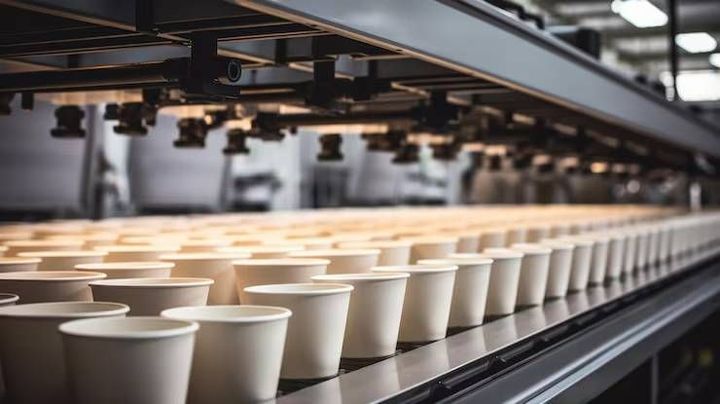
The machine forms each blank into a cylindrical or slightly tapered shape. It then joins the side seam, inserts the bottom disc, seals the bottom edge, and curls the upper rim. Finished cups are collected for inspection and packaging.
The paper used in this process must have suitable stiffness, foldability, and resistance to liquid penetration. Material properties influence how easily the paper forms, how well the seams hold, and whether the finished container maintains its shape during use.
Importance
Paper cup forming machines play an important role in food packaging because they connect material preparation with large-scale container manufacturing. Their operation affects production consistency, material use, packaging quality, and the amount of manual handling required during manufacturing.
Applications Across Different Industries
Paper cups are used in several everyday environments. Coffee shops and tea outlets use them for takeaway beverages, while offices, educational facilities, transport locations, and event venues may use them for drinking water and refreshments.
Food packaging manufacturers also produce cups for vending systems, quick-service restaurants, and beverage distribution networks. Depending on the design, paper cups can accommodate hot drinks, chilled beverages, or other suitable food applications.
Production Efficiency and Quality Control
Automated paper cup manufacturing can coordinate several operations within one production line. This reduces the need to transfer each partially formed cup between separate workstations and helps maintain a consistent manufacturing sequence.
However, production efficiency depends on more than machine speed. Material quality, operator training, equipment maintenance, temperature settings, and inspection procedures all influence the number of acceptable cups produced during a production run.
Important quality checks include:
Side-seam integrity and visible adhesive defects.
Bottom sealing and resistance to leakage.
Rim shape, smoothness, and structural stability.
Cup dimensions, capacity, and overall appearance.
Correct material handling and cleanliness during production.
Common Production Challenges
Paper cup manufacturers may encounter problems such as incomplete sealing, uneven bottom attachment, distorted rims, paper misalignment, or inconsistent cup dimensions. These issues can result from unsuitable paper properties, incorrect machine settings, worn components, or inconsistent feeding.
Preventive maintenance and routine inspection help identify problems before they affect large quantities of finished products. Monitoring rejected cups and recording production interruptions also helps manufacturers identify recurring faults.
Recent Updates
Paper cup forming technology continues to develop through automation, electronic monitoring, improved material handling, and changing packaging requirements. Recent industry trends emphasize process consistency, resource efficiency, and compatibility with different paper-based packaging materials.
Automation and Intelligent Monitoring
Modern equipment may include programmable controls, touchscreen interfaces, automatic lubrication systems, sensor-based fault detection, and production counters. These features allow operators to monitor operating conditions and identify interruptions without relying entirely on manual observation.
Some systems also provide alarms when paper feeding, temperature, or cup collection moves outside defined operating conditions. The available functions vary by machine model, so the presence of advanced monitoring should not be assumed for every installation.
Developments in Paper and Barrier Coatings
Paper cups commonly use a barrier layer to reduce liquid penetration. Depending on the intended application, this layer may consist of a polymer coating, an aqueous barrier formulation, or another suitable material.
Manufacturers are increasingly examining alternative barrier technologies and paper structures that may improve compatibility with particular recycling or recovery systems. However, a paper-based appearance does not automatically mean a cup is recyclable in every location. Actual recovery depends on the material composition, local infrastructure, and applicable waste-management requirements.
Energy and Material Efficiency
Manufacturing facilities are also examining ways to reduce unnecessary material use, compressed-air consumption, heating demand, and production waste. Accurate paper feeding, controlled sealing temperatures, and consistent cutting dimensions can help limit avoidable rejects.
The following table summarizes common machine configurations and their general characteristics.
Machine configuration | Main characteristics | Typical application |
|---|---|---|
Semi-automatic | Requires more operator involvement in selected stages | Smaller production operations |
Automatic | Coordinates several forming and sealing stages | Routine commercial production |
High-speed automatic | Designed for rapid, continuous production | Large manufacturing facilities |
Multi-size configuration | Supports selected cup sizes through adjustments or component changes | Facilities producing varied cup formats |
Actual output depends on cup dimensions, material specifications, operating conditions, and the manufacturer's rated production capacity.
Laws or Policies
Paper cup production is influenced by food-contact material requirements, packaging regulations, workplace safety rules, environmental policies, and waste-management systems. The exact requirements depend on the country where the cups are manufactured, distributed, and used.
Food-Contact Packaging Requirements
Materials intended to contact beverages must comply with the relevant food-contact requirements in the target market. These rules may address material composition, chemical migration, hygiene, labeling, and suitability for the intended temperature or type of beverage.
Manufacturers should maintain documentation identifying the paperboard, coatings, adhesives, inks, and other components used in their products. The finished cup must be evaluated as a complete packaging structure rather than judging suitability from the paper alone.
Environmental and Packaging Policies
Environmental policies increasingly address single-use packaging, waste separation, recycling, and restrictions on particular materials. Paper cups can contain coatings or other components that affect how they are collected and processed after use.
In India, businesses involved in paper cup manufacturing and packaging should examine applicable food-contact requirements, including relevant Food Safety and Standards Authority of India provisions, as well as applicable environmental and waste-management rules. Requirements can differ according to the material composition, manufacturing activity, and product distribution arrangements.
Workplace Safety and Machine Operation
Paper cup forming equipment contains moving mechanisms, heated sealing components, electrical systems, and sometimes pneumatic equipment. Appropriate machine guarding, emergency stops, electrical protection, operator training, and maintenance procedures help reduce workplace risks.
Production facilities should follow the applicable machinery safety and occupational safety requirements in their jurisdiction. Operators should not bypass protective devices or adjust moving equipment while it is running unless a specifically approved safe procedure permits the activity.
Tools and Resources
Selecting, operating, and maintaining a paper cup forming machine involves several practical tools and reference materials. These help production teams understand equipment capabilities, plan material requirements, and monitor product quality.
Production Planning Tools
A production calculator can estimate theoretical output using the machine's rated cups-per-minute figure and planned operating hours. For example, a machine rated at 60 cups per minute has a theoretical output of 3,600 cups per hour before accounting for interruptions, rejects, setup, and maintenance.
A more realistic estimate can be calculated using:
Usable production = Rated hourly output × Operating hours × Effective production rate
If a machine produces 3,600 cups per hour, operates for seven hours, and achieves an effective production rate of 85%, its estimated usable output is 21,420 cups.
This calculation is a planning estimate, not a guarantee of actual output. Real production depends on operating conditions and product specifications.
Quality and Maintenance Resources
Useful resources include equipment operation manuals, maintenance schedules, inspection checklists, material specification sheets, and production records. These documents help operators understand machine settings and maintain consistent procedures between shifts.
A basic inspection checklist can cover the following points:
Confirm that paper rolls, blanks, and bottom discs meet production specifications.
Inspect forming tools, sealing surfaces, sensors, and moving components.
Verify temperature and pressure settings against approved operating instructions.
Examine sample cups for leaks, dimensional variation, and seam defects.
Record production quantities, rejected units, downtime, and maintenance activity.
Packaging and Material Evaluation
Packaging evaluation tools help compare paperboard thickness, barrier performance, cup dimensions, and packaging requirements. Manufacturers may also use sample testing, leak testing, dimensional gauges, and material documentation to verify that the finished cup meets its intended use.
When assessing a machine, relevant technical details include supported cup diameters, cup heights, production capacity, electrical requirements, changeover procedures, compatible paper materials, and available safety features. These specifications provide a clearer basis for comparing different equipment configurations.
FAQs
What Is a Paper Cup Forming Machine Used For?
A paper cup forming machine converts prepared paper blanks and bottom discs into finished cups. It forms the cup body, seals the side seam and bottom, shapes the rim, and collects the completed containers for inspection and packaging.
How Does an Automatic Paper Cup Forming Machine Work?
An automatic paper cup forming machine feeds prepared paper components into a sequence of forming and sealing stations. The machine joins the cup body, attaches the bottom, seals the lower edge, curls the rim, and transfers the finished cups to a collection area.
Which Materials Are Used in Paper Cup Manufacturing?
Paper cup manufacturing generally uses paperboard, a suitable liquid barrier, and materials for joining or sealing the cup structure. The precise composition depends on the intended beverage, temperature range, food-contact requirements, and applicable packaging standards.
What Factors Affect Paper Cup Machine Production Capacity?
Production capacity depends on machine design, rated operating speed, cup size, material characteristics, changeover requirements, maintenance condition, and the frequency of interruptions. The usable output is usually lower than the theoretical maximum because quality checks and production downtime must also be considered.
How Is Packaging Technology Changing Paper Cup Manufacturing?
Packaging technology is developing through improved process monitoring, more precise material feeding, alternative barrier coatings, and better control of production waste. These changes aim to support consistent cup quality and address changing packaging requirements, although the suitability of each technology depends on its application.
Conclusion
Paper cup forming machines combine paper feeding, shaping, sealing, rim finishing, and collection into a coordinated manufacturing process. Their performance depends on equipment configuration, material properties, maintenance, and quality control. Developments in automation and barrier materials are influencing how manufacturers approach production efficiency and packaging design. Understanding these fundamentals provides a useful basis for evaluating paper cup manufacturing methods and the technology used to produce consistent containers.