Confectionery Enrobing Lines Guide With Automated Chocolate Coating and Industrial Processing Solutions
Confectionery enrobing lines are industrial production systems used to cover biscuits, wafers, bars, cookies, cakes, nuts, centers, and other confectionery products with chocolate or another coating material.
An automated chocolate coating line connects several stages, including product feeding, coating, vibration, cooling, inspection, and discharge. These systems are part of modern confectionery processing where consistent coating and controlled product movement are important.
Chocolate enrobing developed from simpler manual dipping and coating methods. In manual production, individual pieces were placed into melted chocolate and then removed for cooling. Industrial processing introduced conveyors, coating curtains, pumps, cooling tunnels, and temperature controls that allowed larger quantities of products to move through a continuous production process.
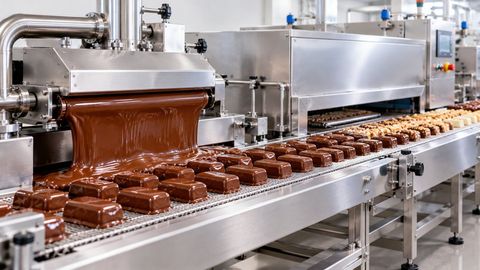
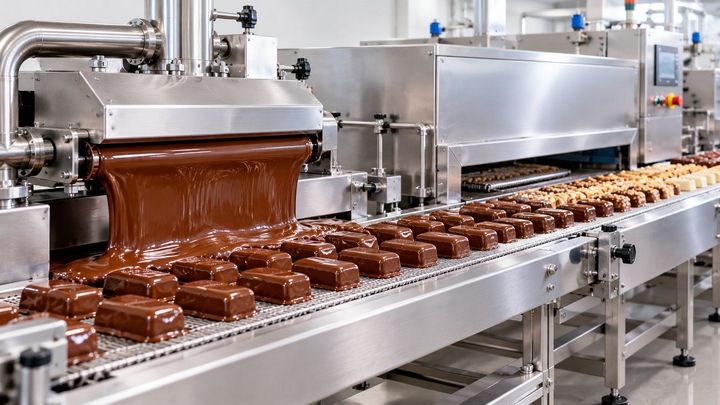
A confectionery enrobing line normally starts with products entering on a conveyor. The products pass beneath a controlled curtain of liquid chocolate or another coating material. The coating can cover the top, bottom, or entire surface depending on the equipment arrangement and product design.
After coating, excess material is removed through vibration or controlled airflow. The coated products then enter a cooling tunnel where the coating gradually sets. Additional equipment can perform decoration, bottom coating, product inspection, transfer, and packaging.
Main Components of an Enrobing Line
A complete confectionery enrobing system can contain several connected components:
Product infeed conveyor for controlled product movement
Chocolate melting and holding equipment
Tempering equipment for controlled chocolate properties
Pumping systems for circulating coating material
Enrobing curtain for applying the coating
Bottom-coating mechanism where required
Vibrating section for removing excess coating
Decorating equipment for additional patterns
Cooling tunnel for setting the coating
Sensors for monitoring process conditions
Control panels for coordinating production stages
Discharge conveyors for transfer to packaging
The exact configuration depends on product dimensions, coating thickness, chocolate type, production capacity, cooling requirements, and packaging arrangements.
How Automated Chocolate Coating Works
An automated chocolate coating process begins with the preparation of the coating material. Chocolate is melted and maintained within a controlled temperature range suitable for the specific formulation and process.
Products are then transferred through the enrobing section. A continuous curtain of chocolate flows over the product while the conveyor maintains a controlled movement speed. The coating system may allow adjustments to the amount of chocolate deposited on different surfaces.
Excess chocolate falls back into the circulation system where appropriate. Vibration or airflow can help remove excess coating and create a more controlled surface. The product then enters the cooling tunnel, where temperature and airflow are managed to allow the coating to solidify.
Importance
Confectionery enrobing lines matter because coating is a repeated stage in many chocolate and confectionery production processes. Manual dipping can become difficult to coordinate when large numbers of products must pass through several stages in a controlled sequence.
Automated chocolate coating allows product movement, coating application, cooling, and monitoring to be connected within one production arrangement. This can also help reduce interruptions between processing stages and create a defined production flow.
Product Consistency and Process Control
Chocolate coating is affected by temperature, viscosity, flow rate, conveyor speed, product temperature, and cooling conditions. Small changes in these factors can influence coating thickness, surface appearance, setting behavior, and product handling.
For this reason, industrial enrobing systems commonly include temperature sensors, pumps, adjustable conveyors, cooling controls, and monitoring equipment. Operators can use these controls to maintain defined process conditions.
Consistency does not mean that every product will have exactly the same coating under every circumstance. Ingredient formulation, ambient conditions, equipment settings, and product geometry can all affect the process.
Industries and Products
Confectionery enrobing equipment can be used for many products, including:
Chocolate-coated biscuits
Wafer products
Cereal and snack bars
Cookies
Cakes and pastries
Nuts and nut-based centers
Filled confectionery pieces
Fruit-based centers
Caramel-based products
Composite chocolate products
The appropriate equipment depends on the shape, size, surface characteristics, temperature sensitivity, and handling requirements of each product.
Production Flow
A typical industrial chocolate coating process may follow this sequence:
Product preparation
Product feeding
Bottom coating where required
Main chocolate enrobing
Vibration and excess-coating removal
Decoration or additional coating
Cooling
Inspection
Product transfer
Packaging
The layout of the production line needs to provide adequate space for conveyors, cooling equipment, cleaning access, inspection areas, electrical systems, and maintenance activities.
Recent Updates
From 2024 through 2026, confectionery processing has continued to incorporate greater automation, digital monitoring, flexible production arrangements, improved temperature management, and more integrated control systems. The general direction is toward connecting individual machines into coordinated production lines.
Automated Temperature Control
Temperature management remains central to chocolate enrobing. Modern equipment can use multiple sensors and control systems to monitor chocolate temperature at different points in the process.
Tempering systems can regulate heating and cooling stages to establish the physical properties required for the chocolate formulation. Automated controls can also adjust heating elements, pumps, and other components according to configured parameters.
Flexible Enrobing Systems
Confectionery manufacturers may process products with different shapes, dimensions, coating thicknesses, and formulations. Equipment is therefore increasingly designed around adjustable conveyors, interchangeable components, programmable settings, and flexible coating arrangements.
Recipe-based controls can store defined operating parameters for different products. When properly configured, this can reduce the amount of manual adjustment required when production changes between established product formats.
Cooling Tunnel Development
Cooling tunnels are an important part of industrial chocolate coating. They control the environment through which freshly coated products travel while the coating changes from a liquid or semi-liquid state to a stable solid surface.
Modern cooling systems can incorporate multiple temperature zones, controlled airflow, insulation, sensors, and automated monitoring. These features allow different parts of the cooling process to be managed separately.
Digital Monitoring
Connected production equipment can collect information about temperatures, conveyor speeds, machine status, alarms, production counts, and other operating conditions.
Digital dashboards can make this information available to operators and maintenance teams. Data records may also support process analysis and equipment maintenance planning.
Hygienic Equipment Design
Food-processing equipment increasingly emphasizes cleanable surfaces, accessible components, controlled drainage, and reduced areas where food material can accumulate. Equipment design must consider the cleaning procedures used by the facility and the characteristics of the processed ingredients.
Hygienic design is particularly important around chocolate circulation systems, conveyors, pumps, cooling tunnels, and product-contact components.
Laws or Policies
Confectionery enrobing lines are affected by food safety, hygiene, machinery safety, worker protection, electrical, environmental, and packaging requirements. The specific rules depend on the country, product category, facility activities, and ingredients used.
Food Safety Requirements
Food-processing facilities generally need systems for controlling contamination, maintaining hygienic conditions, monitoring production processes, and documenting relevant procedures. Hazard Analysis and Critical Control Point, commonly called HACCP, is widely used as a framework for identifying and controlling food safety hazards.
Good Manufacturing Practices can also influence equipment layout, cleaning procedures, personnel practices, ingredient handling, storage, and production controls.
For chocolate and confectionery production, facilities may need to manage allergen-related risks when products contain ingredients such as nuts, milk, soy, or other regulated allergens. Segregation, cleaning procedures, labeling controls, and production records can form part of an allergen-management program.
Machinery Safety
Enrobing lines contain conveyors, pumps, motors, heated surfaces, cooling systems, and moving mechanical components. Safety measures can include machine guarding, emergency-stop controls, access protection, electrical safeguards, and appropriate operating procedures.
Maintenance can require isolation of electrical, mechanical, thermal, or other forms of stored energy. The exact procedures depend on the equipment and applicable workplace regulations.
Packaging and Labeling
Finished confectionery products may be subject to rules concerning ingredient declarations, allergen information, net quantity, date marking, packaging materials, and other labeling requirements.
The applicable requirements vary by jurisdiction and product category. Facilities need to establish labeling procedures that correspond with the regulations governing their products.
Tools and Resources
Planning a confectionery enrobing line involves technical information about products, chocolate formulations, conveyors, cooling requirements, utilities, hygiene, and packaging. Equipment specification sheets can provide information about dimensions, conveyor speeds, electrical requirements, cooling capacity, temperature ranges, and product compatibility.
Production-flow diagrams can show how products move from preparation through enrobing and cooling. Facility-layout software can help visualize equipment placement, access paths, maintenance areas, and connections between production stages.
Useful planning resources include:
Enrobing equipment specification sheets
Chocolate tempering records
Temperature monitoring systems
Conveyor-speed calculations
Cooling-load calculations
Production-flow diagrams
Cleaning schedules
HACCP documentation templates
Allergen-control checklists
Preventive maintenance schedules
Equipment inspection records
Production monitoring dashboards
A simplified comparison of major enrobing components is shown below:
| Equipment Component | Main Function | Important Planning Factor |
|---|---|---|
| Tempering Unit | Controls chocolate properties | Temperature management |
| Enrober | Applies coating | Product dimensions |
| Vibration Section | Removes excess coating | Coating thickness |
| Decorating Unit | Adds surface patterns | Decoration material |
| Cooling Tunnel | Sets the coating | Temperature and airflow |
| Conveyor | Moves products | Speed and product spacing |
| Control System | Coordinates equipment | Automation architecture |
| Inspection System | Checks selected product characteristics | Camera and sensor setup |
Digital production systems can also connect equipment information with batch records, maintenance data, and production schedules. When several machines operate together, communication protocols and control architecture need to be considered during system planning.
FAQs
What are confectionery enrobing lines?
Confectionery enrobing lines are industrial production systems that coat biscuits, wafers, bars, cookies, nuts, cakes, and other products with chocolate or another coating material. They can combine feeding, coating, vibration, cooling, inspection, and discharge equipment.
How does automated chocolate coating work?
Automated chocolate coating generally moves products through a controlled chocolate curtain while pumps, conveyors, temperature systems, and sensors coordinate the process. Excess coating can be removed before products enter a cooling tunnel.
What products can confectionery enrobing lines process?
Enrobing lines can be configured for products such as biscuits, wafers, snack bars, cookies, cakes, nuts, filled centers, and other confectionery products. Equipment configuration depends on product dimensions, shape, surface characteristics, and coating requirements.
Why is chocolate tempering important in an enrobing line?
Tempering controls the physical characteristics of chocolate before and during coating. Appropriate temperature control can influence coating structure, surface appearance, setting behavior, and handling characteristics.
What factors affect confectionery enrobing line design?
Important factors include product dimensions, coating material, coating thickness, conveyor speed, chocolate temperature, cooling requirements, production volume, cleaning procedures, facility layout, packaging integration, and applicable food safety requirements.
Conclusion
Confectionery enrobing lines combine product conveyors, chocolate preparation, coating equipment, vibration, cooling tunnels, sensors, and automated controls into an integrated production process. Automated chocolate coating depends on controlled temperature, material flow, coating application, and cooling conditions. Recent developments include flexible production controls, digital monitoring, improved cooling management, and hygienic equipment design. Food safety, machinery protection, allergen management, labeling requirements, and facility planning remain important considerations for industrial confectionery processing.