AI Content Creation Explained: Types, Tools, Uses, Benefits and Key Considerations
AI content creation refers to using artificial intelligence to help produce written, visual, audio, or video material. Instead of creating every part manually, a person can provide instructions, references, data, or a basic idea and use an AI system to generate or transform content.
Context
AI content creation exists because digital content production often involves several repetitive or time-consuming activities. Writing drafts, creating images, preparing video scenes, producing voice narration, summarizing information, and editing material can each require different skills. Generative AI brings several of these activities into a connected workflow.
The technology does not work in exactly the same way for every type of content. A text-generation system processes language, while an image model interprets visual instructions. Video systems can combine information about objects, movement, environments, and visual style to produce sequences.
How AI content creation works
Most generative AI systems begin with an input. This can be a written prompt, an uploaded image, an audio recording, a document, or existing video. The system processes the input using a trained model and produces an output based on patterns learned during development.
The result may then require human editing. AI can produce incorrect facts, unsuitable wording, distorted objects, inconsistent characters, or other errors. Human review is therefore an important part of creating reliable content.
A general AI content creation workflow can include:
- Planning: defining the subject, audience, purpose, and format.
- Input preparation: creating a prompt, outline, reference image, or source material.
- Generation: producing an initial version with an AI system.
- Editing: correcting errors and adjusting structure, visuals, sound, or language.
- Verification: checking facts, sources, permissions, and context.
- Final preparation: formatting the content for its intended platform or audience.
Importance
AI content creation matters because digital media has become part of everyday communication. People use written articles, images, videos, audio, presentations, and other formats to learn, explain ideas, document experiences, and communicate with different audiences.
The technology can reduce some repetitive production tasks and help people experiment with formats that may otherwise require several separate stages. However, the ability to generate content quickly does not automatically make the material accurate, useful, or appropriate.
AI content creation is therefore most useful when generation is combined with planning and human judgment. A person still needs to decide what information should be included, whether a claim is accurate, which sources are reliable, and whether the final material communicates the intended meaning.
Types of AI content creation
AI content can be divided into several broad categories. Each type uses different inputs and produces different forms of material.
| Content type | Common AI task | Typical output |
|---|---|---|
| Text | Drafting, rewriting, summarizing | Articles, descriptions, scripts |
| Images | Generating or modifying visuals | Illustrations, concepts, graphics |
| Video | Creating or transforming scenes | Short clips, demonstrations |
| Audio | Voice generation and editing | Narration, dialogue, sound |
| Presentations | Organizing information visually | Slides and visual summaries |
| Translation | Converting language between languages | Translated text or captions |
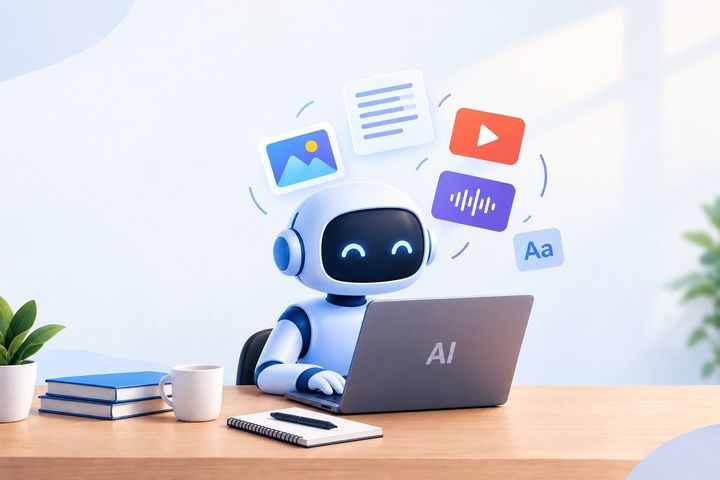
These categories can also be combined. For example, a person may use AI to create a written script, generate visual references, produce narration, and assemble the material into a video.
Common uses of AI content creation
AI-generated material is used across education, communication, entertainment, research, marketing, design, and personal projects. Examples include:
- Creating initial article outlines
- Developing visual concepts
- Producing educational illustrations
- Generating video scenes from descriptions
- Preparing captions and transcripts
- Translating or adapting text
- Summarizing lengthy documents
- Creating presentation drafts
- Producing synthetic narration
- Editing or transforming existing media
The appropriate use depends on the purpose and the level of accuracy required. Content involving important factual, legal, financial, scientific, or personal matters generally requires careful human verification.
Recent Updates
AI content creation has changed considerably during 2024–2026. Generative systems have expanded from producing relatively simple text and images toward multimodal workflows that can work with combinations of text, images, audio, and video.
Video generation is one example of this development. OpenAI's Sora research described a system capable of accepting text, image, and video inputs and generating video outputs. Later developments in video generation added greater control over movement and synchronized audio capabilities.
Another noticeable trend is greater attention to content provenance. Provenance systems can attach information to digital media describing how it was created or modified. The C2PA standard is one approach designed to provide machine-readable information about the origin and editing history of supported content.
Multimodal AI
Modern AI systems increasingly combine several types of information rather than treating text, images, audio, and video as completely separate categories. This allows a single workflow to begin with a written concept, use an image as a visual reference, generate movement, and add spoken audio.
This development can make content production more interconnected, but it also introduces additional opportunities for errors. When multiple generated elements are combined, inconsistencies can appear between the script, visuals, narration, and captions.
Greater focus on transparency
As generated media becomes more realistic, identifying AI-created or AI-modified material has become an important area of technology development and regulation. The European Union's AI Act transparency rules began applying in 2026, including requirements concerning certain AI-generated or manipulated content and deepfakes.
The European Commission's Code of Practice on Transparency of AI-Generated Content also addresses marking and labelling approaches for generated or manipulated text, images, audio, and video.
These developments reflect a wider shift from simply generating content toward documenting and communicating how digital content was produced.
Laws or Policies
AI content creation is influenced by different laws, platform rules, intellectual property frameworks, privacy requirements, and emerging AI regulations. The exact obligations depend on where content is created or distributed, what the content contains, and how it is used.
A major recent regulatory development is the European Union AI Act. Its transparency provisions include requirements relating to certain AI-generated or manipulated content. From August 2026, applicable organizations must follow transparency obligations concerning areas such as deepfakes and certain AI-generated public-interest text.
The rules also address machine-readable marking for certain AI-generated or manipulated material. A limited transition period applies to some AI systems that were already placed on the market before the relevant requirements began applying.
Copyright and personal likeness
Copyright is another important consideration. AI-generated material may involve training data, reference material, existing artwork, music, photographs, recordings, or other protected material. The legal treatment of AI-generated works differs between jurisdictions and continues to develop.
Personal likeness and voice also require attention. Creating realistic material that depicts or imitates a real person can create privacy, impersonation, publicity, or other legal concerns depending on the circumstances.
Transparency and disclosure
Creators should understand whether a platform or jurisdiction requires disclosure when AI is used. Disclosure requirements can vary according to the type of content and how realistic or potentially misleading it may appear.
Provenance technologies can support transparency by recording information about the origin and modification history of digital media. However, provenance metadata should not be treated as proof that every factual claim contained in the media is accurate.
Tools and Resources
AI content creation involves several categories of tools. Text systems can assist with brainstorming, outlining, drafting, summarizing, and language adaptation. Image systems can generate or modify visual material from written descriptions or reference images.
Video-generation systems can create or transform visual sequences, while editing applications can arrange clips, adjust timing, add captions, and combine different media. Audio tools can assist with transcription, narration, voice editing, and sound production.
Research resources are equally important. Official government websites, academic publications, technical documentation, libraries, and established reference sources can help verify information before it becomes part of AI-generated content.
Content provenance resources are also becoming more relevant. C2PA provides technical specifications for recording and verifying provenance information associated with digital media. This can help communicate how supported content was created or modified.
A simple review checklist can help identify common problems:
- Accuracy: Are factual statements supported by reliable sources?
- Originality: Does the material improperly reproduce protected content?
- Consistency: Do characters, objects, voices, and locations remain coherent?
- Privacy: Does the content reveal or imitate personal information without appropriate authorization?
- Transparency: Is AI involvement disclosed when applicable?
- Context: Could an edited or generated scene be mistaken for authentic footage?
- Quality: Are captions, narration, images, and transitions understandable?
FAQs
What is AI content creation?
AI content creation is the use of artificial intelligence to generate or modify text, images, video, audio, presentations, and other digital material. A person usually provides instructions or source material that guides the generation process.
What are the main types of AI content creation?
The main types include AI-generated text, images, video, audio, presentations, translations, and editing. Several types can also be combined within one content workflow.
What are AI content creation tools used for?
AI content creation tools can assist with brainstorming, writing, image generation, video production, narration, transcription, translation, editing, and summarization. Their capabilities vary between systems.
What are the benefits of AI content creation?
Potential benefits include faster drafting, easier experimentation with different formats, assistance with repetitive tasks, and the ability to transform one type of content into another. These benefits depend on the quality of the AI system and the amount of human review involved.
What should be considered when using AI content creation?
Important considerations include factual accuracy, copyright, privacy, personal likeness, transparency, platform rules, and the possibility of misleading audiences. AI-generated material should be reviewed before it is treated as reliable information or presented as authentic media.
Conclusion
AI content creation uses artificial intelligence to generate, transform, and organize different forms of digital material, including text, images, audio, and video. Its development has moved toward multimodal systems, greater creative control, and technologies that document the origin of digital content. At the same time, copyright, privacy, accuracy, transparency, and AI regulation remain important considerations. Human planning and review continue to play an important role in determining whether generated content is appropriate and reliable.