A Complete Guide to Rope Braiding From Machine Types to Finished Product
Rope braiding is a manufacturing process in which multiple strands of yarn, fibre, or wire are interlaced to create a flexible, structured product. The process is used to manufacture ropes and cords for applications such as marine equipment, outdoor products, industrial handling, sports equipment, and general-purpose fastening.
Context
Traditional rope making involved manually twisting or laying fibres together. As manufacturing developed, mechanical systems made it possible to produce more consistent rope structures at higher production rates. Rope braiding machines introduced a different method by moving yarn carriers along defined paths so that strands cross over and under one another.
The finished rope depends on several factors, including the raw material, strand arrangement, braiding pattern, machine configuration, and finishing method. Some ropes are made entirely from braided strands, while others use a braided outer layer around a separate core.
How rope braiding works
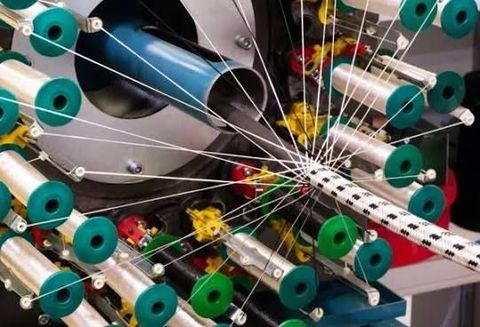
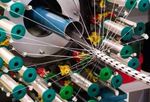
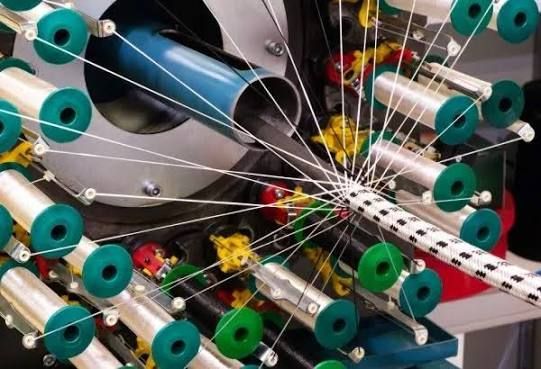
A rope braiding machine holds multiple yarn packages in carriers that travel along a programmed mechanical path. As the carriers move, their strands cross in a repeating pattern and form a continuous braided structure.
The strands are brought together at a central braiding point, where the developing rope is pulled forward at a controlled rate. The relationship between carrier movement, yarn tension, and take-up speed influences the tightness, diameter, flexibility, and appearance of the finished product.
Braided rope differs from twisted rope because its strands follow crossing paths rather than forming only a spiral arrangement. The resulting structure can distribute loads across multiple strands, although its actual strength depends on materials, construction, and manufacturing quality.
Importance
Rope braiding plays a role in industries where flexibility, tensile performance, abrasion resistance, and consistent dimensions are important. The process can produce thin cords for general use as well as larger braided ropes for demanding applications.
Manufacturers use different braiding structures to address different requirements. A rope intended for decorative purposes may prioritize appearance and flexibility, while a rope used for lifting or marine applications requires carefully controlled material properties and documented performance.
Common applications of braided rope
Braided rope is used across a range of sectors:
Marine applications, including lines and general-purpose boat ropes.
Outdoor equipment, including tent cords, utility lines, and camping accessories.
Industrial applications, including pulling lines and equipment cords.
Sports and recreation, including selected fitness and climbing-related products designed for their intended loads.
Textile products, including drawcords, decorative cords, and braided trims.
Electrical and technical applications, including protective braided sleeves made from suitable fibres.
Not every braided rope is suitable for every application. Products intended for climbing, lifting, fall protection, or other safety-critical activities require appropriate design, testing, labeling, and use within their stated limits.
Factors that influence rope quality
The characteristics of a finished rope depend on the relationship between material selection and process control. Important factors include fibre strength, yarn uniformity, carrier tension, braid angle, strand count, core design, and the consistency of the take-up system.
Excessive or uneven tension can affect the structure, while unsuitable material selection may result in poor abrasion resistance, limited flexibility, or reduced resistance to environmental exposure. Inspection throughout production helps identify irregularities before the rope reaches its intended application.
Recent Updates
Rope braiding machinery continues to develop through improvements in automation, process monitoring, material handling, and production control. Rather than representing a single recent invention, these developments reflect a broader movement toward more repeatable manufacturing and better traceability of production conditions.
Modern machines may include electronic speed control, automated take-up systems, sensors for detecting yarn breakage, and monitoring functions that help operators identify interruptions. Computer-controlled equipment can also simplify adjustments between different braid patterns and product dimensions, depending on the machine design.
Automation and production monitoring
Automation can reduce the amount of routine manual adjustment required during production. For example, sensors may detect a broken strand or an abnormal operating condition and alert the operator. Automated winding and take-up systems can also help maintain a consistent collection process.
However, automation does not remove the need for inspection and maintenance. Sensor performance, machine calibration, yarn quality, and operator setup continue to influence the finished product.
Material developments
Braided ropes may use natural fibres, synthetic fibres, or combinations of materials, depending on their intended function. Manufacturers continue to evaluate fibres with different strength-to-weight ratios, flexibility, abrasion resistance, and resistance to moisture or ultraviolet exposure.
Recycled or lower-impact materials are also part of wider textile-manufacturing research. Their suitability depends on fibre consistency, traceability, processing characteristics, and the performance requirements of the finished rope. Environmental claims require appropriate evidence rather than assumptions based only on the source material.
Digital process control
Some manufacturing systems use digital records to track machine settings, production batches, material inputs, and inspection results. Such records can help identify the conditions associated with a particular production run and support investigations when a defect occurs.
The availability of these functions varies by machine model and production facility. A machine with digital controls does not automatically produce a more reliable rope unless its process settings and output are properly evaluated.
Laws or Policies
Rope braiding machinery and finished rope products may be subject to different rules depending on their intended use, destination market, and operating environment. General manufacturing requirements can address machine guarding, electrical safety, workplace exposure, operator training, and maintenance procedures.
Machinery used in production should be assessed for hazards associated with moving carriers, rotating components, pinch points, entanglement, and unexpected machine movement. Appropriate guarding, emergency-stop arrangements, isolation procedures, and operating instructions are important elements of machinery safety.
Finished ropes may be subject to separate technical standards or sector-specific requirements. For example, ropes used for mountaineering, lifting operations, marine applications, or personal protective equipment may need to meet standards that specify testing methods, labeling, traceability, or performance criteria.
ISO standards are commonly used as technical references in manufacturing and product testing. The relevant standard depends on the rope's material, construction, and intended application; there is no single universal specification that covers every braided rope.
Manufacturers should identify the requirements applicable to their products and markets before defining production and inspection procedures. General information about a standard should not be treated as confirmation that a particular rope or machine complies with it.
Tools and Resources
Several tools and technical resources support rope braiding operations, from machine setup to finished-product inspection.
Rope braiding machines
The machine type determines the available braid structures, number of carriers, suitable yarn packages, and production range. Selecting equipment therefore involves matching the intended rope design with the machine's capabilities.
Yarn tension and measurement tools
Tension gauges and related monitoring devices help assess whether yarn is supplied consistently to the braiding point. Measuring tools such as callipers, diameter gauges, and length counters help verify dimensions and production output.
Material and product testing equipment
Testing equipment may be used to evaluate breaking force, elongation, abrasion resistance, and other properties relevant to the rope's intended use. The correct test method depends on the product category and the applicable technical specification.
Production records and inspection sheets
A production record can document the material batch, machine settings, braid pattern, rope diameter, inspection results, and any process interruptions. A basic inspection sheet may include the following items:
Raw material identification and batch reference.
Machine configuration and carrier arrangement.
Yarn tension and take-up settings.
Finished rope diameter and length.
Visual defects, including broken strands or irregular braiding.
Results of required performance tests.
Packaging identification and traceability details.
Technical standards and manufacturer documentation
Machine manuals provide information about setup, maintenance, operating limits, and compatible components. Standards organizations and relevant industry bodies publish technical references for testing and product classification. These documents help manufacturers define suitable procedures without assuming that the same requirements apply to every rope.
FAQs
What is a rope braiding machine?
A rope braiding machine interlaces multiple strands of yarn or fibre by moving them along crossing paths. The strands combine into a continuous structure that can be collected as rope or cord.
What are the main types of rope braiding machines?
Common configurations include maypole braiders, vertical braiding machines, horizontal braiding machines, and specialized braiding systems for particular rope constructions. Machines also differ by carrier count, drive arrangement, automation level, and intended product dimensions.
Which materials are used in rope braiding?
Common materials include polyester, nylon, polypropylene, natural fibres, and selected high-performance fibres. The appropriate material depends on requirements such as tensile strength, flexibility, moisture resistance, abrasion resistance, and environmental exposure.
How is braided rope manufactured?
The process generally involves preparing yarn packages, loading carriers, setting yarn tension, interlacing the strands, controlling take-up, and inspecting the finished rope. Additional operations may include cutting, splicing, coating, or packaging, depending on the product design.
How is the quality of braided rope checked?
Quality checks may include measuring diameter and length, inspecting the braid pattern, identifying broken or uneven strands, and conducting mechanical tests. The test requirements depend on the rope's intended application and the relevant technical specification.