Urban Air Mobility Vehicles Guide: eVTOL Aircraft, Propulsion Systems and Flight Capabilities
Urban Air Mobility (UAM) refers to the use of aircraft to transport people or goods within cities and between nearby urban areas. An Urban Air Mobility Vehicles Guide explains the aircraft, propulsion systems, flight capabilities, infrastructure, and safety requirements involved in this developing form of aviation. One of its central technologies is the electric vertical take-off and landing aircraft, commonly known as an eVTOL.
Context
Urban Air Mobility (UAM) refers to the use of aircraft to transport people or goods within cities and between nearby urban areas. An Urban Air Mobility Vehicles Guide explains the aircraft, propulsion systems, flight capabilities, infrastructure, and safety requirements involved in this developing form of aviation. One of its central technologies is the electric vertical take-off and landing aircraft, commonly known as an eVTOL.
The idea of urban air transport builds on earlier developments in helicopters, electric aviation, battery technology, and automated flight control. Helicopters have long been capable of vertical take-off and landing, but their operating characteristics, noise, maintenance needs, and infrastructure requirements have limited some applications. Modern eVTOL designs explore different ways to combine vertical flight with electric propulsion and, in some cases, more efficient forward flight.
Urban air mobility is intended to address selected transport needs, such as journeys between airports and city centers, travel across congested urban regions, and movement between locations separated by water or difficult terrain. However, these aircraft are not yet a routine form of public transport in most cities. Their practical use depends on aircraft certification, operating rules, infrastructure, economics, and public acceptance.
Understanding eVTOL Aircraft
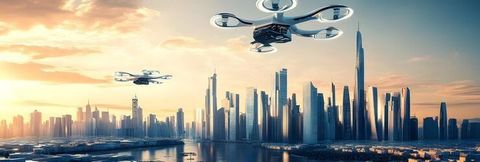
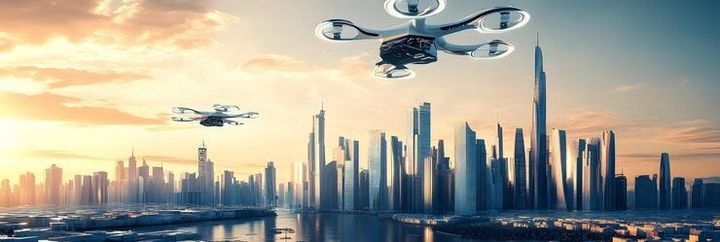
An eVTOL aircraft is designed to take off and land vertically without requiring a conventional runway. Many designs use multiple electric motors and propellers or rotors to generate lift. Some aircraft maintain vertical lift throughout the flight, while others change configuration to use wings for more efficient forward travel.
Common eVTOL design categories include:
Multirotor aircraft: Use several powered rotors to lift and control the aircraft, generally with limited wing-borne flight.
Lift-and-cruise aircraft: Use separate propulsion systems for vertical lift and forward movement.
Tiltrotor or tilt-propeller aircraft: Change the direction of their rotors or propellers between vertical and forward flight.
Winged electric aircraft: Combine vertical-lift mechanisms with wings that generate lift during forward travel.
These designs involve different trade-offs in range, noise, mechanical complexity, energy use, and flight control. Their actual capabilities depend on the specific aircraft rather than the category name alone.
Importance
Urban air mobility matters because road congestion, long ground journeys, and limited connections between certain locations create transport challenges in many urban areas. Aircraft could provide an additional travel option on selected routes, particularly where direct road connections are difficult or where travel between major transport hubs is important.
Potential users include airport travelers, business passengers, emergency planners, and organizations transporting small, time-sensitive items. Yet the usefulness of urban air transport depends on the entire journey. Travel to a landing site, passenger processing, weather restrictions, and the availability of onward transport can affect whether a flight provides a practical advantage.
How Propulsion Systems Work
The propulsion system converts stored energy into the thrust required for flight. In a battery-electric eVTOL, electrical energy powers motors connected to rotors or propellers. The flight-control system adjusts motor output to manage lift, direction, and stability.
Several engineering elements influence propulsion performance:
Electric motors: Convert electrical energy into rotational movement.
Rotors and propellers: Move air to produce thrust and lift.
Battery packs: Store the electrical energy needed for flight.
Power electronics: Control how electrical energy reaches the motors.
Thermal management: Helps keep batteries, motors, and electronic components within their operating temperature ranges.
Flight-control computers: Coordinate aircraft responses to pilot inputs and onboard sensor information.
Some aircraft concepts use hybrid-electric systems, in which a fuel-powered generator supplies electrical energy or supports battery operation. These systems differ from fully battery-electric designs and may have different emissions, maintenance, and operating characteristics.
Flight Capabilities and Limitations
The flight capabilities of an eVTOL depend on its design, payload, battery capacity, weather, altitude, and operating procedures. Vertical take-off can reduce the need for a runway, but it does not remove the need for suitable landing areas, clear flight paths, or controlled airspace access.
Range is particularly important. Battery-powered flight must account for energy used during take-off, transition, cruising, landing, and any required reserve. Carrying more passengers or cargo can increase energy demand, while wind, temperature, and other conditions may affect achievable performance.
| Feature | What it means | Main consideration |
|---|---|---|
| Vertical take-off | Aircraft rises without a runway | Requires suitable landing infrastructure |
| Electric propulsion | Motors drive rotors or propellers | Depends on available electrical energy |
| Cruise speed | Speed during forward flight | Varies by aircraft design and conditions |
| Flight range | Distance achievable during a flight | Affected by payload and energy reserves |
| Payload capacity | Weight of passengers or cargo carried | Influences range and performance |
| Noise profile | Sound produced during operations | Depends on rotor design, power, and location |
| Flight automation | Computer-supported control functions | Requires validated systems and appropriate oversight |
Published performance figures should be interpreted carefully. A manufacturer's projected range or speed may differ from the performance permitted in certified operations, and a maximum figure does not necessarily represent typical passenger-flight conditions.
Urban Air Mobility Infrastructure
Urban air mobility requires more than aircraft. Vertiports are designated areas intended for vertical take-off and landing, with infrastructure that may include passenger access, charging equipment, aircraft parking, emergency arrangements, and links to other transport modes.
The location of a vertiport affects convenience, noise exposure, land use, and access to electricity. Buildings, obstacles, nearby airports, weather patterns, and emergency access also influence whether a site is suitable. Charging capacity and turnaround time are important because aircraft may need to replenish energy between flights.
Recent Updates
Developments in urban air mobility from 2024 through 2026 have focused on aircraft testing, certification, battery performance, flight-control systems, and the infrastructure needed for practical operations. The sector includes both established aviation manufacturers adapting existing technologies and newer companies developing purpose-built eVTOL aircraft. Progress varies substantially among manufacturers and countries.
Aircraft Testing and Certification
Manufacturers use flight testing to evaluate stability, propulsion performance, handling, system reliability, and responses to different operating conditions. Testing can include transitions between vertical lift and wing-borne flight, assessment of emergency procedures, and verification of electrical and flight-control systems.
Regulatory approval remains a major step between a prototype and routine passenger operations. An aircraft must meet the applicable airworthiness requirements, and operators, pilots, maintenance arrangements, and routes may face additional approval requirements. Demonstration flights and prototype testing do not, by themselves, establish that an aircraft is certified for commercial passenger transport.
Battery Technology and Automation
Battery development continues to focus on energy density, charging performance, durability, and thermal safety. Greater usable energy can support longer flights or additional payload, but battery weight, reserve requirements, and degradation remain important engineering constraints.
Automation can assist with flight stabilization, navigation, route monitoring, and fault detection. However, the degree of automation differs across aircraft, and automated functions do not remove the need for validated safety systems, suitable oversight, and defined procedures for abnormal conditions.
Noise reduction is another area of research. Rotor size, rotational speed, aircraft configuration, flight paths, and operating procedures can all influence the sound experienced by people on the ground. No single design eliminates every noise concern.
Laws or Policies
Urban air mobility is governed by aviation safety rules, airspace requirements, aircraft certification standards, and local land-use regulations. The applicable framework depends on the country, the aircraft category, and whether a flight is experimental, private, cargo-related, or intended to carry passengers commercially.
Aviation Rules in India
In India, the Directorate General of Civil Aviation (DGCA) oversees civil aviation safety and regulatory matters within its authority. The Ministry of Civil Aviation establishes national aviation policy, while the Airports Authority of India has responsibilities relating to air navigation and airport operations.
An eVTOL intended for use in India would need to comply with the applicable aircraft certification, registration, operational, and airspace requirements. The exact approvals depend on the aircraft's classification and intended use. Existing rules for helicopters or unmanned aircraft should not automatically be assumed to apply to every piloted eVTOL design.
Airspace, Landing Sites, and Passenger Safety
Aircraft operations must account for controlled airspace, separation from other aircraft, communication procedures, weather limits, and emergency planning. Flights near airports or other restricted areas may require specific coordination or authorization.
Vertiport development may also involve local planning, building safety, environmental assessment, fire protection, and electrical infrastructure requirements. Passenger operations would additionally depend on approved procedures, maintenance arrangements, crew qualifications, and applicable commercial aviation rules.
International developments can influence the sector. For example, aviation regulators in other jurisdictions have developed or are developing certification pathways for powered-lift aircraft. However, approval in one country does not automatically authorize operations in another. Regulatory status should therefore be checked with the relevant national aviation authority.
Tools and Resources
Several technical and regulatory resources help explain urban air mobility vehicles, aircraft performance, and operational requirements. Their usefulness depends on whether the reader is researching general concepts, studying engineering, or examining the status of a specific aircraft.
Aviation Authorities and Technical References
The DGCA India website provides information about Indian civil aviation regulations, safety requirements, and regulatory notices. The Ministry of Civil Aviation publishes policy information, while the Airports Authority of India provides information relevant to airports and air navigation.
Internationally, the Federal Aviation Administration (FAA) and the European Union Aviation Safety Agency (EASA) publish materials on aircraft certification, powered-lift operations, and emerging aviation technologies. These sources help readers distinguish proposed aircraft capabilities from requirements for approved operations.
Flight Planning and Engineering Tools
Mapping applications and geographic information systems can help examine possible routes, distances, obstacles, and the relationship between landing sites and transport hubs. Such tools are useful for preliminary analysis but do not establish that a route is legally authorized or operationally safe.
Engineering teams may use battery-performance models, energy-consumption calculators, propulsion simulations, and flight-dynamics software to estimate aircraft behavior. These models rely on assumptions about payload, weather, power demand, and reserve energy. Results should not be treated as certified flight performance unless validated through the applicable engineering and regulatory processes.
FAQs
What are urban air mobility vehicles?
Urban air mobility vehicles are aircraft intended to transport people or goods within cities and nearby areas. The category includes eVTOL aircraft and other aircraft concepts designed for selected urban or regional journeys.
How do eVTOL aircraft propulsion systems work?
Most battery-electric eVTOL designs use electric motors to drive rotors or propellers. Batteries supply electrical energy, while power electronics and flight-control systems regulate propulsion to maintain controlled flight.
What is the typical flight range of an eVTOL aircraft?
There is no single typical range for all eVTOL aircraft. Achievable distance depends on the design, battery capacity, passenger or cargo load, weather, flight profile, and required energy reserves.
Are eVTOL aircraft approved for passenger flights in India?
Approval depends on the specific aircraft and its intended operation. Aircraft certification, operating permissions, and applicable airspace requirements must be established with the relevant Indian aviation authorities before passenger operations can proceed.
What infrastructure do urban air mobility vehicles need?
They generally require suitable take-off and landing areas, charging or energy facilities where applicable, maintenance arrangements, emergency procedures, and connections to ground transport. Infrastructure requirements vary with aircraft design and operational purpose.
Conclusion
Urban air mobility vehicles combine aviation engineering, electric or hybrid propulsion, flight-control technology, and specialized landing infrastructure. eVTOL aircraft offer vertical take-off and landing capabilities, but their range, payload, noise, and operating limits vary by design and conditions. Certification, airspace rules, infrastructure, and public acceptance remain important factors in their development. Their role in urban transport will depend on demonstrated safety, practical operating performance, and the regulatory framework in each country.