Tyre Manufacturing Explained: Raw Materials, Machinery, Production Processes and Industry Insights
Tyre manufacturing is a multi-stage industrial process that combines rubber compounds, reinforcing materials, chemicals, machinery, heat, and controlled pressure to produce tyres for vehicles and equipment. Although a finished tyre appears to be a single piece, it is actually a layered structure made from several materials that perform different functions.
Context
Modern tyre production developed from early rubber products into a highly engineered manufacturing field. Natural rubber was initially an important material, while synthetic rubber, steel, textile cords, carbon black, silica, and various chemical additives later became important parts of tyre compounds.
A tyre must perform several functions at the same time. It supports vehicle weight, transfers driving and braking forces, helps maintain contact with the road, and contributes to handling and ride characteristics. These requirements influence the selection of materials, tread pattern, internal construction, and manufacturing method.
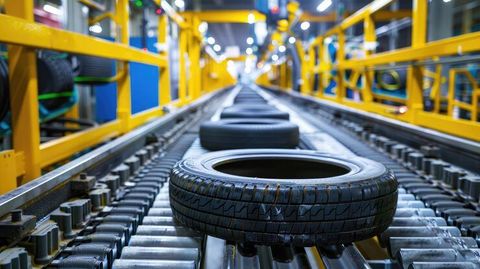
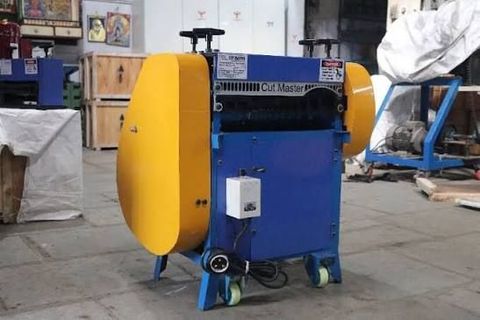
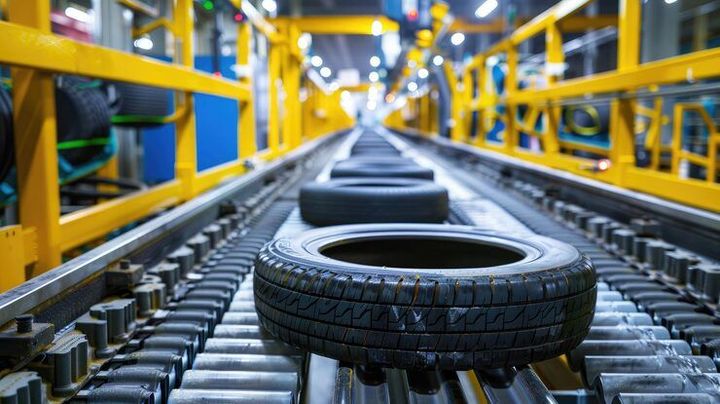
Tyre manufacturing machinery is designed to transform raw materials into accurately formed components and then combine them into a finished tyre. Typical equipment includes rubber mixing systems, calenders, extruders, bead-making machines, tyre-building machines, curing presses, inspection equipment, and testing systems.
Main components of a tyre
A tyre contains several structural elements. Their arrangement varies according to tyre type and intended application, but common components include:
- Tread: The outer portion that contacts the road surface.
- Sidewall: The flexible outer section between the tread and bead.
- Carcass: The internal structure that provides shape and strength.
- Bead: The reinforced area that connects the tyre securely with the wheel rim.
- Belts: Reinforcing layers located beneath the tread in many radial tyres.
- Inner liner: An airtight layer used in many tubeless tyre designs.
These components are produced separately or in stages before being assembled into a green tyre, which is then cured to develop its final shape and properties.
Importance
Tyre manufacturing matters because tyres form an important connection between a vehicle and the road. Their design and construction influence traction, steering response, braking behavior, rolling resistance, durability, and ride characteristics.
The manufacturing process also affects material efficiency and production consistency. Small variations in compound formulation, component dimensions, temperature, pressure, or curing conditions can influence the characteristics of the finished product.
Tyres are produced for many applications, including passenger vehicles, trucks, buses, motorcycles, agricultural equipment, construction machinery, and industrial vehicles. Each category can require different dimensions, materials, tread patterns, and internal structures.
Raw materials used in tyre manufacturing
Rubber is the primary material family used in tyre compounds. Natural rubber is derived from latex obtained from rubber-producing plants, while synthetic rubber is manufactured through chemical processes.
Other materials are added to modify physical and processing characteristics. Carbon black is widely used as a reinforcing filler, while silica is used in certain compounds to influence properties such as rolling resistance and wet grip.
Steel and textile materials provide structural reinforcement. Polyester, nylon, rayon, and steel cords may be incorporated into different tyre components depending on the design.
| Material | Typical role in tyre production |
|---|---|
| Natural rubber | Elasticity and structural properties |
| Synthetic rubber | Compound-specific performance characteristics |
| Carbon black | Reinforcement and compound formulation |
| Silica | Compound modification and rolling characteristics |
| Steel cord | Structural reinforcement |
| Polyester or nylon | Reinforcing textile layers |
| Sulfur and curing chemicals | Vulcanization process |
| Processing oils and additives | Compound processing and formulation |
The exact formulation varies according to tyre design and manufacturer specifications.
Why compound formulation matters
Rubber compounds are prepared according to carefully controlled recipes. Different portions of a tyre can require different compounds because the tread, sidewall, inner liner, and other components perform different functions.
During mixing, rubber and selected ingredients are combined using industrial mixing equipment. The resulting compound may then pass through additional processing stages before it becomes suitable for extrusion, calendering, or other production operations.
Recent Updates
Tyre manufacturing from 2024 through 2026 has increasingly focused on material efficiency, alternative raw materials, digital production controls, recycling, and environmental considerations. Manufacturers and research organizations have been investigating ways to incorporate renewable and recycled materials while maintaining the required characteristics of tyre compounds.
One documented industry example is the increased use of renewable and recycled inputs. Continental reported that renewable and recycled materials represented an average of 26% of its tyre material composition in 2024 and described further increases during 2025, including recycled PET polyester, recycled steel, and silica derived from rice husk ash.
This broader movement does not mean that all tyres use the same proportion of alternative materials. Material selection depends on tyre design, technical requirements, available feedstocks, and applicable testing requirements.
Automation and digital production
Modern tyre plants increasingly use automated material handling, process monitoring, machine controls, sensors, and computerized quality systems. These technologies can help manufacturers monitor variables such as compound temperature, component dimensions, curing conditions, and production consistency.
Digital systems can also connect information from multiple stages of production. This creates opportunities for process analysis, equipment monitoring, traceability, and identification of manufacturing variations.
Sustainability and material development
Another area of development involves reducing dependence on virgin raw materials. Research and industrial programs are examining recycled rubber, recovered carbon materials, recycled steel, bio-based materials, and alternative silica sources.
Regulatory attention is also influencing tyre development. UN Regulation No. 117 addresses areas including rolling resistance, rolling noise, and wet grip, and amendments to the regulation continue to be discussed through the UN vehicle-regulation framework.
Laws or Policies
Tyre manufacturing is subject to different technical and regulatory requirements depending on the market in which tyres are produced or used. These requirements can cover dimensions, construction, performance, labeling, testing, environmental management, and product approval.
A significant international framework is the United Nations vehicle-regulation system. UN Regulation No. 117 covers tyre requirements related to rolling resistance, rolling noise, and wet grip. Its regulatory development has continued through recent working documents and proposed amendments.
Other UN regulations address specific tyre categories and applications. Regulatory requirements can differ between passenger-car tyres, commercial-vehicle tyres, motorcycle tyres, and retreaded tyres.
Environmental policies are also becoming relevant to the tyre industry. Depending on the jurisdiction, manufacturers and other participants in the tyre lifecycle may face requirements concerning waste tyres, recycling, producer responsibility, or material recovery.
Because regulatory systems differ between jurisdictions, manufacturers generally need to identify the requirements applicable to the intended market, tyre category, and production facility. This article provides general information rather than regulatory or legal advice.
Quality and conformity controls
Manufacturing facilities may use laboratory testing, dimensional inspection, endurance testing, uniformity measurement, compound analysis, and other quality-control procedures. Regulatory approval may require specified testing methods before a tyre type can enter a regulated market.
Tools and Resources
Several technical resources can help readers understand tyre manufacturing, production machinery, and industry developments.
Production process diagrams
A process map can be used to visualize the main manufacturing sequence:
Raw materials → Mixing → Component preparation → Extrusion and calendering → Bead preparation → Tyre building → Curing → Inspection → Testing
This sequence can vary according to tyre type and manufacturing system.
Material and compound analysis
Laboratories use instruments and test methods to examine rubber compounds and finished components. Common measurements may include hardness, tensile properties, abrasion behavior, compound composition, dimensions, and curing characteristics.
Manufacturing machinery
Important equipment categories include:
- Internal mixers for compound preparation
- Rubber extruders for producing continuous profiles
- Calendering machines for applying rubber to reinforcement materials
- Bead-making equipment for producing reinforced bead assemblies
- Tyre-building machines for assembling components
- Curing presses for applying heat and pressure
- Uniformity and balance equipment for finished-tyre inspection
- X-ray or other inspection technologies for examining internal structures
Industry and regulatory resources
The United Nations Economic Commission for Europe provides documents covering international vehicle regulations and ongoing technical discussions concerning tyres.
Technical standards, manufacturer documentation, laboratory procedures, machinery manuals, and national regulatory publications can also help explain specific production and conformity requirements.
FAQs
What are the main raw materials used in tyre manufacturing?
The main material groups include natural and synthetic rubber, carbon black, silica, steel, textile reinforcement, oils, sulfur, and other chemical additives. The precise formulation depends on the tyre's construction and intended application.
What machinery is used in tyre manufacturing?
Tyre manufacturing machinery commonly includes rubber mixers, extruders, calenders, bead-making machines, tyre-building equipment, curing presses, and inspection systems. Additional laboratory and testing equipment is used for compound and finished-product evaluation.
What are the main steps in the tyre manufacturing process?
The process generally involves material preparation, rubber mixing, component production, bead preparation, tyre building, curing, inspection, and testing. The exact sequence varies according to tyre construction and production system.
How does tyre curing work?
Curing uses controlled heat and pressure to transform the assembled green tyre into a finished tyre. During this process, vulcanization creates cross-links within the rubber compound, helping establish the required shape and physical characteristics.
How is technology changing tyre manufacturing?
Recent developments include greater use of automation, digital process monitoring, data collection, alternative raw materials, and recycling technologies. Regulatory discussions are also placing continued attention on properties such as rolling resistance, wet grip, and rolling noise.
Conclusion
Tyre manufacturing combines specialized materials, machinery, process controls, and testing into a sequence that produces a multilayered finished product. Rubber compounds, reinforcing materials, extrusion, calendering, tyre building, and curing each contribute to the final structure. From 2024 through 2026, industry development has included greater attention to alternative materials, automation, recycling, and regulated tyre performance characteristics. The manufacturing process and applicable requirements vary according to tyre type, intended application, and market.