Industrial Water Pumps Guide With Advanced Fluid Handling and Process Technology
Industrial water pumps are mechanical systems designed to move, circulate, transfer, or pressurize water through industrial facilities and process networks. An industrial water pumps guide helps explain how different pump designs work, where they are used, and how advanced fluid handling technology supports modern operations.
These systems are found in manufacturing plants, power facilities, water treatment operations, agriculture, construction, chemical processing, food production, and many other environments.
Industrial water pumps can handle tasks ranging from moving clean water between storage tanks to circulating cooling water through complex equipment. Their design depends on factors such as flow rate, pressure, water temperature, pipe layout, operating conditions, and the properties of the fluid being moved.
Context
How Industrial Water Pumps Developed
Water movement has been part of industrial development for centuries, but modern industrial water pumps evolved alongside mechanical engineering, electric motors, and automated process equipment. Early pumping systems relied heavily on manual or mechanical power, while modern installations commonly use electric motors, control systems, sensors, and variable speed technology.
The basic purpose remains straightforward: create enough pressure and movement to transfer water from one location to another. Modern designs add greater control over flow, operating speed, pressure, energy use, and system monitoring.
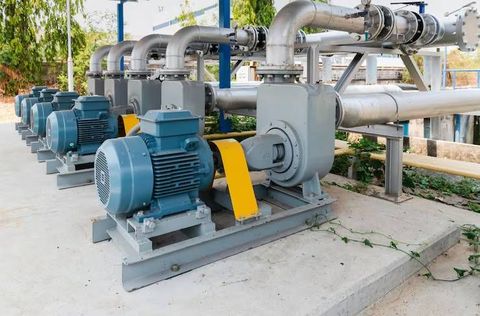
Industrial water pumps are commonly grouped according to their operating principles. Centrifugal pumps use rotating impellers to transfer energy to water, while positive displacement pumps move defined volumes of fluid through repeated mechanical action.
Main Pump Types
Different applications require different pump configurations. Common industrial water pump categories include:
- Centrifugal pumps for continuous water movement and circulation
- Multistage pumps for applications requiring higher pressure
- Submersible pumps for submerged water movement
- Diaphragm pumps for controlled fluid transfer
- Gear pumps for specific fluid-handling conditions
- Axial-flow pumps for high-volume movement at relatively lower pressure
- Vertical pumps for applications where floor space and installation arrangement matter
Pump selection depends on the relationship between flow, pressure, fluid characteristics, and system design rather than on the pump type alone.
Main Components
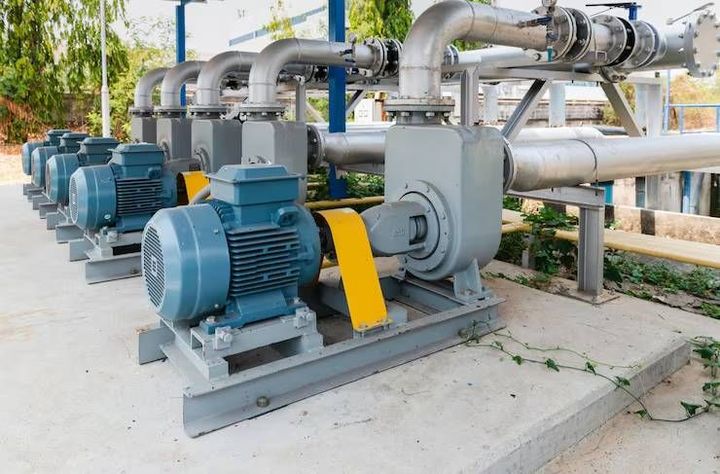
A typical pump assembly may include an electric motor, pump casing, impeller or displacement mechanism, shaft, bearings, seals, inlet connection, outlet connection, and control equipment. Each component contributes to the movement and management of water.
Sensors can measure pressure, temperature, vibration, flow, and motor conditions. These measurements can then be displayed through a local control panel or integrated into a larger industrial automation system.
Importance
Supporting Industrial Processes
Water is used in many industrial processes for cooling, cleaning, heating, circulation, material processing, and environmental management. Industrial water pumps maintain the movement required for these processes.
In a manufacturing facility, for example, pumps may circulate cooling water through machinery. In a treatment facility, pumps can transfer water between different stages. In agriculture, pumping systems can move water through irrigation networks and storage systems.
Managing Flow and Pressure
Industrial processes often require specific water flow and pressure conditions. Too little flow may reduce process performance, while excessive pressure can place unnecessary stress on pipes, valves, and equipment.
Pump systems therefore need to match the hydraulic requirements of the network. Important factors include:
| Factor | What It Describes | Why It Matters |
|---|---|---|
| Flow rate | Volume moved over time | Determines water delivery |
| Head | Pressure-related pumping requirement | Indicates lifting or pressure needs |
| Motor power | Energy required for operation | Influences system operation |
| Pipe diameter | Internal pipe size | Affects flow resistance |
| Fluid temperature | Water operating temperature | Influences materials and seals |
| Efficiency | Relationship between input and hydraulic output | Helps evaluate energy performance |
Energy Management
Pumping can represent a significant portion of electricity use in facilities where water moves continuously. Energy demand is affected by pump design, motor characteristics, operating speed, pipe resistance, pressure requirements, and system layout.
Variable frequency drives can adjust motor speed according to changing process requirements. Instead of operating at one fixed speed, the pump can operate at different speeds when the process allows it. This approach can help align pumping activity with actual system demand.
Reliability and Process Continuity
Industrial water pumps may operate for extended periods, making mechanical condition important. Wear can occur in bearings, seals, shafts, impellers, and other components.
Monitoring pressure, vibration, temperature, and flow can help identify changes in operating conditions. Maintenance planning can then be based on observed equipment conditions rather than relying only on fixed inspection intervals.
Recent Updates
Digital Pump Monitoring
A major trend in industrial water pumps is the integration of digital monitoring. Sensors and connected controllers can collect information about pressure, flow, vibration, temperature, motor load, and operating hours.
Industrial facilities can use this information to understand equipment behavior and identify unusual changes. Data may also be integrated into supervisory control and data acquisition systems or industrial Internet of Things platforms.
Variable Speed Pumping
Variable speed operation continues to become more common in fluid handling systems. Traditional fixed-speed pumps may operate continuously even when process demand changes, while variable speed systems can adjust output according to control requirements.
This approach is particularly relevant in systems where water demand changes throughout the production cycle.
Improved Materials
Pump construction has also developed through improvements in metals, coatings, polymers, elastomers, and corrosion-resistant materials. Material selection is important when pumps operate with treated water, elevated temperatures, abrasive particles, or chemically influenced fluids.
Modern designs may also use improved sealing arrangements and surface treatments to reduce wear under particular operating conditions.
Automation and Predictive Monitoring
Advanced industrial water pumps can be integrated into automated control networks. Controllers can adjust pump operation based on pressure, flow, tank levels, temperature, or other process signals.
Predictive monitoring uses collected operating information to identify patterns that may indicate mechanical changes. This does not eliminate physical inspection, but it provides additional information for maintenance planning and process management.
Laws or Policies
Equipment and Energy Requirements
Industrial water pumps can be affected by equipment efficiency requirements, electrical safety rules, environmental regulations, workplace requirements, and water-management policies. The specific requirements vary by jurisdiction and by the application in which the pump operates.
Energy-related rules may establish efficiency requirements for motors, pumps, or complete pumping systems. Electrical installation standards can also specify requirements for wiring, protection, grounding, control panels, and motor installations.
Water Management Rules
Facilities that extract, transfer, treat, discharge, or reuse water may need to comply with local water-management requirements. Industrial operations can face rules covering wastewater quality, discharge conditions, water conservation, and environmental protection.
The applicable requirements depend on the type of facility, water source, process, and jurisdiction. Pump specifications alone do not determine regulatory compliance because the complete water system and its operating environment must also be considered.
Workplace Safety
Industrial pump installations generally require attention to mechanical guarding, electrical protection, pressure management, emergency controls, and safe maintenance procedures. Equipment documentation and workplace procedures can help operators understand operating limits and potential hazards.
Tools and Resources
Pump Selection Calculators
Pump calculators can help estimate hydraulic requirements using values such as flow rate, head, pipe dimensions, fluid density, and system pressure. These tools are useful during preliminary system evaluation.
Pump Curves
A pump curve presents relationships between flow rate, head, efficiency, and sometimes power requirements. Reading a pump curve helps users understand how a pump may behave under different operating conditions.
System Curves
A system curve represents the pressure or head required by a piping network at different flow rates. Comparing a pump curve with a system curve helps identify an operating point where the pump and piping system interact.
Monitoring Platforms
Industrial monitoring platforms can collect information from pressure sensors, flow meters, vibration sensors, motor controls, and other equipment. Depending on the installation, this information can be displayed through a plant control system or industrial data platform.
Maintenance Templates
Inspection templates can record operating hours, vibration readings, pressure measurements, temperature observations, seal condition, and other equipment information. Consistent records make it easier to compare current conditions with earlier measurements.
FAQs
What are industrial water pumps used for?
Industrial water pumps are used to transfer, circulate, pressurize, and manage water in manufacturing, treatment, cooling, irrigation, power generation, construction, and other industrial processes.
How do industrial water pumps work?
Many industrial water pumps use a rotating impeller to increase water velocity and pressure. Other designs use mechanical displacement to move defined quantities of fluid through the system.
What is advanced fluid handling technology?
Advanced fluid handling technology combines pumps with sensors, controls, variable speed drives, monitoring systems, improved materials, and automated processes to manage fluid movement more precisely.
How is pump efficiency evaluated?
Pump efficiency can be evaluated by comparing hydraulic output with energy input. Flow rate, head, motor performance, operating speed, piping resistance, and system conditions all influence overall performance.
What factors affect industrial water pump selection?
Important factors include required flow rate, pressure or head, water temperature, pipe configuration, operating schedule, fluid characteristics, motor requirements, installation conditions, and control strategy.
Conclusion
Industrial water pumps are central components in many water-transfer, cooling, treatment, circulation, and process systems. Modern industrial water pumps increasingly combine mechanical equipment with sensors, variable speed controls, digital monitoring, and improved materials. Pump performance depends on hydraulic requirements, equipment configuration, operating conditions, and the surrounding piping system. Regulations concerning energy use, electrical safety, water management, environmental protection, and workplace safety can also influence industrial pumping installations.