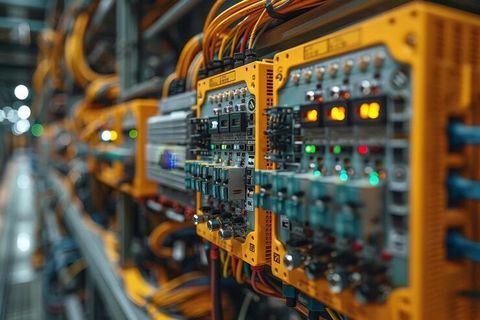
Industrial Control Systems Explained: Types, Components, Applications, Benefits and Security
Industrial Control Systems, commonly called ICS, are technologies used to monitor, control, and automate physical processes in industrial environments. An Industrial Control Systems Explained overview helps readers understand how these systems connect sensors, controllers, software, machines, and human operators to manage processes in a controlled manner.
ICS technology developed alongside industrial automation as factories and infrastructure became more dependent on electrical and electronic control. Earlier systems relied heavily on mechanical controls and manual operation, while modern facilities use programmable controllers, computerized monitoring systems, industrial networks, and specialized software.
Today, industrial control systems can be found in manufacturing plants, power facilities, water treatment operations, transportation infrastructure, oil and gas facilities, building systems, and other industrial environments. Their design varies according to the process, operating requirements, safety considerations, and level of automation.
How Industrial Control Systems Work
An ICS generally follows a continuous process. Sensors collect information from equipment or the surrounding environment, controllers process that information, and control devices respond according to programmed instructions.
Operators can monitor these processes through graphical interfaces and receive information about equipment status, alarms, temperatures, pressures, flow rates, production conditions, or other operational variables.
A simplified control process can be represented as:
Sensor → Controller → Network → Control Device → Physical Process
Feedback from the physical process is then measured again, creating a continuous control loop.
Importance
Industrial control systems are important because many industrial processes require continuous monitoring and precise coordination. Manual control alone may not be practical for large facilities containing thousands of sensors, machines, valves, motors, and other devices.
Automation can also help organizations maintain consistent operating procedures and respond to changing process conditions. However, automation does not remove the need for trained personnel, maintenance procedures, monitoring, and appropriate safety controls.
Industries Using ICS
ICS technology is used across a wide range of sectors, including:
- Manufacturing and assembly facilities
- Electricity generation and distribution
- Water and wastewater treatment
- Oil and gas processing
- Chemical and pharmaceutical production
- Food and beverage manufacturing
- Mining and mineral processing
- Transportation infrastructure
- Building and facility automation
The specific technologies used can differ substantially between industries. A factory may emphasize programmable machines and production monitoring, while a utility may require extensive supervisory systems and geographically distributed equipment.
Operational and Security Challenges
Industrial environments face challenges that differ from ordinary information technology environments. Control equipment may need to operate continuously, and unexpected changes can affect physical processes.
Common challenges include aging equipment, limited maintenance windows, network complexity, configuration errors, unauthorized access, and difficulties integrating older systems with newer technologies.
Security is particularly important because an incident involving an ICS can potentially affect physical equipment or industrial operations rather than only digital information.
Recent Updates
IT and OT Convergence
One significant trend from 2024 through 2026 has been the continued convergence of information technology (IT) and operational technology (OT). Industrial organizations increasingly connect control environments with enterprise networks, analytics platforms, remote monitoring systems, and cloud-based technologies.
This connectivity can improve visibility and data analysis, but it also creates additional communication paths that need to be managed carefully.
Greater Attention to Cybersecurity
Cybersecurity has become an increasingly important part of ICS planning. Organizations are paying greater attention to network segmentation, asset inventories, access controls, security monitoring, vulnerability management, and incident response.
Industrial environments can have long equipment lifecycles, meaning older devices may remain operational while newer security technologies are introduced around them. This makes system architecture and compensating controls important considerations.
Industrial Data and Analytics
Modern ICS environments can generate large amounts of operational data. Organizations increasingly use this information for process analysis, equipment monitoring, quality management, and maintenance planning.
Data analytics can help identify unusual operating patterns, but analytical systems should be designed so that monitoring or data-processing activities do not interfere with essential control functions.
Remote Operations
Remote monitoring and administration have also become more common. Remote access can allow authorized personnel to examine equipment and system conditions without being physically present at a facility.
Because remote connections can introduce security risks, organizations generally need appropriate authentication, authorization, monitoring, and network controls.
Laws or Policies
Industrial control systems are affected by a combination of cybersecurity requirements, industry regulations, workplace safety rules, privacy requirements, and sector-specific policies. The exact requirements depend on the country, industry, type of facility, and criticality of the infrastructure.
Cybersecurity Frameworks
Organizations may use established cybersecurity frameworks and standards to structure their ICS security programs. The NIST Cybersecurity Framework and NIST guidance for operational technology provide approaches for identifying assets, protecting systems, detecting incidents, responding to events, and recovering operations.
The IEC 62443 family of standards is another important reference for industrial automation and control-system cybersecurity. It addresses areas such as system security, components, development processes, and security responsibilities.
These frameworks and standards should not be treated as substitutes for applicable laws or regulatory requirements.
Critical Infrastructure
Some industrial facilities may be classified as critical infrastructure and therefore face additional cybersecurity or reporting requirements. Electricity, water, transportation, communications, and other sectors can have specific regulatory structures.
Requirements vary by jurisdiction. Organizations should therefore determine which national, regional, and industry-specific rules apply to their facilities.
Workplace and Process Safety
Cybersecurity is only one part of industrial control management. Facilities must also comply with applicable workplace safety, electrical safety, environmental, and process-safety requirements.
Control-system changes should be considered in relation to physical safety because incorrect control logic, equipment configuration, or unauthorized changes can affect industrial processes.
Tools and Resources
Several technical resources can help organizations and learners understand Industrial Control Systems and their security requirements.
Monitoring and Management Tools
ICS environments commonly use tools for asset inventory, network monitoring, alarm management, configuration tracking, and system diagnostics. These tools can help operators understand the condition of connected equipment and identify unusual behavior.
The exact toolset depends on the control architecture and the equipment installed at a facility.
Network Segmentation
Network segmentation separates different parts of an industrial environment according to their function and security requirements. Firewalls, industrial gateways, access-control systems, and other network technologies can be used to restrict unnecessary communication between systems.
Segmentation should be designed carefully because industrial processes can depend on specific communication paths.
Security Frameworks and Standards
Useful educational resources include:
- NIST cybersecurity and operational technology guidance
- IEC 62443 industrial cybersecurity standards
- ISA materials concerning industrial automation and control
- CISA guidance concerning industrial control systems and critical infrastructure
- Manufacturer documentation for specific controllers and industrial equipment
These resources can help professionals understand security principles, system architecture, and operational considerations.
Asset Inventory Templates
An ICS asset inventory can record information such as device type, manufacturer, firmware version, network location, function, owner, and maintenance status.
Maintaining accurate inventory information can help organizations understand which devices are present and identify systems that require additional security attention.
FAQs
What are Industrial Control Systems?
Industrial Control Systems are technologies used to monitor and control physical processes. They can include sensors, programmable controllers, supervisory software, industrial networks, and control equipment.
What are the main types of Industrial Control Systems?
Common types include Supervisory Control and Data Acquisition (SCADA), Distributed Control Systems (DCS), Programmable Logic Controllers (PLC), and Industrial Automation and Control Systems. These technologies can overlap and may be integrated within a larger industrial architecture.
What components are used in an ICS?
Typical components include sensors, actuators, PLCs or other controllers, human-machine interfaces, engineering workstations, servers, industrial networks, and supervisory applications.
Why is Industrial Control Systems security important?
ICS security is important because these systems can directly influence physical processes. Unauthorized access, incorrect configurations, malware, or communication failures can potentially affect equipment, production, safety, or infrastructure operations.
How can Industrial Control Systems be protected?
Protection can involve asset inventories, network segmentation, strong access controls, secure configurations, system monitoring, vulnerability management, backups, incident-response planning, and appropriate security practices for remote access.
Conclusion
Industrial Control Systems connect digital technologies with physical industrial processes through sensors, controllers, networks, software, and control devices. Their applications range from manufacturing and utilities to water treatment, transportation, and other infrastructure. Recent developments have increased connectivity, remote monitoring, data use, and attention to cybersecurity. Understanding the different ICS types, components, applications, operational requirements, and security principles provides a useful foundation for understanding modern industrial automation.