Concrete Block Making Machines: Learn About Moulding Technology, Block Types and Production Methods
Concrete block making machines are industrial or semi-automated machines used to produce concrete masonry units from a mixture of cement, aggregates, water, and, in some formulations, other materials.
The machines shape and compact the mixture inside moulds to create blocks with consistent dimensions and surface characteristics.
Concrete blocks have been used in construction for many decades because they can be produced in different sizes and configurations. As construction activity expanded, mechanical production methods became useful for improving dimensional consistency and reducing the amount of manual moulding required.
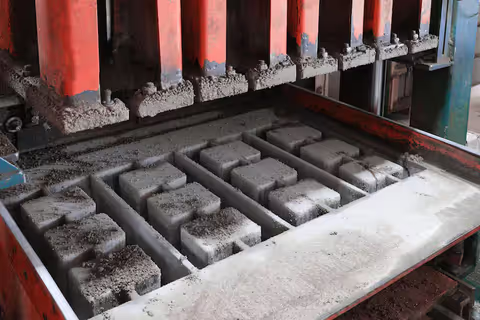
A typical concrete block making machine combines material feeding, mixing, mould filling, vibration or pressure-based compaction, and block ejection. Depending on the machine configuration, several blocks can be formed during one production cycle.
How concrete blocks are produced
The manufacturing process generally starts with proportioning the raw materials. Cement and aggregates are measured according to the intended concrete mixture, followed by controlled addition of water.
The mixture is then transferred to a block-making machine. Inside the machine, the material enters a mould and is compacted through vibration, pressure, or a combination of both. After compaction, the newly formed blocks are removed and transferred to a curing area.
Curing is an important part of production because concrete gains strength as cement hydrates. The duration and conditions depend on the mixture, block type, cement characteristics, temperature, humidity, and applicable specifications.
Main machine categories
Concrete block making machines can be grouped according to their level of automation and operating method.
| Machine type | General characteristics | Typical application |
|---|---|---|
| Manual | Greater operator involvement | Small-scale production |
| Semi-automatic | Mechanical moulding with operator-assisted stages | Small and medium production |
| Automatic | Automated feeding, moulding, and handling stages | Higher-volume production |
| Hydraulic | Uses hydraulic pressure during forming | Dense masonry units |
| Vibratory | Uses vibration for compaction | Various concrete blocks |
| Mobile | Designed for movement between production areas | Selected site-based applications |
The appropriate configuration depends on production requirements, block dimensions, available space, material characteristics, and the desired degree of automation.
Importance
Concrete block making machines are relevant to construction-material production because they provide a controlled method for forming masonry units. Consistent mould dimensions can help manufacturers maintain uniform block geometry when the machine is correctly adjusted and the concrete mixture is properly controlled.
Concrete blocks are used in residential, commercial, industrial, institutional, and infrastructure construction. Different block designs can be used for walls, partitions, foundations, landscaping, and other applications depending on structural requirements.
Factors affecting block quality
Machine operation is only one part of block production. The final characteristics of a concrete block are influenced by several factors:
- Aggregate grading and particle size
- Cement proportion
- Water content
- Mixing uniformity
- Mould dimensions
- Compaction pressure or vibration
- Machine alignment
- Curing conditions
- Handling after moulding
- Testing procedures
Water content is particularly important. A mixture with unsuitable moisture can create difficulties during mould filling and compaction. Excessive water may also affect the properties of the finished concrete, while insufficient moisture can interfere with proper compaction.
Production consistency
A mechanically controlled production process can help maintain consistent mould filling and compaction between production cycles. However, machine automation does not automatically ensure identical block properties. Raw materials, machine settings, curing conditions, and quality-control procedures all contribute to the final result.
Operators generally monitor dimensions, visible defects, mixture characteristics, and machine operation. Laboratory testing may also be used to evaluate compressive strength, water absorption, density, and other properties specified for the particular block.
Recent Updates
From 2024 through 2026, developments in concrete block manufacturing have continued to focus on automation, process monitoring, energy management, material efficiency, and integration with broader production systems.
Automation and controls
Modern automatic concrete block making machines can incorporate programmable controllers, sensors, automated material handling, and electronic monitoring. These systems can coordinate different stages of the production cycle and reduce the amount of manual intervention required for repetitive operations.
Digital controls can also record production parameters and machine status. Depending on the system, operators may monitor cycle times, alarms, material movement, and selected operating conditions from a centralized interface.
Material efficiency
Manufacturers are also examining ways to improve material utilization. Accurate batching and controlled mixing can help reduce variation in the concrete mixture. Some production systems are designed to accommodate different aggregate combinations or recycled materials when these materials meet the relevant technical requirements.
The suitability of recycled aggregates depends on their composition, processing, contamination level, moisture characteristics, and the requirements of the intended block. Their use therefore requires appropriate material evaluation rather than assuming that every recycled material is suitable for every block type.
Energy and equipment monitoring
Energy use is another area receiving attention. Motors, hydraulic systems, vibration units, conveyors, and material-handling equipment all contribute to the overall energy demand of a production line.
Monitoring equipment operation can help identify unusual vibration, temperature changes, electrical loading, or other conditions that may indicate a maintenance requirement. Such monitoring is increasingly integrated into industrial automation systems.
Laws or Policies
In India, concrete block manufacturing is influenced by construction standards, material specifications, workplace safety requirements, environmental rules, and local regulatory provisions. The exact requirements depend on the type of block, intended application, production location, and applicable construction specification.
The Bureau of Indian Standards publishes standards relevant to concrete masonry units and related construction materials. Specifications can address dimensions, compressive strength, water absorption, density, tolerances, and testing methods.
Standards and testing
Before a concrete block is used in a particular construction application, its properties may need to meet the relevant specification. Testing can include:
- Compressive strength
- Water absorption
- Density
- Dimensional measurements
- Visual examination
- Moisture-related characteristics
The applicable standard depends on the block category and intended use. Project specifications can also establish requirements beyond a general product standard.
Environmental considerations may include dust control, aggregate handling, wastewater management, noise, and disposal or reuse of production residues. Industrial facilities must also follow applicable workplace safety requirements concerning moving machinery, electrical systems, lifting equipment, and material handling.
Because Indian regulations can vary by state and facility type, manufacturers and project teams need to verify the current requirements applicable to their particular location and production activity.
Tools and Resources
Several tools are used to plan, operate, and monitor concrete block production. Material batching equipment helps measure cement, aggregates, and water according to the selected mixture design.
Production and quality-control tools
Common resources include:
- Aggregate weighing systems
- Concrete mixers
- Moisture meters
- Block moulds
- Vibration monitoring equipment
- Dimensional measurement tools
- Compressive-strength testing machines
- Curing-area monitoring instruments
- Programmable machine controllers
- Production records and inspection checklists
A compressive-strength testing machine is used to determine how much compressive load a test specimen can withstand under a defined testing procedure. The result can then be compared with the relevant specification.
Machine selection considerations
When evaluating a concrete block making machine, technical factors can include mould dimensions, production cycle, automation level, vibration arrangement, hydraulic configuration, power requirements, material-feeding method, and compatibility with the intended block design.
Available floor space and material movement should also be considered. A production line may include aggregate storage, batching, mixing, block formation, transfer equipment, curing areas, and finished-block handling.
Maintenance documentation is another useful resource. Inspection schedules can cover lubrication points, hydraulic components, electrical connections, mould wear, vibration components, fasteners, sensors, and safety devices.
FAQs
What is a concrete block making machine?
A concrete block making machine is equipment used to mould and compact concrete mixtures into masonry blocks. Depending on the design, it may use vibration, hydraulic pressure, or both to form the blocks.
How does a concrete block making machine work?
The machine receives a prepared concrete mixture and transfers it into a mould. The material is then compacted, the block is formed and ejected, and the fresh unit is moved to a controlled curing area.
What materials are used in concrete block production?
Common materials include cement, fine and coarse aggregates, and water. Some formulations may include supplementary materials or approved additives depending on the required properties and applicable specifications.
What tests are performed on concrete blocks?
Common tests can include compressive strength, water absorption, density, and dimensional checks. The exact tests depend on the block type and relevant Indian or project specification.
Are automatic concrete block making machines suitable for every plant?
No single machine configuration is suitable for every production environment. Selection depends on block dimensions, production requirements, material characteristics, available space, automation requirements, power availability, and applicable quality specifications.
Conclusion
Concrete block making machines provide a mechanical method for forming and compacting concrete masonry units with controlled mould dimensions and production cycles. Machine configuration, concrete mixture, compaction, curing, and quality testing all influence the characteristics of finished blocks. Recent developments have increased the use of automation, electronic controls, production monitoring, and material-efficiency practices. In India, concrete block production must also consider applicable BIS specifications, construction requirements, workplace safety provisions, and environmental regulations.