Welding Machine Guide With Modern Welding Technology and Engineering Insights
Welding machines are industrial and workshop tools used to join metal components through heat, pressure, or a combination of both. Welding has existed for centuries in various forms, but modern welding machines developed alongside electrical engineering, manufacturing, construction, transportation, and metal fabrication.
A welding machine controls the electrical energy or other heat source required to create a weld. Depending on the welding process, the equipment may use an electrode, welding wire, shielding gas, or a focused energy source. The selection of equipment depends on the material, thickness, joint design, working environment, and required production method.
How welding machines work
In electrical welding, the machine generates and controls an electrical current that creates sufficient heat to melt a small area of the base metal. As the heated region cools, the metals become joined into a solid connection.
Different welding machines use different methods. Common processes include shielded metal arc welding, gas metal arc welding, gas tungsten arc welding, flux-cored arc welding, resistance welding, and automated laser welding.
Important components can include:
- Power source for generating welding current
- Electrode holder or welding torch
- Ground connection
- Welding cable
- Wire feeder where continuous wire is used
- Shielding-gas equipment for applicable processes
- Control panel for adjusting operating parameters
Modern equipment can combine several of these functions into a compact system, making process control easier for trained operators.
Common welding machine categories
The welding machine category generally reflects the welding process and its intended application.
| Welding machine type | Main process | Typical applications |
|---|---|---|
| Stick welding machine | Shielded metal arc welding | Structural work and outdoor fabrication |
| MIG welding machine | Gas metal arc welding | Fabrication, automotive work, and general metal joining |
| TIG welding machine | Gas tungsten arc welding | Precision work and thinner materials |
| Flux-cored welding machine | Flux-cored arc welding | Structural and industrial fabrication |
| Spot welding machine | Resistance welding | Sheet-metal assembly |
| Laser welding machine | Laser beam welding | Automated and precision manufacturing |
Inverter welding machines are another important category. They use electronic power conversion technology to create a relatively compact power source with controlled output characteristics. Traditional transformer-based machines remain relevant for certain applications, while inverter systems are widely used across modern workshops and production environments.
Importance
Welding is important because many structures and manufactured products depend on permanent metal joints. Buildings, machinery, transportation equipment, pipelines, storage systems, agricultural equipment, and metal products can all involve welded components.
The quality of a weld can influence structural strength, dimensional accuracy, appearance, and long-term durability. An unsuitable welding process can create defects such as cracks, porosity, incomplete fusion, excessive spatter, distortion, or undercutting.
Industries using welding technology
Welding machines are used across a broad range of sectors. Manufacturing facilities use welding for frames, enclosures, brackets, machinery components, and assemblies. Construction applications can include structural steel components, reinforcement-related fabrication, and metal frameworks.
Other applications include:
- Automotive and transportation manufacturing
- Shipbuilding and marine fabrication
- Agricultural machinery production
- Industrial equipment manufacturing
- Metal furniture production
- Energy-related equipment
- Maintenance and fabrication workshops
- Heavy machinery production
The welding process also affects workplace conditions. Heat, ultraviolet radiation, fumes, sparks, electrical energy, and hot metal create hazards that require appropriate controls and protective equipment.
Factors affecting welding quality
A successful welding operation depends on more than the machine itself. Material preparation, electrode or wire selection, current, voltage, travel speed, shielding, joint design, and operator technique can all influence the resulting weld.
Material thickness is particularly important. Thin sheet metal may require controlled heat input to reduce burn-through and distortion, while thicker sections may require greater penetration and carefully planned welding sequences.
Recent Updates
Welding technology has continued to change through greater use of electronic controls, automation, sensors, robotics, and digital monitoring. From 2024 through 2026, the broader manufacturing trend has focused on improving process consistency, reducing unnecessary material use, and integrating welding equipment into connected production environments.
Inverter and digital control technology
Modern inverter welding machines commonly use electronic controls to regulate welding parameters. Digital interfaces can allow operators to adjust current, voltage, wire-feed speed, polarity, and related settings depending on the welding process.
Some systems can store process settings or display operating information. This can make repeatable production easier when the same welding procedure is used across multiple components.
Robotic welding systems
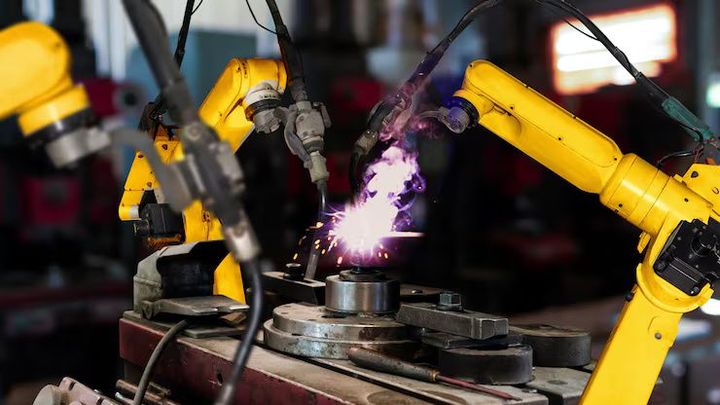
Robotic welding has become increasingly relevant in repetitive manufacturing. A robotic welding cell can combine a robot arm, welding power source, wire feeder, fixture, sensors, and control software.
Automation is particularly useful where components have repeatable dimensions and welding paths. Human workers remain important for programming, inspection, setup, material handling, maintenance, and process supervision.
Sensor-based welding
Sensors and machine vision are being incorporated into some modern welding systems. These technologies can detect joint position, track seams, monitor process conditions, or support inspection.
Data collection is another developing area. Production systems can record information about welding parameters and equipment operation, creating digital records that can help identify variations between production runs.
Energy-efficient equipment
Electronic power conversion has also influenced welding machine design. Equipment manufacturers continue to develop systems intended to use electrical energy more efficiently while providing controlled welding output.
The practical performance of a welding machine still depends on the selected process, operating conditions, material, and application. Energy efficiency should therefore be considered alongside technical requirements rather than as an isolated specification.
Laws or Policies
Welding activities are influenced by occupational safety rules, electrical requirements, environmental controls, and manufacturing standards. The exact requirements vary by country, industry, workplace, and welding process.
Workplace safety requirements
Common safety frameworks address exposure to welding fumes, ultraviolet radiation, heat, fire hazards, electrical risks, compressed gases, and protective equipment. Workplaces may need appropriate ventilation, screens, protective clothing, gloves, eye protection, and procedures for handling hot materials.
Electrical safety requirements can also apply to welding power sources, cables, grounding arrangements, plugs, and surrounding equipment. Equipment should be installed and operated according to applicable national requirements and manufacturer instructions.
Welding standards
Technical standards can define requirements for welding procedures, personnel qualifications, materials, inspection, testing, and weld quality. Standards may be developed by national or international standards organizations and can differ according to the industry.
For regulated projects, organizations may need documented welding procedures and inspection records. Structural, pressure-related, transportation, and specialized industrial applications can have additional requirements.
Environmental considerations
Welding can generate fumes, gases, particulate matter, noise, and other workplace emissions. Local environmental and occupational rules may establish requirements for ventilation, exposure control, waste handling, and workplace conditions.
Because regulations differ between jurisdictions, businesses and individuals should consult the applicable authorities and current standards for their location rather than relying on a general description.
Tools and Resources
Several tools help users understand and manage welding processes. Welding calculators can assist with estimating heat input, electrical parameters, material requirements, or related technical values. These calculations are normally dependent on the welding process and material characteristics.
Useful welding resources
Helpful resources can include:
- Welding procedure templates for documenting process parameters
- Welding parameter charts for common materials and processes
- Electrode and filler-metal selection tables
- Material thickness reference charts
- Welding defect identification guides
- Electrical load calculators
- Personal protective equipment checklists
- Welding inspection forms
- Manufacturer equipment manuals
- Technical standards databases
- Training and educational platforms
Digital welding software can also help with production planning and parameter documentation. In automated facilities, welding control systems may connect with manufacturing execution systems or other industrial software.
For general readers, a useful starting point is understanding the relationship between material type, thickness, welding process, power requirements, and safety controls. These factors provide a foundation for understanding why different welding machines exist.
FAQs
What is a welding machine used for?
A welding machine provides the controlled heat or energy needed to join metal components. The specific method depends on the welding process, material, joint design, and application.
How does a MIG welding machine differ from a TIG welding machine?
A MIG welding machine normally uses a continuously fed welding wire as the electrode, while a TIG welding machine uses a non-consumable tungsten electrode. TIG welding provides precise control and is commonly associated with applications where careful heat management is important.
What should be considered when selecting a welding machine?
Important considerations include the material type, material thickness, welding process, required electrical input, output range, duty cycle, portability, control features, and applicable safety requirements.
Are inverter welding machines different from conventional welding machines?
Yes. Inverter welding machines use electronic power-conversion technology, which can allow a more compact design and precise control of welding output. Conventional transformer-based equipment uses a different electrical design.
What safety equipment is needed for welding?
Typical welding protection includes an appropriate welding helmet or eye protection, gloves, protective clothing, suitable footwear, and ventilation or respiratory controls where required. The exact protective measures depend on the welding process and workplace conditions.
Conclusion
Welding machines provide controlled energy for joining metals across manufacturing, construction, transportation, and fabrication applications. Modern welding technology increasingly combines inverter electronics, digital controls, automation, sensors, and production data systems. Choosing and operating equipment involves considering material characteristics, welding processes, electrical requirements, workplace hazards, and applicable standards. Understanding these fundamentals helps explain how welding equipment fits into modern engineering and manufacturing environments.