Pipeline Welding System Guide: Equipment, Welding Methods, Applications and Key Considerations
A pipeline welding system is a combination of welding equipment, materials, procedures, inspection methods, and safety controls used to join sections of pipe. Pipeline welding is common in systems that transport natural gas, petroleum products, water, chemicals, and other fluids over long distances. The welded joints connect individual pipe sections into a continuous pipeline capable of operating under defined pressure and environmental conditions.
Pipeline construction developed alongside the expansion of industrial energy and water networks. As pipelines became longer and operating conditions became more demanding, standardized welding procedures were developed to create consistent pipe joints. Standards such as API 1104 and ASME piping codes are widely referenced for welding and inspection requirements, while national regulations can add further requirements.
A typical pipeline welding system includes pipe alignment equipment, welding power sources, electrodes or welding wire, shielding gases where applicable, preheating equipment, clamps, inspection instruments, and safety equipment. The exact combination depends on pipe material, diameter, wall thickness, location, and the substance being transported.
How pipeline welding works
Before welding begins, pipe sections are aligned and prepared so their ends form the required joint geometry. The surfaces are cleaned, and the welding procedure specifies factors such as heat input, welding sequence, filler material, and temperature controls.
The joint is then created through one or more welding passes. After welding, the joint can undergo visual examination and nondestructive testing. Depending on the pipeline specification, methods may include radiographic testing, ultrasonic testing, magnetic particle testing, or other inspection techniques.
Importance
Pipeline welding matters because welded joints form critical connections throughout a pipeline network. A pipeline may contain hundreds or thousands of joints, and each joint needs to meet the applicable engineering and inspection requirements.
For communities, pipeline integrity is relevant to the transportation of energy, water, and industrial materials. Pipeline systems can cross roads, agricultural areas, industrial zones, rivers, and other environments, making construction quality and monitoring important considerations.
Pipeline welding also affects construction planning. Factors such as pipe diameter, terrain, weather, material characteristics, welding position, and access conditions can influence the equipment and welding method selected.
Main equipment used
A pipeline welding system may include several categories of equipment:
- Welding power source: Supplies controlled electrical energy for the welding process.
- Electrode or wire system: Provides the material needed to form the weld.
- Pipe alignment clamp: Holds pipe sections in the correct position during joint preparation and welding.
- Preheating equipment: Raises the pipe temperature when the welding procedure requires controlled preheating.
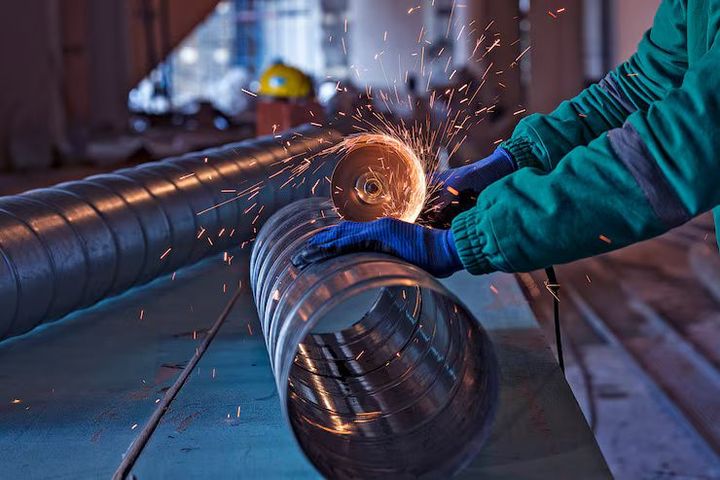
- Grinding and preparation tools: Help prepare pipe ends and clean areas around the joint.
- Shielding gas equipment: Used with welding processes that require protection of the molten weld from atmospheric contamination.
- Inspection equipment: Supports visual and nondestructive examination of completed welds.
- Safety equipment: Includes protective clothing, welding helmets, eye protection, gloves, respiratory protection where required, and suitable fire-prevention equipment.
Common welding methods
Several welding methods are used in pipeline construction. The selection depends on the project specification and qualified welding procedure.
Shielded Metal Arc Welding (SMAW) uses a flux-coated electrode to create the weld. It can be used in different positions and is suitable for many field pipeline applications.
Gas Tungsten Arc Welding (GTAW) uses a non-consumable tungsten electrode and can provide precise control of the weld. It may be used for specific root-pass or specialized welding requirements.
Gas Metal Arc Welding (GMAW) uses a continuously supplied wire electrode and shielding gas. It can support controlled and relatively continuous welding operations when environmental conditions are suitable.
Flux-Cored Arc Welding (FCAW) uses a tubular wire containing flux. Depending on the procedure, it can be used for different pipeline fabrication or construction situations.
Mechanized and automated welding uses controlled equipment to regulate welding movement and selected parameters. These systems can help maintain consistency across repeated welds when the project conditions and qualified procedures are suitable.
Pipeline welding system comparison
| Welding method | Main feature | Typical consideration |
|---|---|---|
| SMAW | Coated electrode | Flexible field application |
| GTAW | Tungsten electrode | Precise weld control |
| GMAW | Continuous wire | Controlled wire feeding |
| FCAW | Flux-cored wire | Different wire and flux configurations |
| Mechanized welding | Automated movement and control | Requires suitable setup and procedure |
Recent Updates
Pipeline welding practices have increasingly incorporated mechanized equipment, digital monitoring, improved inspection technologies, and more structured data management. These developments are particularly relevant to large pipeline projects where many joints need to be produced and documented consistently.
Mechanized welding systems can integrate controlled welding parameters with equipment that moves around or along the pipe. Digital monitoring can record information such as welding current, voltage, travel speed, and other procedure-related variables. Such records can support quality documentation and process review.
Inspection technology is also developing. Ultrasonic methods, including advanced forms of ultrasonic examination, can provide detailed information about weld conditions without cutting open the joint. Radiographic methods remain relevant for applications where they are specified by the governing procedure.
Pipeline integrity management has also received continued attention. In India, the Petroleum and Natural Gas Regulatory Board maintains technical and safety regulations for natural gas and petroleum-product pipelines, including integrity management requirements. The PNGRB currently lists consolidated natural-gas pipeline technical and safety regulations and petroleum-product pipeline regulations incorporating amendments through 2025.
Another ongoing trend is greater attention to traceability. Welding records, welder qualifications, material information, inspection results, and repair records can be organized digitally so that individual joints can be tracked through different construction stages.
Laws or Policies
In India, pipeline welding is influenced by regulations and technical standards from organizations such as the Petroleum and Natural Gas Regulatory Board (PNGRB) and the Oil Industry Safety Directorate (OISD). The applicable requirements depend on the pipeline type, transported material, location, and project classification.
For natural gas pipelines, PNGRB's Technical Standards and Specifications including Safety Standards regulations establish technical and safety requirements. The regulatory framework also includes integrity management requirements for natural gas pipelines.
For petroleum and petroleum-product pipelines, PNGRB maintains separate technical and safety regulations along with integrity management regulations. The regulatory listings show amendments through 2025.
OISD also maintains standards relevant to pipeline safety and inspection. Its current standards list includes OISD-STD-141 for cross-country liquid hydrocarbon pipelines, OISD-STD-130 for inspection of piping systems, and other documents covering pipeline and petroleum-industry safety.
Welding procedures may also reference international standards. PNGRB material identifies API 1104, titled Welding of Pipelines and Related Facilities, alongside ASME B31.8 and other standards for natural gas pipeline applications.
Specific welding procedures, welder qualifications, inspection requirements, and acceptance criteria should be determined from the applicable project specification and governing standards. For example, OISD documentation states that repair welding procedures and welders performing certain repair work are to be qualified according to API 1104 or ASME Section IX.
These requirements can change as regulations and standards are revised. Project teams therefore need to check the current applicable editions rather than relying on older documents.
Tools and Resources
Several technical resources can help readers understand pipeline welding systems and related requirements.
Standards and regulatory resources
The PNGRB website contains regulations covering natural gas pipelines and petroleum-product pipelines. It is useful for checking regulatory documents and amendments applicable in India.
The OISD website provides access to standards, guidelines, recommended practices, safety information, and pipeline-related documents. OISD also provides a search function for locating documents by standard number or subject.
Welding and inspection resources
Useful technical resources can include:
- Welding procedure specifications and qualification records
- Welder qualification records
- Pipe material certificates
- Welding parameter records
- Joint tracking and weld maps
- Nondestructive testing reports
- Pipeline inspection checklists
- Heat-treatment records where applicable
- Engineering drawings and isometric diagrams
- Pipe alignment and fit-up measurement tools
Digital weld tracking platforms can also organize joint numbers, welding stages, inspection results, repair records, and related documentation. Calculators for pipe dimensions, welding heat input, material thickness, and other engineering quantities can support preliminary technical work, but project-specific requirements remain governed by the applicable engineering documents.
FAQs
What is a pipeline welding system?
A pipeline welding system is the combination of equipment, welding procedures, materials, inspection methods, and safety controls used to join pipeline sections. The configuration varies according to pipe material, dimensions, location, and project requirements.
Which welding methods are used in pipeline welding?
Common methods include SMAW, GTAW, GMAW, FCAW, and mechanized welding. The selected method depends on the qualified welding procedure, pipe material, environmental conditions, joint design, and applicable standards.
What equipment is used in a pipeline welding system?
Typical pipeline welding equipment includes welding power sources, electrodes or wire feeders, alignment clamps, preheating equipment, grinders, shielding-gas equipment where required, inspection instruments, and protective equipment.
Which standards apply to pipeline welding in India?
Requirements can involve PNGRB regulations, OISD standards, API 1104, ASME codes, and other applicable technical documents. The exact combination depends on the pipeline type and project requirements.
How are pipeline welds inspected?
Pipeline welds can be examined through visual inspection and nondestructive testing methods such as radiographic or ultrasonic examination. The required method and acceptance criteria are established by the applicable specification and governing standard.
Conclusion
A pipeline welding system brings together welding equipment, qualified procedures, pipe preparation, inspection, and safety controls to create pipeline joints. SMAW, GTAW, GMAW, FCAW, and mechanized welding are among the methods used for different applications. Recent developments include greater use of mechanized equipment, digital welding records, advanced inspection techniques, and structured integrity management. In India, PNGRB regulations and OISD standards form an important part of the regulatory and technical framework for applicable pipeline systems.