Marine Propeller Machining Systems Guide With Precision Manufacturing Insights
Marine propeller machining systems are specialized manufacturing technologies used to produce and finish propellers for ships, boats, offshore equipment, and other watercraft. A marine propeller converts rotational energy from an engine or electric motor into thrust, allowing a vessel to move through water.
Modern marine propeller machining systems combine computer-controlled machines, cutting tools, measurement equipment, and specialized software. These systems can process materials such as bronze alloys, stainless steel, nickel-aluminum bronze, and other engineering metals selected for marine environments.
Traditional propeller manufacturing involved extensive manual shaping, pattern making, casting, and finishing. Computer numerical control, commonly known as CNC, has changed this process by allowing complex blade geometries to be reproduced from digital design information. The transition has made precision manufacturing an important part of modern marine equipment production.
How Marine Propellers Are Manufactured
A propeller generally begins with a digital design that defines the diameter, blade count, pitch, thickness, hub dimensions, and surface geometry. Manufacturing software converts this information into machining instructions that control tool movement.
A typical production sequence may include:
- Digital propeller design and geometry preparation
- Material preparation or casting
- Rough machining to remove excess material
- Precision machining of blade surfaces
- Hub and mounting-hole machining
- Dimensional inspection
- Surface finishing
- Balancing and final quality checks
Marine propeller machining systems can use multi-axis CNC equipment because propeller blades contain curved surfaces that cannot always be produced efficiently with simple three-axis movement.
Why Propeller Geometry Matters
The shape of a propeller influences how efficiently it interacts with water. Pitch, rake, skew, blade area, thickness, and diameter are among the design characteristics that affect thrust, vibration, noise, and rotational behavior.
Precision manufacturing therefore involves more than simply removing metal from a blank. The machining process must maintain the intended geometry across the entire blade while controlling dimensional variation and surface quality.
Importance
Marine propeller machining systems matter because propellers operate under demanding mechanical and environmental conditions. A small dimensional difference can affect the way a blade interacts with water, particularly when several blades must operate together at high rotational speeds.
The topic affects several groups, including shipbuilders, marine equipment manufacturers, naval architects, maintenance teams, engineering organizations, and operators of commercial and recreational vessels. It is also relevant to manufacturers developing propulsion equipment for offshore platforms and specialized watercraft.
Precision and Vessel Performance
Propeller manufacturing accuracy can influence propulsion characteristics. Correct blade geometry helps maintain the relationship between the propeller design and the propulsion system for which it was developed.
Manufacturing challenges can include:
- Maintaining complex three-dimensional blade profiles
- Controlling blade thickness
- Achieving accurate pitch measurements
- Reducing dimensional variation between blades
- Managing difficult-to-machine alloys
- Checking finished surfaces against digital models
- Maintaining consistent balance
These factors explain why CNC machining and digital inspection have become increasingly important in marine manufacturing.
CNC Machining and Automation
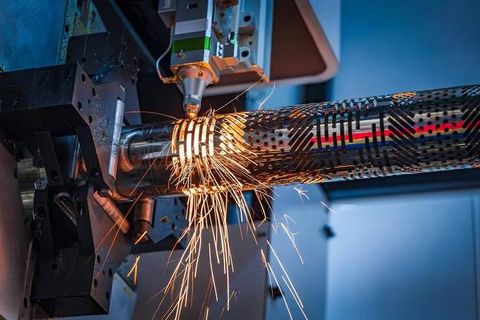
CNC technology allows cutting tools to follow programmed toolpaths generated from digital geometry. Multi-axis machining can position the cutter at different orientations, making it possible to reach curved blade surfaces while maintaining controlled tool engagement.
Automation can also connect machining with inspection. A completed propeller may be measured using coordinate measuring machines, laser scanners, or other metrology equipment. The resulting measurements can then be compared with the original design model.
Typical System Components
| System Component | Main Purpose | Common Application |
|---|---|---|
| Multi-axis CNC machine | Shapes complex surfaces | Blade and hub machining |
| CAM software | Creates machining toolpaths | CNC programming |
| Coordinate measuring machine | Checks dimensions | Precision inspection |
| 3D scanner | Captures surface geometry | Profile comparison |
| Cutting tools | Remove material | Rough and finish machining |
| Balancing equipment | Checks rotational balance | Final verification |
| Digital inspection software | Analyzes measurements | Quality documentation |
Recent Updates
From 2024 through 2026, the marine manufacturing sector has continued moving toward greater digital integration, automation, and data-based quality control. These developments are connected with broader changes in shipbuilding, propulsion technology, computer-aided engineering, and industrial manufacturing.
Digital Propeller Manufacturing
One important trend is the greater use of digital workflows connecting design, simulation, machining, and inspection. A digital model can provide a common reference throughout the manufacturing process, reducing the need to recreate geometry at different production stages.
CAD and CAM platforms increasingly support complex marine components with detailed three-dimensional geometry. Manufacturers can also use simulation to evaluate toolpaths before machining begins, helping identify potential collisions, excessive tool movement, or inefficient cutting sequences.
Five-Axis and Multi-Axis Technology
Five-axis machining remains particularly relevant for complex propeller blades. Instead of moving only along three linear directions, a five-axis machine can combine linear and rotational movements.
This capability allows the cutting tool to approach curved surfaces from more suitable angles. It can reduce the need for multiple setups and help maintain geometric consistency across complicated blade profiles.
Advanced Inspection
Measurement technology has also become more digital. Portable scanners, optical measurement equipment, and coordinate measuring machines can capture large quantities of geometric information.
Inspection software can compare measured data with the original CAD model and identify deviations. This approach is useful when checking blade contours, pitch, thickness, hub dimensions, and other critical characteristics.
New Propulsion Requirements
The growth of alternative marine propulsion technologies is also influencing propeller development. Electric propulsion, hybrid systems, efficiency-focused vessel designs, and specialized underwater propulsion systems can require different propeller configurations.
As propulsion systems evolve, marine propeller machining systems must accommodate increasingly varied geometries and materials. This supports continued interest in flexible CNC equipment and digitally controlled manufacturing.
Laws or Policies
Marine propeller production is influenced by several layers of technical requirements rather than one universal manufacturing rule. Requirements can come from maritime authorities, classification organizations, vessel-specific specifications, environmental regulations, and technical standards.
Maritime and Classification Requirements
Classification organizations establish technical frameworks used for assessing many types of marine equipment and vessels. Depending on the vessel and its intended operation, documentation may be required for materials, manufacturing processes, dimensional inspections, balancing, and final verification.
The applicable requirements vary according to vessel type, propulsion arrangement, operating environment, and classification framework.
Environmental Considerations
Marine manufacturing is also affected by environmental requirements covering industrial emissions, waste handling, metalworking fluids, material management, and pollution prevention. Regulations differ between jurisdictions, so manufacturers normally need to follow the requirements applicable to their production location.
Digital Documentation
Modern manufacturing environments increasingly maintain digital records for design revisions, machining programs, inspection results, and material information. Traceability can help establish which material, process parameters, and inspection results relate to a particular component.
For readers researching marine propeller machining systems, the relevant rules should therefore be considered alongside the technical requirements of the specific vessel and propulsion project.
Tools and Resources
Several categories of tools help readers understand, design, manufacture, and inspect marine propellers. The appropriate combination depends on whether the activity involves engineering design, machining, inspection, education, or production planning.
Design and Engineering Platforms
CAD software is commonly used to create three-dimensional propeller models. Computational fluid dynamics platforms can help engineers study water flow around blades and evaluate design characteristics before physical production.
CAM software then converts suitable geometry into CNC toolpaths. Important functions can include toolpath simulation, collision checking, machining strategy selection, and post-processing for particular CNC controllers.
Inspection Resources
Coordinate measuring machines and three-dimensional scanners are useful for checking finished propellers. Inspection software can compare measured geometry against a reference model and produce dimensional reports.
Other useful resources include:
- CNC machine manuals and programming references
- Cutting-tool catalogs and technical guides
- CAD and CAM training materials
- Metrology documentation
- Marine classification technical publications
- Propeller design references
- Manufacturing process templates
- Digital quality-control records
Choosing a Suitable Machining Approach
The machining approach depends on factors such as propeller diameter, material, blade geometry, production quantity, required accuracy, available machine capacity, and inspection requirements.
A small propeller may require a substantially different setup from a large marine propeller designed for a commercial vessel. Material characteristics also influence cutting parameters, tooling, coolant selection, and machining strategy.
FAQs
What are marine propeller machining systems?
Marine propeller machining systems are combinations of CNC machines, software, cutting tools, inspection equipment, and related manufacturing technologies used to produce and finish marine propellers.
How does CNC machining improve marine propeller manufacturing?
CNC machining provides programmed control over tool movement. Multi-axis CNC systems can follow complex three-dimensional blade geometry and maintain controlled machining paths across curved surfaces.
Why are marine propeller machining systems important for precision manufacturing?
Marine propeller machining systems help manufacturers maintain dimensional accuracy across blade surfaces, hubs, and other features. Digital inspection can then compare the finished component with its intended design.
What materials are used in marine propeller machining?
Common materials include nickel-aluminum bronze, stainless steel, and other corrosion-resistant engineering alloys. Material selection depends on the vessel, operating conditions, mechanical requirements, and design specifications.
What tools are used to inspect marine propellers?
Inspection may involve coordinate measuring machines, three-dimensional scanners, optical measurement systems, gauges, balancing equipment, and specialized software for comparing measured geometry with design data.
Conclusion
Marine propeller machining systems combine digital design, CNC machining, advanced tooling, and precision inspection to manufacture complex propulsion components. Modern production is increasingly connected through CAD, CAM, multi-axis machining, and digital measurement workflows. Regulatory requirements, vessel specifications, material characteristics, and inspection procedures all influence how propellers are manufactured. As marine propulsion technologies continue to evolve, precision manufacturing remains an important part of producing accurately shaped and properly inspected propeller components.