Industrial Welding Machines Guide With Modern Welding Technology and Manufacturing Insights
Industrial welding machines are equipment systems used to join metal parts through controlled heat, pressure, electrical energy, or a combination of these methods. Welding is widely used in manufacturing, construction, transportation, energy equipment, machinery production, metal fabrication, and infrastructure development.
Modern welding developed from early metal-joining techniques into highly controlled industrial processes. Traditional methods depended heavily on manual handling, while modern industrial welding machines can regulate electrical current, welding speed, pressure, shielding gas, and other operating conditions. This has made welding more consistent across different production environments.
Several welding technologies are used in industrial applications. These include arc welding, MIG welding, TIG welding, resistance welding, spot welding, laser welding, and automated robotic welding. Each process has different characteristics and is selected according to material type, thickness, joint design, production requirements, and operating conditions.
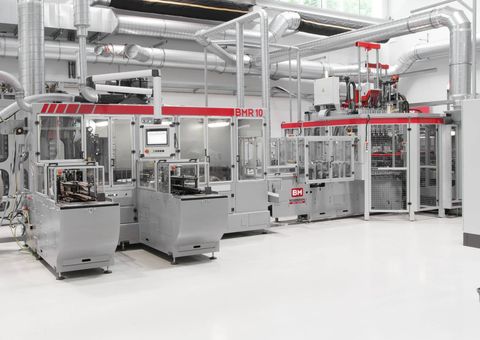
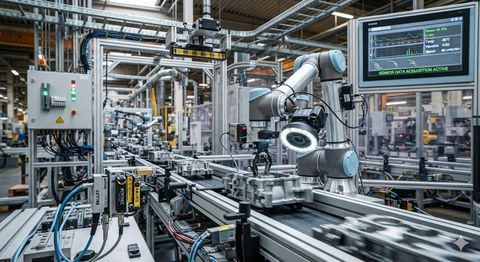
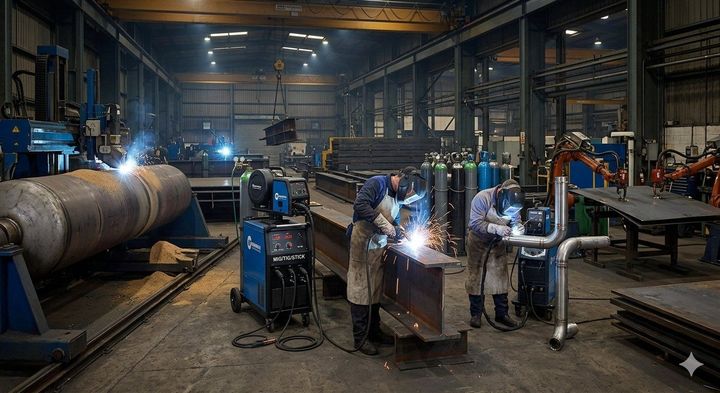
Industrial welding machines may range from compact equipment for fabrication workshops to large automated systems integrated into manufacturing lines. Some systems are manually operated, while others use programmable controls, robotic arms, sensors, cameras, and production software.
The main components can include a power source, welding torch or electrode system, control panel, cooling equipment, shielding-gas system, wire-feeding mechanism, workpiece fixtures, and safety equipment. The exact configuration depends on the welding process and application.
Importance
Industrial welding is important because many manufactured structures depend on permanent metal joints. Welded connections can be found in machinery frames, pipelines, storage structures, vehicles, pressure equipment, agricultural equipment, structural components, and industrial assemblies.
For manufacturers, welding quality can influence dimensional accuracy, structural integrity, production consistency, and material usage. Poorly controlled welding may result in defects such as porosity, cracking, incomplete penetration, distortion, or excessive spatter.
Modern welding technology also addresses production challenges. Automated welding systems can maintain programmed movement patterns, while sensors can monitor selected operating conditions. These capabilities can help reduce variation between repeated welds when the equipment is correctly configured and maintained.
Different industries have different welding requirements:
- Automotive manufacturing uses resistance welding, laser welding, MIG welding, and robotic welding for various assemblies.
- Heavy machinery production commonly uses arc welding processes for structural and fabricated components.
- Construction and structural fabrication use several welding methods depending on material thickness and joint configuration.
- Energy equipment manufacturing may require carefully controlled welding procedures for specialized materials and components.
- General metal fabrication uses MIG welding machines, TIG welding machines, plasma systems, and other equipment for varied applications.
The choice of industrial welding machines therefore depends on more than electrical power. Material compatibility, joint geometry, production volume, operator skill, automation requirements, shielding method, and inspection procedures all influence the selection process.
Recent Updates
Automation and Robotic Welding
One of the major developments during the 2024–2026 period has been continued integration of automation into welding operations. Robotic welding systems increasingly combine programmable motion with sensors, digital controls, machine vision, and monitoring technologies.
Robotic welding can be particularly useful when the same type of weld must be repeated many times. Automated systems can follow programmed paths and maintain defined process parameters, while human workers remain involved in setup, programming, inspection, maintenance, and process supervision.
Digital Welding Controls
Modern welding machines increasingly use digital interfaces instead of basic mechanical controls. Digital systems can provide more precise adjustment of welding parameters and may store selected configurations for repeated production tasks.
Some industrial welding equipment also records operating information. This can support process monitoring and production documentation, although the available functions differ substantially between equipment models.
Laser and Advanced Welding Technology
Laser welding continues to receive attention in manufacturing because concentrated energy can create precise welds in suitable materials and component designs. It can be integrated with automated production systems and is used in applications where controlled heat input and accurate positioning are important.
Other developments include improved inverter-based power sources, automated wire feeding, real-time process monitoring, collaborative robotic systems, and sensor-based inspection.
Comparison of Common Welding Technologies
| Welding Technology | Common Materials | Typical Application | Automation Potential |
|---|---|---|---|
| MIG Welding | Steel, stainless steel, aluminum | Fabrication and assemblies | High |
| TIG Welding | Stainless steel, aluminum, specialty metals | Precision welding | Medium to high |
| Resistance Welding | Sheet metals | Vehicle and component assembly | High |
| Spot Welding | Thin metal sheets | Repeated sheet-metal joints | High |
| Laser Welding | Various compatible metals | Precision manufacturing | High |
| Arc Welding | Steel and other metals | Heavy fabrication | Medium to high |
Modern industrial welding machines are also being connected with broader manufacturing systems. Data collection, programmable controls, equipment diagnostics, and production monitoring can make welding equipment part of a digitally managed manufacturing environment.
Laws or Policies
Workplace Safety Requirements
Welding operations are generally subject to workplace safety requirements concerning electrical hazards, fire prevention, fumes, radiation, compressed gases, machinery movement, and personal protective equipment. Exact requirements vary according to the country, industry, workplace, and welding process.
Welding areas normally require appropriate ventilation or fume-control measures because welding can produce airborne particles and gases. The specific control method depends on the materials, consumables, welding process, and workplace conditions.
Equipment and Electrical Safety
Industrial welding machines must be operated according to applicable electrical and equipment-safety requirements. Proper grounding, electrical protection, cable management, equipment inspection, and maintenance are important parts of safe operation.
Manufacturers and workplaces may also follow recognized technical standards for welding procedures, personnel qualification, inspection, and equipment performance. Standards can differ by jurisdiction and application, so industrial organizations normally identify the requirements applicable to their particular operation.
Environmental Considerations
Environmental policies may also influence welding facilities through requirements related to air emissions, waste materials, energy consumption, and industrial operations. Welding fumes, used consumables, metal waste, and shielding gases may require appropriate handling depending on local regulations.
Government programs in many regions increasingly support industrial modernization, energy efficiency, advanced manufacturing, and automation. The specific eligibility rules and programs differ between jurisdictions and should be checked against current local requirements.
Tools and Resources
Welding Parameter Calculators
Welding calculators can help users estimate relationships between variables such as current, voltage, wire-feed rate, travel speed, material thickness, and heat input. These tools are useful for understanding process relationships, although actual settings depend on equipment, materials, joint design, and qualified procedures.
Welding Procedure Templates
Welding procedure templates can organize information such as base material, joint type, electrode or wire specification, shielding gas, welding position, current range, voltage range, and inspection requirements.
Welding Inspection Tools
Common inspection resources include visual inspection equipment, weld gauges, temperature measurement devices, and non-destructive testing systems. More advanced inspection can involve ultrasonic testing, radiographic testing, magnetic-particle testing, or dye-penetrant testing, depending on the material and application.
Manufacturer Documentation and Technical Platforms
Equipment manuals, technical datasheets, welding handbooks, training platforms, CAD software, production-management systems, and industrial automation software can provide useful technical information. Documentation should be checked for the specific welding machine and process being used.
Robotic Welding Software
Robotic welding systems commonly use programming and simulation software to define movement paths, welding parameters, fixtures, and production sequences. Simulation can help identify movement conflicts and positioning problems before a production sequence is implemented.
FAQs
What are industrial welding machines used for?
Industrial welding machines are used to join metal components in manufacturing, fabrication, construction, transportation, machinery production, and other industrial applications. The appropriate machine depends on the material, joint design, thickness, and production method.
How does MIG welding differ from TIG welding?
MIG welding generally uses a continuously fed wire electrode and is widely used for production and fabrication. TIG welding uses a non-consumable tungsten electrode and provides greater control for many precision applications.
What is robotic welding?
Robotic welding uses programmable robotic equipment to move a welding tool along defined paths. Robotic welding can support repeated production tasks and may incorporate sensors, fixtures, monitoring systems, and automated parameter controls.
How do modern welding machines improve manufacturing?
Modern welding machines can provide digital parameter controls, automated wire feeding, programmable operations, process monitoring, and integration with robotic systems. These features can improve process consistency when properly configured.
What safety equipment is needed for industrial welding?
Typical welding safety equipment can include an appropriate welding helmet, protective clothing, gloves, safety footwear, eye protection, hearing protection where necessary, and suitable ventilation or fume-control equipment. Requirements depend on the welding process and workplace conditions.
Conclusion
Industrial welding machines have developed from manually controlled equipment into sophisticated systems incorporating digital controls, automation, sensors, robotics, and advanced welding technologies. MIG welding, TIG welding, resistance welding, laser welding, and robotic welding each serve different manufacturing requirements. Safety regulations, technical standards, inspection procedures, and environmental requirements also influence how welding equipment is operated. Understanding the differences between welding processes helps explain how modern manufacturing achieves controlled and repeatable metal joining.