Industrial Plastic Molding Details: Machine Types, Molding Methods, Materials and Applications
Industrial plastic molding is a manufacturing process used to create plastic components by shaping heated or liquid plastic inside a mold. It is used for products ranging from automotive components and electrical housings to packaging parts, medical equipment components, appliance panels, and industrial machine parts. Industrial plastic molding details include machine types, molding methods, plastic materials, mold designs, production stages, and common applications.
Plastic molding developed as manufacturers looked for practical ways to produce consistent shapes in larger quantities. Early plastic processing methods were relatively simple, but improvements in polymers, machinery, mold design, and automation have expanded the range of products that can be manufactured.
How Industrial Plastic Molding Works
Most molding processes follow a basic sequence. Plastic material is prepared, heated or otherwise made flowable, introduced into a mold, shaped under controlled conditions, and then cooled or cured. The finished component is removed after it reaches sufficient dimensional stability.
The exact process depends on the plastic material and the required shape. Some methods use pressure to force plastic into a mold, while others use air pressure, rotation, compression, or a combination of heat and pressure.
Main Stages
A typical molding cycle includes several stages:
- Material preparation involves drying, mixing, or preparing plastic pellets, powder, sheets, or other feedstock.
- Plasticizing changes the material into a suitable form for molding.
- Mold filling places the material into the mold cavity.
- Cooling or curing allows the component to retain its intended shape.
- Ejection removes the molded component from the mold.
- Inspection checks dimensions, appearance, and other required characteristics.
Importance
Industrial plastic molding is important because many modern products require lightweight components with repeatable shapes and controlled dimensions. Plastic can also provide characteristics such as electrical insulation, chemical resistance, low density, and resistance to moisture, depending on the selected polymer.
The process affects manufacturers, product designers, maintenance teams, engineers, packaging producers, automotive industries, electronics manufacturers, and consumers. The choice of molding method can influence production speed, component geometry, material selection, surface appearance, and waste generation.
Problems Addressed by Plastic Molding
Plastic molding can address several manufacturing challenges. Complex shapes can often be produced without assembling many separate pieces, while molds can establish consistent dimensions across repeated production cycles.
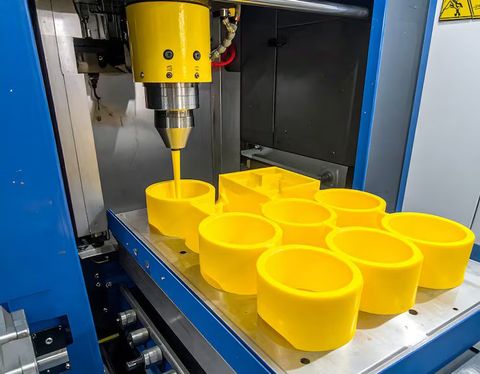
Different molding processes also allow manufacturers to work with different product sizes and material characteristics. For example, injection molding is commonly associated with rigid precision components, while rotational molding can be used for larger hollow products.
Common Industrial Applications
Industrial plastic molding appears in many areas, including:
- Automotive interiors, covers, brackets, housings, and structural plastic components
- Electrical and electronic enclosures, connectors, switches, and protective parts
- Packaging containers, closures, caps, and protective packaging components
- Industrial equipment housings, handles, guards, tanks, and covers
- Consumer appliances such as panels, knobs, internal components, and housings
- Agricultural equipment components and irrigation-related plastic parts
- Medical and laboratory equipment components where appropriate material and manufacturing controls are applied
The required properties of the finished component determine which polymer and molding method are suitable.
Recent Updates
From 2024 through 2026, industrial plastic molding has continued moving toward greater automation, process monitoring, material efficiency, and digital production control. Modern molding equipment increasingly incorporates sensors and computerized controls to monitor variables such as temperature, pressure, cycle conditions, and machine performance.
Automation and Digital Monitoring
Automated material handling, robotic part removal, vision inspection, and machine monitoring are increasingly connected with molding production systems. These technologies can help manufacturers collect process information and identify variations during production.
Computer-aided engineering is also used during mold and component development. Simulation tools can help examine material flow, cooling behavior, filling patterns, and potential design issues before physical production.
Material Developments
Material selection is receiving increased attention as industries examine recycled polymers, recyclable designs, bio-based materials, and lightweight engineering plastics. The suitability of these materials depends on factors such as mechanical requirements, thermal conditions, contamination levels, processing behavior, and intended application.
Manufacturers are also examining ways to reduce material waste through improved mold design, controlled processing parameters, and reuse of suitable production scrap.
Energy and Process Efficiency
Energy consumption has become an important consideration in molding operations. Modern machines may use improved heating systems, variable-speed drives, electric actuation, and process controls to manage energy use.
However, energy performance varies by machine design, material, product geometry, operating conditions, and production volume. A specific technology does not automatically provide the same results in every application.
Laws or Policies
Industrial plastic molding is influenced by environmental, workplace, product-safety, and waste-management requirements. The exact rules depend on the country, product category, plastic material, and industrial activity.
Regulations in India
In India, plastic manufacturing and waste management are influenced by rules issued under the country's environmental framework. The Plastic Waste Management Rules establish requirements concerning plastic waste handling, while Extended Producer Responsibility provisions apply to specified plastic packaging activities.
Industrial facilities may also need to follow applicable pollution-control requirements concerning emissions, waste, wastewater, and manufacturing operations. Requirements can vary according to the nature and scale of the facility.
Workplace safety is another consideration. Plastic molding machinery can involve heated surfaces, moving mechanisms, electrical systems, hydraulic equipment, and pressurized components. Facilities therefore need appropriate safety procedures, machine guarding, training, and workplace controls under applicable occupational and industrial requirements.
For specific compliance decisions, manufacturers should refer to current rules issued by relevant Indian authorities and applicable state-level regulatory bodies.
Tools and Resources
Several technical tools help explain, design, monitor, and evaluate industrial plastic molding processes.
Design and Simulation Tools
Computer-aided design software is used to create component and mold geometry. Plastic-flow simulation tools can examine how material may fill a cavity and how cooling or shrinkage can affect the final component.
These tools can be useful during development because changes to geometry, gate locations, wall thickness, cooling arrangements, and material selection can be examined before physical mold production.
Production Monitoring Tools
Modern molding equipment may use sensors and digital controllers to monitor process conditions. Common measurements include:
- Injection pressure
- Melt temperature
- Mold temperature
- Cycle time
- Cooling time
- Machine energy consumption
- Material usage
- Part weight
Production data can be recorded and reviewed to identify process variations and maintain manufacturing records.
Reference Resources
Useful resources include government environmental agencies, plastics industry associations, polymer manufacturer technical datasheets, machinery manuals, mold-design references, and engineering standards. Material datasheets are particularly useful because they provide information about processing temperatures, mechanical characteristics, thermal properties, and other material-specific considerations.
Comparison of Common Molding Methods
| Molding Method | Typical Material Form | Common Applications | Main Process Characteristic |
|---|---|---|---|
| Injection Molding | Plastic pellets | Housings, automotive parts, components | Material is injected into a mold |
| Blow Molding | Heated plastic or preform | Bottles, containers, hollow parts | Air expands plastic against a mold |
| Rotational Molding | Plastic powder | Tanks, bins, large hollow products | Mold rotates while material forms against its walls |
| Compression Molding | Sheet, pellets, or compound | Industrial and electrical parts | Material is shaped under heat and pressure |
| Thermoforming | Plastic sheet | Trays, panels, packaging | Heated sheet is formed over a mold |
| Extrusion Molding | Plastic pellets | Pipes, profiles, films | Continuous material is pushed through a die |
Common Plastic Materials
Different polymers provide different combinations of strength, flexibility, temperature resistance, chemical resistance, transparency, and impact performance. Frequently used materials include polyethylene, polypropylene, polyvinyl chloride, polystyrene, acrylonitrile butadiene styrene, polyamide, polycarbonate, and engineering thermoplastics.
Material selection depends on the intended application. A component exposed to heat may require a polymer with suitable thermal performance, while an electrical enclosure may require appropriate insulating characteristics. Chemical exposure, ultraviolet radiation, moisture, impact, and mechanical loads can also affect material selection.
FAQs
What is industrial plastic molding?
Industrial plastic molding is a manufacturing process in which plastic material is shaped using a mold. Depending on the process, heat, pressure, air, or rotation may be used to create the required component geometry.
What are the main types of plastic molding machines?
Common industrial plastic molding machines include injection molding machines, blow molding machines, rotational molding machines, compression molding equipment, and thermoforming equipment. Machine selection depends on the product design, material, size, production requirements, and molding method.
Which materials are used in industrial plastic molding?
Industrial plastic molding can use materials such as polyethylene, polypropylene, PVC, ABS, polystyrene, polyamide, and polycarbonate. Each polymer has different physical, thermal, chemical, and processing characteristics.
What are common plastic molding methods?
Common plastic molding methods include injection molding, blow molding, rotational molding, compression molding, and thermoforming. Extrusion is also widely used for continuous plastic products such as pipes, films, and profiles.
How is a plastic molding method selected?
Selection generally considers product geometry, material properties, component dimensions, surface requirements, production volume, dimensional requirements, and operating conditions. Mold design and machine capabilities are also important factors.
Conclusion
Industrial plastic molding uses different machines, materials, and forming methods to produce components for automotive, electronics, packaging, industrial, agricultural, and consumer applications. Injection molding, blow molding, rotational molding, compression molding, and thermoforming each have different process characteristics and suitable applications. Recent developments have emphasized automation, digital monitoring, material efficiency, recycling considerations, and improved process control. Applicable environmental and workplace requirements also play an important role in how plastic molding operations are managed.