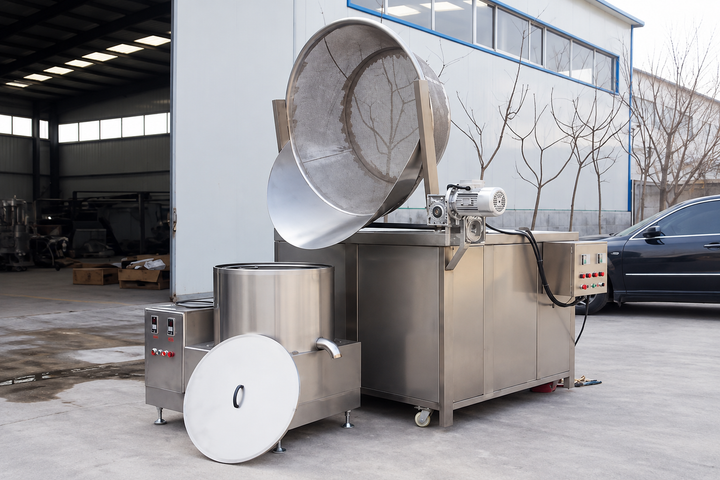
Industrial Deep Fryers Guide: Types, Equipment, Working Processes and Food-Industry Uses
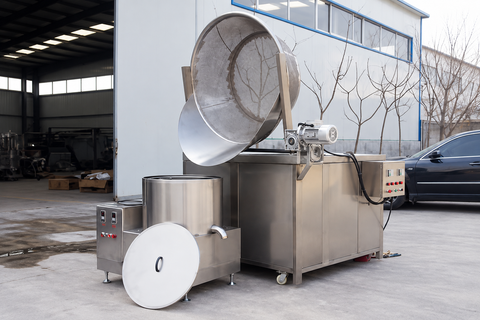
Industrial deep fryers are commercial food-processing machines designed to cook products by immersing them in heated cooking oil or another suitable frying medium. They are used in food manufacturing facilities, commercial kitchens, prepared-food production, snack processing, and other environments where frying is performed in repeated or continuous batches.
Context
Unlike small household fryers, industrial deep fryers are designed around larger production volumes, controlled temperatures, consistent cooking conditions, and integration with other food-processing equipment. Depending on the application, a fryer may operate as a batch system or as part of a continuous production line.
The basic frying process involves transferring heat from the heated oil to the food. As the food enters the fryer, moisture near the surface begins to evaporate while the exterior develops its characteristic texture and color. The precise result depends on factors such as oil temperature, frying time, product size, moisture content, oil movement, and the formulation of the food.
Industrial deep fryers can be used for products such as potato products, coated foods, snacks, dough-based foods, vegetables, seafood, and various prepared foods. Different products require different equipment configurations, so fryer design is closely connected with the production process.
Main equipment components
A typical industrial fryer may contain several connected components:
- Frying tank or chamber for holding the frying medium
- Heating system for bringing the oil to the required temperature
- Conveyor or product-handling mechanism for moving food through the fryer
- Temperature controls for maintaining operating conditions
- Oil filtration equipment for removing food particles
- Exhaust or ventilation arrangements for managing heat and vapors
- Drainage and collection components for handling oil
- Control panel for monitoring and adjusting operating parameters
The exact configuration varies according to product characteristics, production volume, and the type of frying process.
Importance
Industrial frying is an important food-processing method because it can produce a recognizable texture, color, and flavor while allowing repeated processing under controlled conditions. Maintaining consistent conditions becomes particularly important when large quantities of similar products are prepared.
Frying equipment also needs to manage several variables simultaneously. Excessive heat can affect product quality and accelerate oil degradation, while insufficient heat can increase cooking time and influence moisture retention.
Where industrial deep fryers are used
Industrial deep fryers appear across several food-processing categories. Common applications include:
- Potato and vegetable products
- Fried snack products
- Breaded and battered foods
- Dough-based foods
- Prepared frozen foods
- Seafood and protein-based foods
- Extruded and formed snack products
The same fryer design may not be appropriate for every application. A thin snack product can behave very differently in hot oil from a thick coated product, which is why fryer selection is normally connected to the characteristics of the food being processed.
Batch and continuous frying
Two broad operating approaches are batch frying and continuous frying. Batch systems process a defined quantity of food during each frying cycle, while continuous systems move products through the frying zone using conveyors or related handling mechanisms.
| Fryer approach | Operating method | Typical application |
|---|---|---|
| Batch fryer | Product is added and removed in individual cycles | Variable product batches |
| Continuous fryer | Product moves continuously through heated oil | Repeated high-volume production |
| Conveyor fryer | Product movement is controlled mechanically | Uniform products requiring controlled residence time |
| Pressure fryer | Frying occurs under controlled pressure | Certain specialized food applications |
The appropriate configuration depends on production requirements rather than on a single universal design.
Recent Updates
Industrial frying technology has increasingly focused on process control, energy management, oil monitoring, automation, and integration with wider food-production lines. Modern systems may use digital controls, automated temperature regulation, sensors, programmable operating parameters, and data collection.
Automation can reduce the amount of manual adjustment required during repetitive production. Sensors may monitor temperature, oil conditions, product movement, or other process variables, allowing operators to identify deviations more quickly.
Energy and process efficiency
Heating oil requires substantial energy, so fryer design increasingly considers heat transfer and energy recovery. Insulation, controlled heating, heat exchangers, and exhaust-heat management can influence overall energy use.
Modern fryer systems may also be integrated with upstream and downstream equipment. For example, a food-processing line can connect product preparation, frying, oil removal, cooling, seasoning, inspection, and packaging into a coordinated sequence.
Oil management
Oil condition is another area receiving attention in industrial frying. Food particles, moisture, oxygen, heat, and repeated use can gradually change frying oil characteristics.
Filtration systems can remove particles from the oil, while monitoring equipment can help track oil-related parameters. These systems do not eliminate the need for appropriate oil handling practices, but they can make process monitoring more systematic.
Automation and data monitoring
Industrial food equipment is increasingly connected to digital control systems. Fryers may record operating temperatures, production intervals, alarms, and other process information.
Data can help production teams identify changes in operating conditions and compare different production runs. The usefulness of such systems depends on sensor accuracy, proper calibration, data interpretation, and the way information is incorporated into production procedures.
Laws or Policies
Industrial deep fryers are affected by food-safety requirements, workplace-safety rules, equipment standards, fire-safety provisions, electrical requirements, and environmental regulations. Exact requirements vary by jurisdiction and by the type of facility in which the equipment operates.
Food-processing facilities generally need procedures covering hygienic handling, contamination prevention, cleaning, equipment maintenance, and safe food production. Frying equipment can also create heat, oil vapors, and fire hazards, making ventilation and fire-prevention measures important parts of facility planning.
Food and equipment requirements
Regulatory frameworks may address areas such as:
- Food-contact materials
- Sanitation and cleaning procedures
- Temperature monitoring
- Cooking-process controls
- Oil handling and disposal
- Electrical safety
- Fire prevention and suppression
- Worker protection
- Ventilation and exhaust management
Equipment used in food production may also need to meet applicable machinery, electrical, pressure, or sanitation standards. The relevant requirements depend on the equipment configuration and jurisdiction.
Operators should distinguish between food-safety requirements and equipment compliance requirements. A machine can meet an equipment standard while the facility still needs separate procedures for sanitation, food handling, ventilation, and workplace safety.
Tools and Resources
Several practical resources can help people understand, operate, monitor, and maintain industrial deep frying processes.
Temperature measurement tools
Calibrated temperature sensors and suitable thermometers can help monitor frying conditions. Consistent temperature measurement is important because the temperature displayed by a control system may not always represent conditions at every point within a fryer.
Oil monitoring tools
Oil-quality testing instruments can measure selected characteristics associated with frying oil condition. Depending on the equipment, these tools may assess parameters related to oil degradation or help identify changes during repeated frying cycles.
Production records
A structured frying log can record:
- Product type
- Batch or production period
- Oil temperature
- Frying duration
- Oil condition observations
- Filtration activity
- Cleaning activity
- Equipment alarms or interruptions
These records can help identify recurring process changes and provide documentation for internal production procedures.
Equipment manuals and standards
Manufacturer documentation contains information about operating ranges, cleaning procedures, maintenance requirements, component specifications, and safety precautions. Applicable food-safety authorities and recognized technical standards can provide additional guidance on hygienic production and equipment operation.
Process calculations
Production planners may also use calculations involving fryer capacity, product throughput, residence time, heat requirements, and oil volume. These calculations help connect fryer specifications with the wider production line.
FAQs
What is an industrial deep fryer?
An industrial deep fryer is food-processing equipment that cooks food by immersing it in heated cooking oil or another frying medium. Industrial models are designed for repeated production and can use batch or continuous operating methods.
How does an industrial deep fryer work?
An industrial deep fryer heats the frying medium to a controlled temperature and transfers heat to food placed in the frying zone. Depending on the design, conveyors, baskets, pumps, filtration systems, and temperature controls manage product movement and frying conditions.
What are the main types of industrial deep fryers?
Common categories include batch fryers, continuous fryers, conveyor fryers, and specialized pressure fryers. The appropriate configuration depends on the product, production process, throughput requirements, and desired cooking characteristics.
How is oil managed in industrial deep fryers?
Oil management can include temperature control, filtration, particle removal, monitoring, replenishment, and appropriate disposal procedures. The specific process depends on the fryer design, food product, oil type, and applicable food-safety procedures.
What factors affect industrial deep fryer performance?
Important factors include oil temperature, frying time, product size, moisture content, product loading, oil circulation, filtration, heating capacity, and conveyor speed. Changes in any of these variables can influence the final food characteristics and process consistency.
Conclusion
Industrial deep fryers use controlled immersion frying to process food products across a range of commercial and manufacturing applications. Batch, continuous, conveyor, and specialized fryer designs differ in how they manage product movement, heating, and production cycles. Modern systems increasingly incorporate automation, temperature monitoring, oil management, energy-conscious design, and data collection. Safe operation also depends on applicable food-safety, equipment, fire-prevention, sanitation, and workplace requirements.