Hydraulic Press Machines Overview: Machine Types, Features and Industrial Applications
Hydraulic press machines are industrial machines that use pressurized fluid to generate force for forming, shaping, compressing, bending, punching, and other manufacturing processes. The basic principle is based on hydraulic pressure: a relatively small force applied to a confined fluid can be transferred through the fluid to produce a larger force at another point.
Context
The concept comes from Pascal's law, which describes how pressure applied to a confined fluid is transmitted throughout that fluid. This principle became important in mechanical engineering because it provided a practical way to generate controlled pressing forces without relying entirely on mechanical arrangements such as screws, cams, or direct impact mechanisms.
A typical hydraulic press machine contains a hydraulic pump, reservoir, valves, cylinders, hoses or pipes, a frame, and a control system. Hydraulic fluid is directed into a cylinder, where pressure causes a piston to move. The movement of this piston produces the force required for the particular manufacturing operation.
Hydraulic presses are used across industries because the same basic technology can be adapted for different materials, component sizes, production requirements, and forming processes. Machine configurations range from compact workshop presses to large industrial systems used for metal forming and heavy manufacturing.
How hydraulic pressing works
The operation begins when a hydraulic pump moves fluid from a reservoir into the hydraulic circuit. Valves control the direction and amount of fluid entering the cylinder.
As fluid enters the cylinder, pressure acts on the piston. The resulting piston movement transfers force to a ram, tooling assembly, or other working component.
The relationship between pressure, piston area, and force is important when understanding hydraulic press machines. In simplified terms, hydraulic force can be represented as:
Force = Pressure × Piston Area
Actual machine performance also depends on hydraulic-system design, mechanical losses, tooling, operating conditions, and control settings.
Main components
Common hydraulic press components include:
- Hydraulic cylinder for converting fluid pressure into mechanical movement
- Hydraulic pump for circulating pressurized fluid
- Reservoir for holding hydraulic fluid
- Valves for controlling pressure and fluid direction
- Ram or platen for applying force to the workpiece
- Frame for supporting the pressing load
- Control system for operating machine movements and settings
- Tooling or dies designed for a particular manufacturing process
Importance
Hydraulic press machines are important because many manufacturing processes require controlled force rather than simple cutting or impact. Materials such as sheet metal, plastics, rubber, composites, and other industrial materials can require different combinations of pressure, movement, temperature, tooling, and holding time.
A hydraulic press can provide controlled movement and substantial force over a defined stroke. This makes the technology useful for processes where material needs to be compressed, formed, molded, or reshaped.
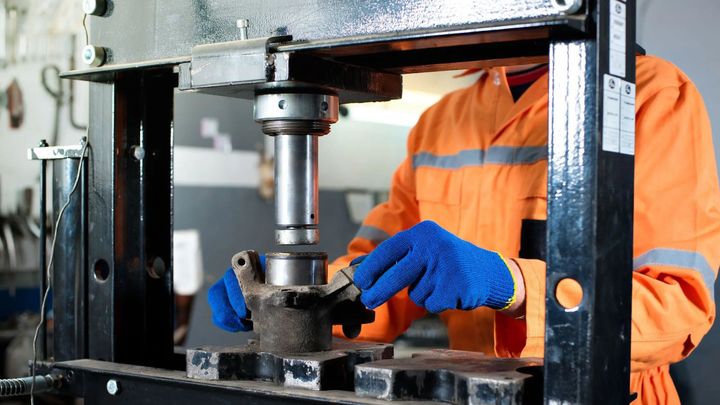
Hydraulic pressing also plays a role in repair and maintenance environments. Workshop presses can be used for tasks such as pressing bearings, bushings, shafts, and other components where controlled mechanical force is required.
Common industrial applications
Hydraulic presses are used in a wide range of applications, including:
- Sheet-metal forming and bending
- Deep drawing
- Compression molding
- Rubber molding
- Plastic processing
- Forging operations
- Component assembly
- Bearing and bushing installation
- Straightening metal components
- Powder compaction
- Scrap and material compaction
The exact application depends on the machine's force capacity, working area, stroke length, speed, tooling arrangement, and control system.
Types of hydraulic press machines
Different press configurations are designed around particular production requirements.
| Press type | General configuration | Typical applications |
|---|---|---|
| H-frame press | Four-sided structural frame with working area | Workshop and general pressing |
| C-frame press | Open-front frame | Forming, punching and component work |
| Four-column press | Four supporting columns around the working area | Molding and larger forming processes |
| Horizontal press | Working movement arranged horizontally | Bending, straightening and forming |
| Hydraulic forging press | Designed for substantial forming forces | Metal forging and shaping |
| Laminating press | Uses controlled pressure across layers | Composite and laminated materials |
H-frame presses provide a rigid structure around the working area and are commonly associated with general-purpose pressing tasks. C-frame configurations provide access from the front and are used where easier loading and unloading are important.
Four-column presses distribute structural loads through four columns and can accommodate relatively large working areas. Horizontal presses change the direction of movement and can be useful for particular bending and straightening operations.
Features that influence machine operation
Hydraulic press specifications can vary considerably. Important features include maximum pressing force, cylinder arrangement, stroke length, working-table dimensions, operating speed, pressure-control range, and control-system configuration.
The type of hydraulic circuit also influences how a press behaves during operation. Some systems are designed for simple manual control, while others incorporate programmable controls, sensors, position monitoring, and automated sequences.
Recent Updates
From 2024 through 2026, hydraulic press technology has continued to develop around automation, energy management, condition monitoring, digital controls, and integration with modern manufacturing systems.
One notable trend is the use of variable-speed or variable-displacement hydraulic systems. Instead of operating hydraulic components continuously at a fixed level, these approaches can adjust system operation according to demand. The objective is to reduce unnecessary energy use during portions of the operating cycle.
Digital controls and monitoring
Modern hydraulic presses can incorporate programmable logic controllers, digital displays, pressure sensors, position sensors, and electronic monitoring systems. These components allow machine operators to observe operating conditions and control sequences more precisely.
Data collection can also support maintenance planning. Monitoring pressure, temperature, cycle information, or other operating parameters can help identify changes in machine behavior that may require inspection.
Integration with manufacturing systems
Industrial presses are increasingly being connected with broader production systems. Depending on the machine and factory environment, information may be exchanged with production-monitoring platforms or manufacturing execution systems.
Automation can also include robotic loading and unloading, automatic die changes, material handling, and programmed pressing sequences. The degree of automation varies considerably between applications.
Hydraulic and electric technologies
Another continuing development is the comparison between traditional hydraulic systems and electrically driven alternatives. Electric servo systems can provide precise motion control in some applications, while hydraulic systems remain relevant where substantial force and particular forming characteristics are required.
The appropriate technology depends on factors such as force requirements, stroke, speed, duty cycle, material characteristics, precision requirements, energy consumption, and machine configuration.
Laws or Policies
Hydraulic press machines are subject to workplace safety requirements, machinery regulations, electrical requirements, and occupational health and safety rules. The exact requirements depend on the country, industry, machine configuration, and intended use.
Safety frameworks commonly address hazards such as crushing, shearing, unexpected movement, stored hydraulic energy, electrical hazards, hot surfaces, and tooling failure. Machine guarding and appropriate control arrangements are important parts of safe operation.
International standards can also provide technical guidance for machinery safety. ISO 16092 is a series of standards addressing machine tools, including safety requirements for presses. Different parts of the series address different press technologies and associated hazards.
Safety considerations
A hydraulic press should be operated according to its technical documentation and applicable workplace requirements. Important safety elements can include:
- Guards around hazardous moving areas
- Emergency-stop arrangements where applicable
- Appropriate control systems
- Pressure and overload protection
- Correctly secured tooling
- Inspection of hydraulic hoses and connections
- Lockout and isolation procedures during maintenance
- Operator training appropriate to the equipment
Hydraulic systems can retain stored energy even when a machine is not actively moving. Maintenance procedures therefore need to account for pressure release and other forms of stored energy before work begins.
Tools and Resources
Several technical resources can help readers understand hydraulic press machines and their operating requirements.
Force calculations
Hydraulic force calculations can provide a basic understanding of how pressure and piston area relate to output force. Hydraulic engineering references and manufacturer documentation commonly provide equations and technical tables for more detailed calculations.
A simplified calculation is:
Hydraulic force = Hydraulic pressure × Effective piston area
For practical machine selection or engineering design, additional factors such as efficiency, pressure losses, cylinder geometry, tooling forces, and safety margins need to be considered.
Technical manuals and diagrams
Machine manuals can provide information about hydraulic circuits, pressure settings, lubrication requirements, component identification, maintenance procedures, and operating sequences.
Hydraulic circuit diagrams are also useful for understanding how pumps, cylinders, valves, reservoirs, filters, and pressure-control components interact.
Standards and technical references
International standards organizations and national workplace-safety authorities publish information relevant to machinery safety. Engineering textbooks, hydraulic-system references, technical drawings, and equipment documentation can also help readers understand specific press configurations.
Maintenance records
A maintenance record can document inspections, hydraulic-fluid checks, hose condition, unusual operating behavior, tooling changes, and other relevant observations. Such records can help organize routine equipment management.
FAQs
What is a hydraulic press machine?
A hydraulic press machine uses pressurized fluid to generate controlled mechanical force. The hydraulic system moves a piston or ram, which applies force to a workpiece through suitable tooling.
What are the main types of hydraulic press machines?
Common types include H-frame presses, C-frame presses, four-column presses, horizontal presses, forging presses, and laminating presses. Their structural arrangements and operating characteristics differ according to the intended application.
What are hydraulic press machines used for?
Hydraulic presses can be used for metal forming, bending, deep drawing, forging, compression molding, powder compaction, component assembly, straightening, and other processes requiring controlled mechanical force.
What features should be considered in a hydraulic press machine?
Important specifications include pressing force, stroke length, working area, operating speed, pressure range, cylinder arrangement, control system, tooling configuration, and safety features. The relevant specifications depend on the material and manufacturing process.
Are hydraulic presses suitable for automated manufacturing?
Hydraulic presses can be integrated into automated production systems using programmable controls, sensors, robotic material handling, and production-monitoring systems. The level of automation depends on the machine design and manufacturing process.
Conclusion
Hydraulic press machines use controlled fluid pressure to generate mechanical force for forming, molding, pressing, bending, forging, and other industrial processes. Different configurations, including H-frame, C-frame, four-column, horizontal, and forging presses, address different manufacturing requirements. Recent developments have focused on digital controls, automation, monitoring, and energy management while hydraulic technology continues to be used where substantial controlled force is required. Safe operation depends on suitable machine design, correct tooling, appropriate safeguards, maintenance procedures, and compliance with applicable machinery requirements.