Hydraulic Cylinders Guide: Designs, Functions, Hydraulic Systems and Key Performance Factors
Hydraulic cylinders are mechanical actuators that convert pressurized hydraulic fluid into controlled linear movement. They are widely used in construction equipment, agricultural machinery, manufacturing systems, lifting equipment, material-handling machines, and many other hydraulic systems. A hydraulic cylinder can push, pull, lift, tilt, clamp, or position a load, depending on its design and connection to the wider hydraulic circuit.
Context
What a Hydraulic Cylinder Does
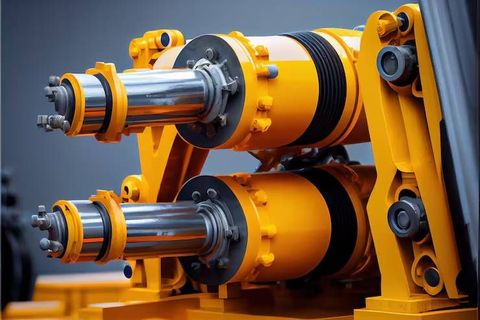
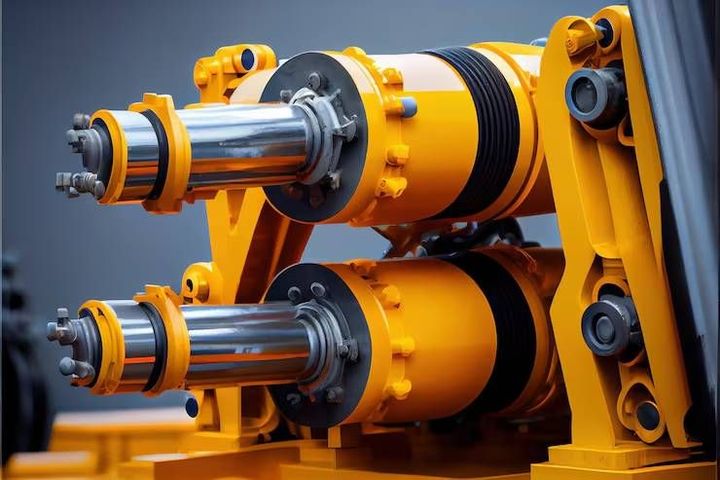
A hydraulic cylinder usually contains a barrel, piston, piston rod, seals, and connection points. Hydraulic fluid enters one side of the cylinder and acts on the piston. The resulting force moves the piston and rod in a straight line.
The basic principle is based on pressure acting over an area. When hydraulic pressure reaches the piston, the cylinder produces linear force. The amount of force depends on pressure and effective piston area, while movement speed is influenced by fluid flow and cylinder dimensions.
Main Hydraulic Cylinder Designs
Several hydraulic cylinder designs are used for different movement requirements.
- Single-acting cylinders use hydraulic pressure for movement in one direction and rely on gravity, a spring, or an external force for the return movement.
- Double-acting cylinders use hydraulic pressure on both sides of the piston, allowing controlled movement in both directions.
- Telescopic cylinders contain multiple nested stages and can produce a long stroke from a relatively compact closed length.
- Tie-rod cylinders use rods and end caps to hold the cylinder assembly together and are common in industrial machinery.
- Welded cylinders have components joined through welding and are often used where compact construction and resistance to demanding operating conditions are required.
How Hydraulic Systems Work With Cylinders
A hydraulic cylinder is only one part of a complete hydraulic system. A typical arrangement includes a reservoir, pump, valves, hoses or pipes, filters, pressure-control components, and the cylinder.
The pump moves hydraulic fluid through the system. Valves direct the fluid toward a selected cylinder chamber and control movement. Pressure-control components help regulate system pressure, while the reservoir stores fluid and provides space for thermal expansion and air separation.
Importance
Why Hydraulic Cylinders Matter
Hydraulic cylinders are important because they provide linear motion for machines that require controlled movement and substantial force. They can be used for lifting a bucket, extending an arm, opening a gate, moving a press, steering equipment, or positioning a component.
Their operation affects both machine function and safety. Incorrect cylinder sizing, unsuitable pressure, poor alignment, damaged seals, or contaminated hydraulic fluid can cause slow movement, leakage, uneven motion, or unexpected machine behavior.
Key Performance Factors
Several factors influence hydraulic cylinder performance:
- Bore diameter: A larger piston area can produce more force at the same pressure.
- Rod diameter: Rod size affects strength, buckling resistance, and the effective area during retraction.
- Stroke length: This determines how far the piston rod can travel.
- Operating pressure: The cylinder and connected components must be suitable for the pressure used by the hydraulic system.
- Flow rate: Fluid flow influences how quickly the cylinder extends or retracts.
- Mounting and alignment: Poor alignment can create side loads and increase wear.
- Seal condition: Seals help retain fluid and reduce the entry of external contamination.
- Fluid cleanliness: Particles and contamination can damage precision surfaces, valves, and seals.
- Temperature: Hydraulic fluid properties change with temperature, affecting system behavior.
Basic Cylinder Calculations
A simple force calculation helps explain cylinder sizing. The theoretical extension force is approximately pressure multiplied by piston area. For retraction, the rod area is subtracted from the piston area because the rod occupies part of the pressure area.
For example, a cylinder with a 50 mm bore has a piston area of about 1,963 square millimeters. At 10 MPa pressure, its theoretical extension force is about 19.6 kN before losses caused by friction and other system effects.
| Factor | What it influences | Common measurement |
|---|---|---|
| Bore diameter | Piston area and force | mm |
| Rod diameter | Retraction area and rod strength | mm |
| Stroke | Linear travel | mm |
| Pressure | Force potential | MPa or bar |
| Flow rate | Movement speed | L/min |
| Temperature | Fluid behavior and sealing | °C |
| Mounting | Alignment and side loading | Application-specific |
Recent Updates
Digital Monitoring and Sensors
From 2024 through 2026, hydraulic technology has continued moving toward greater digital integration. Hydraulic systems are increasingly being combined with electronic controls, sensors, data collection, and software-based monitoring. These developments can help machines observe pressure, temperature, position, oil condition, and other operating information.
Some modern systems use connected sensors and software to support condition monitoring and predictive maintenance. Digital twins and simulation tools are also being used to model hydraulic functions before physical machine commissioning.
Electrification and Electro-Hydraulic Designs
Another current trend is the combination of hydraulic components with electric drives and electronic controls. This approach is particularly relevant to mobile and off-highway equipment, where manufacturers are examining battery-electric and hybrid architectures.
The result is not necessarily a complete replacement of hydraulics. Instead, many designs combine electric power, electronic control, hydraulic pumps, valves, and cylinders so that each technology performs a suitable function.
Greater Attention to Efficiency
Current hydraulic development also focuses on reducing unnecessary energy use through variable-speed drives, improved control, integrated components, and more precise sensing. These approaches can help systems match hydraulic output more closely with machine demand.
Laws or Policies
India
In India, hydraulic equipment can fall under several layers of machinery safety, workplace safety, and product standards depending on the machine, industry, and application. The Bureau of Indian Standards maintains Indian Standards covering machinery safety, hydraulic systems, connections, seals, and related equipment.
The Machinery and Electrical Equipment Safety framework has also developed through the Ministry of Heavy Industries' Omnibus Technical Regulation. The 2024 order and subsequent amendments cover specified categories of machinery and refer to safety principles such as risk assessment and risk reduction under relevant Indian and international standards. The exact applicability depends on the equipment category rather than simply on whether a machine contains a hydraulic cylinder.
Workplace safety requirements are also relevant. India's Occupational Safety, Health and Working Conditions Code includes matters such as machine guarding, work around moving machinery, lifting machines, pressure plant, and machinery safety. Implementation can involve rules and requirements applicable to the particular workplace and sector.
Because standards and regulatory requirements can change, technical documentation should be checked against the current BIS and government requirements applicable to the specific machine and use case.
Tools and Resources
Useful Technical Tools
Several resources can help readers understand hydraulic cylinders and hydraulic systems.
- Cylinder force calculators can estimate theoretical extension and retraction force from pressure, bore, and rod dimensions.
- Flow-rate calculators can estimate approximate cylinder speed from flow and piston area.
- Hydraulic circuit diagrams can show how pumps, valves, reservoirs, filters, and cylinders interact.
- Dimension tables can help explain bore, rod, stroke, mounting, and connection terminology.
- The BIS online standards portal can be used to search Indian Standards by number or keyword.
- ISO fluid-power standards provide internationally used terminology and design references for relevant hydraulic applications.
- Maintenance records and inspection checklists can help track pressure readings, leakage observations, temperature, fluid condition, and cylinder movement.
These resources are educational aids. Actual machine design, pressure selection, structural assessment, and safety verification depend on the specifications and conditions of the particular application.
FAQs
What is a hydraulic cylinder?
A hydraulic cylinder is an actuator that converts hydraulic pressure into linear movement. It normally contains a piston, rod, barrel, seals, and connection points.
How does a hydraulic cylinder work in a hydraulic system?
A pump moves hydraulic fluid, while valves direct that fluid into one side of the cylinder. Pressure acting on the piston creates linear movement, and the valve arrangement determines the direction and control of that movement.
What factors affect hydraulic cylinder performance?
Bore and rod diameter, stroke length, pressure, flow rate, mounting alignment, seal condition, fluid cleanliness, and operating temperature can all affect hydraulic cylinder performance.
What is the difference between single-acting and double-acting hydraulic cylinders?
A single-acting cylinder uses hydraulic pressure primarily in one direction, with an external force providing the return. A double-acting cylinder uses hydraulic pressure on both sides of the piston for controlled extension and retraction.
Are hydraulic cylinders covered by machinery safety rules in India?
The answer depends on the machine and equipment category. Indian machinery safety requirements can include applicable BIS standards and broader workplace or machinery regulations. The specific rules should be checked for the equipment and application involved.
Conclusion
Hydraulic cylinders convert fluid pressure into controlled linear movement and form an important part of many hydraulic systems. Their performance depends on factors such as bore, rod size, stroke, pressure, flow, alignment, seals, fluid condition, and temperature. From 2024 through 2026, hydraulic technology has increasingly incorporated sensors, electronic controls, digital monitoring, and electrified architectures. In India, applicable machinery and workplace requirements depend on the equipment category, industry, and operating environment.