Heat Press Machine Guide to Types, Heating Methods, Pressure Settings and Printing Applications
A heat press machine is equipment that uses controlled heat, pressure, and time to transfer a design or material onto a surface. It is commonly associated with garment printing, but heat pressing can also be used with fabrics, bags, signs, promotional materials, ceramic surfaces, and other compatible substrates.
Context
The basic process involves placing a transfer material and the receiving surface between heated plates. The machine applies pressure while maintaining a selected temperature for a defined period. Heat activates the transfer material, while pressure helps establish contact between the design and the receiving surface.
Heat presses developed alongside improvements in textile decoration and transfer-printing methods. Earlier processes relied more heavily on manual techniques, while modern equipment provides digital temperature displays, adjustable pressure mechanisms, automatic timers, interchangeable attachments, and different platen configurations.
A heat press machine is therefore not a printing technology by itself. It is a finishing and transfer system that can be used with several printing methods, including heat-transfer vinyl, sublimation, transfer papers, and direct-to-film transfers.
Basic heat press components
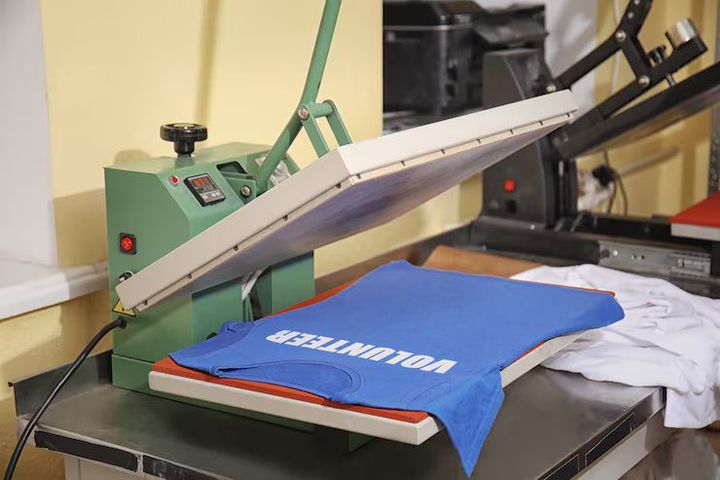
Most heat press machines contain several common components:
- Heated platen: The heated surface that transfers thermal energy to the material.
- Lower platen: The supporting surface where the garment or substrate is positioned.
- Pressure mechanism: Controls how firmly the upper platen contacts the material.
- Temperature controller: Sets and displays the heating temperature.
- Timer: Determines how long the materials remain under heat and pressure.
- Handle or operating mechanism: Allows the platen to close and open.
- Safety features: Depending on the design, these may include insulated handles, automatic shutoff functions, or heat-resistant components.
Importance
Heat pressing matters because it provides a controlled way to apply designs, graphics, lettering, and printed transfers to compatible materials. It is used across garment decoration, textile production, personalization, signage, sportswear, craft applications, and other areas where a printed or cut design needs to be bonded to a surface.
The result depends on several variables rather than heat alone. Temperature, pressure, dwell time, transfer material, substrate, surface condition, and machine calibration can all influence the outcome.
Why temperature, pressure and time matter
Heat transfer materials generally have a specified application range. If the temperature is too low, the transfer may not activate properly. Excessive heat can affect certain fabrics, coatings, adhesives, or transfer materials.
Pressure also needs to be appropriate for the particular application. Too little pressure can reduce contact between the transfer and substrate, while excessive pressure can affect delicate materials or produce unwanted marks.
Time determines how long heat and pressure are applied. These three variables are often considered together:
| Setting | Main function | What can happen if unsuitable |
|---|---|---|
| Temperature | Activates the transfer material | Incomplete bonding or material damage |
| Pressure | Creates contact between surfaces | Poor transfer or surface marks |
| Time | Controls exposure duration | Incomplete transfer or overheating |
| Platen alignment | Distributes contact across the design | Uneven application |
| Substrate preparation | Provides a suitable receiving surface | Adhesion or appearance problems |
Common printing applications
Heat presses are used with several transfer processes. Heat-transfer vinyl is commonly cut into shapes or lettering before being applied to compatible textiles. Sublimation transfers use specially prepared inks and substrates, with heat converting the dye into a gas that enters suitable polymer-based surfaces.
Direct-to-film transfers use a printed film carrying the design, which is transferred to a compatible surface through heat and pressure. Transfer papers provide another approach in which a printed image is transferred onto a suitable substrate.
The appropriate method depends on the material, design, durability requirements, surface characteristics, and transfer manufacturer's specifications.
Recent Updates
Recent developments in heat press equipment have focused on greater control, digital operation, workflow consistency, and compatibility with newer transfer processes. Modern machines commonly include digital temperature and timer controls, while some models include programmable settings or automatic opening mechanisms.
The growth of direct-to-film printing has also expanded the range of applications in which heat presses are used. DTF workflows separate the printing stage from the final heat-transfer stage, allowing printed designs to be prepared on film before being applied to compatible garments and other materials.
Digital controls and monitoring
Digital displays make it easier to monitor temperature and pressing time. Some machines can maintain preset parameters for repeated applications, reducing the need to manually reset each setting.
However, a digital display does not by itself establish measurement accuracy. Heating elements, sensors, platen temperature distribution, pressure mechanisms, and machine condition can influence actual operating conditions.
Improved heat distribution
Uniform heating across the platen is an important area of equipment design. Uneven temperature distribution can result in differences in transfer performance across a large design.
Some equipment uses multiple heating elements or redesigned platen structures to distribute heat more consistently. Actual performance varies between machines and should be assessed according to the intended application.
Equipment variety
Heat presses are now available in several configurations designed around different substrates and workflows. Common types include:
- Clamshell presses, where the upper platen lifts upward from a hinge point.
- Swing-away presses, where the heated platen moves horizontally away from the lower platen.
- Draw-style presses, where the lower platen pulls outward for positioning.
- Automatic presses, which can automate portions of the closing or opening process.
- Multi-function presses, which may use interchangeable attachments for different substrates.
- Specialty presses, including equipment designed for caps, mugs, plates, or other shaped objects.
Laws or Policies
Heat press machines are generally governed by product-safety, electrical-safety, workplace-safety, and consumer-protection requirements applicable to the jurisdiction where the equipment is manufactured, imported, distributed, or used.
Requirements can vary according to electrical specifications, equipment classification, intended environment, and applicable national or regional standards. Businesses using heat presses may also need to consider workplace rules relating to hot surfaces, electrical equipment, ventilation, fire prevention, and operator safety.
The materials being transferred can introduce additional considerations. Certain transfer films, coatings, inks, adhesives, and substrates may have handling instructions or chemical safety information that should be followed.
General safety considerations
A heat press operates at elevated temperatures and can create burn, fire, electrical, and material-handling hazards. General precautions include:
- Keep combustible materials away from exposed hot surfaces.
- Use the equipment on a stable and suitable work surface.
- Follow the machine manufacturer's electrical requirements.
- Avoid touching heated platens during operation.
- Allow heated components to cool before handling or storage.
- Use suitable ventilation when the transfer process or material instructions require it.
- Follow the application instructions supplied with the transfer material.
Applicable regulations should always be checked for the specific location and workplace environment.
Tools and Resources
Heat pressing involves several supporting tools and resources beyond the machine itself. These help with design preparation, material selection, measurement, application, and quality checking.
Temperature measurement tools
An infrared thermometer can be used to investigate surface temperature differences across a platen. Such measurements can help identify whether the displayed temperature corresponds reasonably with surface conditions, although measurement technique and instrument limitations should be considered.
Temperature strips or heat-sensitive materials can also provide information about temperature distribution in certain testing situations.
Pressure adjustment
Some heat presses use mechanical pressure adjustment, while others provide digital or automated pressure controls. Pressure settings should generally be established according to the transfer material and substrate rather than using one setting for every application.
Design and cutting tools
For heat-transfer vinyl, cutting machines can prepare letters, shapes, and graphics before pressing. Design software is commonly used to create or modify artwork, mirror designs when required, and prepare files for cutting or printing.
For DTF workflows, printer systems, transfer film, powder application equipment, and curing processes may be used before the final heat-press stage.
Application reference charts
Transfer-material manufacturers commonly provide recommended temperature, pressure, and time ranges. These references are useful because different materials can respond differently to the same heat press settings.
A simple application record can contain:
- Substrate type
- Transfer material
- Temperature
- Pressure setting
- Pressing time
- Peel method, where applicable
- Post-press instructions
- Observed result
Keeping these details together can make repeated production processes easier to compare.
FAQs
What is a heat press machine used for?
A heat press machine applies controlled heat and pressure to transfer designs or compatible materials onto substrates. Common applications include garments, textiles, bags, signs, and certain coated or polymer-based products.
What temperature and pressure settings should a heat press use?
There is no single setting that applies to every material. Temperature, pressure, and time depend on the transfer material, substrate, and application method. Manufacturer application instructions should determine the starting parameters.
What are the main types of heat press machines?
Common types include clamshell, swing-away, draw-style, automatic, multi-function, and specialty presses. The configuration affects how materials are positioned and how the heated platen operates.
How does a heat press work with DTF printing?
In a DTF workflow, a design is printed onto transfer film and prepared with an appropriate adhesive layer. The prepared transfer is then positioned on a compatible substrate and applied using heat and pressure according to the material's specified conditions.
Why are heat press temperature, pressure and time important?
These three variables determine how the transfer material interacts with the receiving surface. Incorrect settings can contribute to incomplete bonding, image distortion, material damage, or other application problems.
Conclusion
A heat press machine uses controlled heat, pressure, and time to apply compatible transfers to different substrates. Clamshell, swing-away, draw-style, automatic, and specialty configurations provide different approaches to positioning and operation. Temperature, pressure, dwell time, platen condition, transfer material, and substrate characteristics all influence the application process. Recent equipment developments have focused on digital controls, heat distribution, automation, and compatibility with modern transfer workflows such as direct-to-film printing.