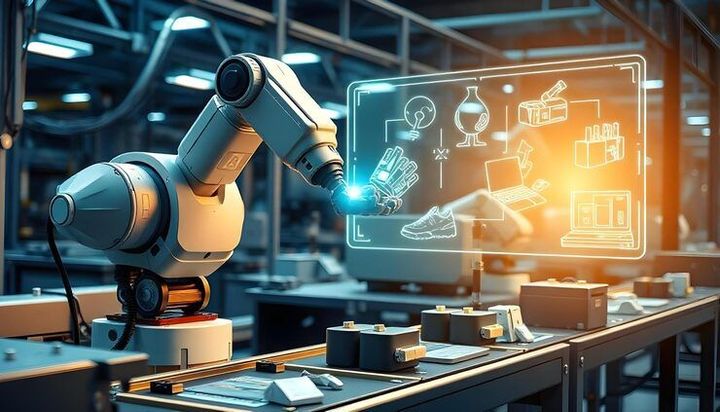
Explore Industrial Automation Design With Innovative Engineering and Smart Manufacturing Solutions
Industrial automation design is the process of planning and developing systems that use machines, electronic controls, sensors, and software to perform manufacturing and industrial operations with limited manual intervention.
It combines innovative engineering with smart manufacturing solutions to improve production consistency, operational control, workplace safety, and equipment coordination. Industrial automation design is widely used in automotive manufacturing, food processing, pharmaceuticals, packaging, electronics, chemical production, and industrial equipment facilities.
The concept developed alongside the growth of industrial machinery and electrical control systems. Early factories relied heavily on manual labour and mechanical equipment. As production requirements increased, industries began introducing electrical motors, relays, programmable controllers, and automated production systems.
Modern industrial automation combines mechanical engineering, electrical engineering, computer programming, and industrial communication technologies. These elements work together to control machines, monitor production activities, and coordinate different manufacturing processes.
What Is Industrial Automation Design?
Industrial automation design refers to the engineering process of creating automated systems for industrial environments. It involves selecting suitable equipment, developing control logic, connecting machines, and establishing communication between different production components.
A typical automation system may include:
Sensors: Detect temperature, pressure, movement, distance, and other operating conditions.
Actuators: Convert electrical or pneumatic signals into physical movement.
Programmable Logic Controllers (PLCs): Control machines and industrial processes through programmed instructions.
Human-Machine Interfaces (HMIs): Allow operators to monitor equipment and interact with control systems.
Variable Frequency Drives (VFDs): Regulate electric motor speed according to operating requirements.
Industrial networks: Connect controllers, sensors, machines, and monitoring platforms.
Supervisory Control and Data Acquisition (SCADA): Collects and displays information from industrial processes.
These components are selected according to the production environment, machine requirements, and level of automation needed.
Main Types of Industrial Automation Systems
Different automation systems are designed for different production requirements.
Fixed automation: Uses dedicated machinery to perform repetitive operations in a consistent sequence. It is commonly found in high-volume production lines, such as bottling and assembly operations.
Programmable automation: Allows production equipment to be reprogrammed for different products or manufacturing sequences. It is useful when production requirements change between batches.
Flexible automation: Uses programmable equipment and coordinated controls to handle product variations with limited manual adjustments.
Integrated automation: Connects multiple machines, production systems, and monitoring platforms into a coordinated manufacturing environment.
The appropriate system depends on production volume, product variation, equipment complexity, and operational requirements.
Engineering Principles Behind Automation Design
Industrial automation design requires coordination between mechanical, electrical, electronic, and software systems. Engineers must understand how machines operate and how information moves between different components.
Important engineering considerations include:
Electrical load requirements and power distribution.
Sensor selection and signal compatibility.
PLC programming and control logic.
Machine movement and actuator positioning.
Industrial communication protocols.
Emergency shutdown and safety arrangements.
Equipment reliability and maintenance planning.
A well-designed automation system must also account for future equipment changes, production expansion, and compatibility with existing machinery.
Importance of Industrial Automation Design in Modern Manufacturing
Industrial automation design matters because manufacturing facilities must manage increasingly complex production activities. Products often require consistent dimensions, controlled processing conditions, accurate assembly, and coordinated material movement.
Automation helps address these requirements by reducing repetitive manual operations and allowing machines to perform specific tasks according to programmed instructions. It also provides operators with better visibility into machine conditions and production activities.
Industrial Applications of Smart Manufacturing Solutions
Industrial automation is used across several sectors.
Automotive manufacturing: Controls robotic welding, vehicle assembly, painting operations, and component handling.
Food and beverage processing: Manages filling, mixing, packaging, temperature monitoring, and material transportation.
Pharmaceutical manufacturing: Supports controlled production environments, packaging operations, and process monitoring under applicable quality requirements.
Electronics manufacturing: Controls component placement, circuit board assembly, inspection, and testing.
Chemical processing: Monitors pressure, temperature, liquid flow, and process sequences.
Packaging industry: Coordinates filling machines, labelling systems, conveyors, and packaging equipment.
Water treatment: Controls pumps, filtration systems, chemical dosing, and water monitoring operations.
Problems Addressed by Industrial Automation
Automation technology helps manage several challenges associated with industrial production.
Repetitive operations: Automated equipment performs repeated tasks according to programmed sequences, reducing dependence on continuous manual operation.
Production inconsistencies: Sensors and control systems monitor important process conditions and help maintain consistent operating parameters.
Equipment coordination: Industrial networks allow different machines to exchange information and operate in a coordinated sequence.
Workplace risks: Robots and automated handling systems can perform certain operations in hazardous or difficult environments, reducing direct human exposure.
Production monitoring: SCADA and industrial monitoring platforms provide information about machine conditions, alarms, and production activities.
However, automation also introduces challenges such as system integration, cybersecurity, technical training, and equipment maintenance.
Common Industrial Automation Technologies
| Technology | Main Function | Industrial Application |
|---|---|---|
| PLC | Controls machine operations | Assembly lines |
| HMI | Operator interaction | Machine monitoring |
| SCADA | Supervisory process monitoring | Water treatment |
| Robotics | Automated physical movement | Welding and handling |
| VFD | Controls motor speed | Pumps and conveyors |
| Industrial IoT | Connects equipment and collects data | Smart factories |
| Machine vision | Inspects products using cameras | Quality inspection |
Recent Developments in Industrial Automation Design
Industrial automation is evolving through artificial intelligence, connected equipment, robotics, digital simulation, and data-based manufacturing. Developments across the 2024–2026 period reflect increasing attention to smart factories, connected production systems, cybersecurity, and flexible industrial operations.
Artificial Intelligence in Industrial Automation
Artificial intelligence is increasingly being applied to industrial monitoring, production analysis, and equipment maintenance. AI-based systems can examine operating data to identify unusual patterns and support the detection of possible equipment problems.
Machine learning can also help analyse production information, identify process variations, and support quality inspection. However, the accuracy of these systems depends on data quality, system configuration, and appropriate human supervision.
Industrial Internet of Things
The Industrial Internet of Things (IIoT) connects industrial machines, sensors, controllers, and monitoring platforms through communication networks. Connected equipment can transmit information about operating temperatures, vibration, pressure, energy consumption, and production output.
This information helps manufacturing teams understand machine conditions and monitor different production stages. Industrial connectivity also supports integration between factory equipment and higher-level production management systems.
Robotics and Collaborative Robots
Industrial robots are widely used for welding, painting, assembly, packaging, and material handling. Collaborative robots, commonly called cobots, are designed to operate in applications where people and robots share working areas under suitable safety arrangements.
Their use requires appropriate risk assessments, protective measures, and task-specific programming.
Digital Twins and Simulation
A digital twin is a digital representation of a physical machine, production line, or industrial process. It uses information from the physical system to support monitoring, analysis, and simulation.
Engineering teams can use digital models to examine machine behaviour, test control strategies, and study possible production changes before implementing them in an operating facility.
Cybersecurity in Smart Manufacturing
Connected industrial systems introduce cybersecurity requirements because machines and controllers increasingly communicate through digital networks. Current automation planning places greater attention on network segmentation, access controls, software updates, backup arrangements, and continuous security monitoring.
Laws and Policies Affecting Industrial Automation in India
Industrial automation design in India is influenced by workplace safety regulations, electrical standards, environmental requirements, and industrial development policies. These frameworks establish requirements for machinery operation, worker protection, energy systems, and manufacturing activities.
Industrial Safety Regulations
Automated production environments contain moving machinery, electrical equipment, robotic arms, press systems, and high-pressure processes. Appropriate safety arrangements are necessary to reduce the risk of accidents.
India's Occupational Safety, Health and Working Conditions Code, 2020, forms part of the country's occupational safety framework. Relevant provisions and implementation requirements depend on the establishment and applicable government notifications.
Industrial facilities should consider:
Machine guarding and emergency stopping systems.
Electrical isolation and protection.
Safe access to automated equipment.
Operator training and operating procedures.
Risk assessments for robotic applications.
Maintenance procedures for electrical and mechanical systems.
Electrical and Industrial Standards
Automation systems must account for electrical safety, equipment ratings, wiring practices, and control panel requirements. Applicable Indian Standards developed by the Bureau of Indian Standards (BIS) provide technical guidance for various electrical and industrial equipment categories.
Depending on the application, manufacturers may also refer to relevant international standards covering machinery safety, functional safety, industrial control systems, and electrical equipment.
Environmental Regulations
Industrial automation facilities may be subject to pollution control requirements involving emissions, wastewater, hazardous waste, and industrial energy use.
The Central Pollution Control Board (CPCB) and State Pollution Control Boards oversee relevant environmental compliance within India's regulatory framework. Requirements depend on the type of industrial activity and the applicable pollution category.
Government Initiatives Supporting Smart Manufacturing
Government programmes such as Make in India and the National Manufacturing Mission reflect India's broader focus on manufacturing development, industrial capabilities, and technology adoption.
These initiatives form part of the wider policy environment encouraging modern manufacturing infrastructure, technological development, and industrial competitiveness. Specific eligibility and implementation provisions vary between programmes.
Tools and Resources for Industrial Automation Design
Engineering software, calculation tools, and monitoring platforms help industrial teams plan, develop, and evaluate automation systems.
PLC Programming and Automation Software
PLC programming platforms allow engineers to develop control logic for machines and production processes. They support functions such as motor control, sensor monitoring, sequencing, alarms, and automated equipment coordination.
HMI development software is used to create operator screens that display machine conditions, production information, and control options.
Electrical Design and CAD Software
Electrical design platforms help engineers prepare wiring diagrams, control panel layouts, electrical schematics, and equipment documentation.
Mechanical CAD software supports machine layouts, robotic workstations, equipment positioning, and manufacturing system integration.
Simulation and Engineering Calculators
Industrial simulation tools help engineers evaluate automation concepts before physical implementation. They can be used for robotic movement studies, production line balancing, process simulation, and equipment capacity analysis.
Common engineering calculations include:
Motor power and current estimation.
Conveyor speed and throughput calculations.
Pneumatic and hydraulic system sizing.
Electrical load calculations.
Production cycle time estimation.
Sensor range and positioning calculations.
Industrial Monitoring and Data Platforms
SCADA, Manufacturing Execution Systems (MES), and IIoT platforms help collect and organise production information.
These systems can monitor machine status, production quantities, equipment alarms, energy usage, and process conditions. Their integration depends on communication protocols, equipment compatibility, and data security requirements.
Frequently Asked Questions About Industrial Automation Design
What Is Industrial Automation Design Used For?
Industrial automation design is used to develop systems that control machines, production lines, material handling, and industrial processes. It is commonly applied in automotive, food processing, electronics, packaging, chemical, and pharmaceutical manufacturing.
What Are the Main Components of an Industrial Automation System?
The main components include sensors, actuators, PLCs, HMIs, motor drives, industrial communication networks, and monitoring platforms such as SCADA. Each component performs a specific role in controlling or monitoring industrial operations.
How Do Smart Manufacturing Solutions Improve Industrial Automation?
Smart manufacturing solutions connect machines, sensors, software, and data platforms. They help monitor production conditions, identify process variations, coordinate equipment, and support data-based operational decisions.
What Is the Role of PLC Programming in Industrial Automation Design?
PLC programming establishes the instructions that control industrial machines and processes. It determines how equipment responds to sensor signals, operator commands, safety conditions, and programmed operating sequences.
What Are the Latest Trends in Industrial Automation Engineering?
Current trends include artificial intelligence, Industrial Internet of Things, collaborative robotics, digital twins, machine vision, and improved industrial cybersecurity. These technologies support connected manufacturing and more flexible production systems.
Conclusion
Industrial automation design combines mechanical engineering, electrical controls, software, and connected technologies to manage modern manufacturing operations. Its applications extend across automotive, food processing, electronics, packaging, chemical production, and other industrial sectors. Artificial intelligence, robotics, IIoT, and digital twins are shaping the development of smart manufacturing solutions. Successful automation planning depends on system compatibility, engineering requirements, workplace safety, cybersecurity, and applicable industrial regulations.