Electric Heavy Equipment Explained: Types, Components, Applications, Benefits and Key Considerations
Electric heavy equipment refers to large machinery that uses electric motors and electrical energy to perform demanding tasks in construction, mining, agriculture, warehousing, and industrial operations. Examples include electric excavators, wheel loaders, forklifts, cranes, dump trucks, and material-handling machines. These machines perform activities such as digging, lifting, transporting materials, moving earth, and handling heavy loads.
Context
Electric heavy equipment refers to large machinery that uses electric motors and electrical energy to perform demanding tasks in construction, mining, agriculture, warehousing, and industrial operations. Examples include electric excavators, wheel loaders, forklifts, cranes, dump trucks, and material-handling machines. These machines perform activities such as digging, lifting, transporting materials, moving earth, and handling heavy loads.
Traditional heavy equipment commonly relies on diesel engines to generate mechanical power. Electric heavy equipment instead uses energy stored in batteries or supplied through an external electrical connection. Some machines also use hybrid systems that combine an electric drive with another power source. The design depends on the machine's purpose, required operating time, load capacity, and working environment.
How Electric Heavy Equipment Developed
Electric machinery has existed for many decades, particularly in factories, underground mining operations, and facilities with established electrical infrastructure. Early applications often used cables or fixed electrical connections because battery technology was limited in capacity and portability.
Advances in battery chemistry, electric motors, power electronics, and charging systems have expanded the range of mobile electric machinery. Manufacturers can now develop equipment for selected construction sites, warehouses, ports, and industrial environments where reduced local exhaust emissions and lower operating noise may be useful.
Main Types of Electric Heavy Equipment
Electric heavy equipment covers several machine categories, each designed for particular working conditions.
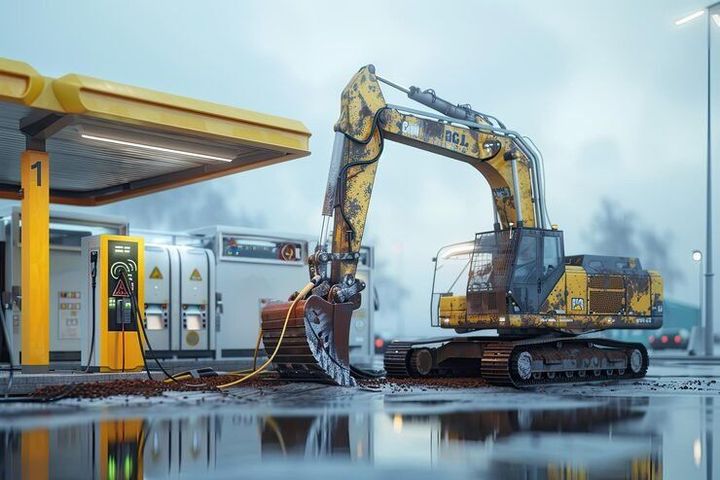
Electric excavators: Use electric motors to power digging, lifting, and material movement. Battery-powered models are suitable for selected applications, while cable-connected versions may be used where a stable power supply is available.
Electric wheel loaders: Move soil, gravel, construction materials, and other bulk materials around work areas.
Electric forklifts: Lift and transport pallets, containers, and industrial materials within warehouses and manufacturing facilities.
Electric cranes: Use electric drives for lifting and moving heavy loads in construction, ports, factories, and storage yards.
Electric dump trucks: Transport excavated material, minerals, and construction waste. Some designs use batteries, while others use electric drive systems supplied by different power sources.
Electric agricultural equipment: Includes selected tractors, utility vehicles, and material-handling machines used in farming operations.
Not every machine category is equally suited to battery operation. Equipment that works continuously under very heavy loads or far from electrical infrastructure may require different energy arrangements from machinery used for shorter shifts.
Importance
Electric heavy equipment matters because construction companies, industrial operators, mining organizations, and warehouse managers must consider energy use, noise, maintenance, and environmental conditions when choosing machinery. In locations with strict air-quality requirements or limited ventilation, reducing exhaust emissions at the machine can be particularly relevant.
Electric machinery can also support work in enclosed or noise-sensitive environments. For example, an electric forklift operating inside a warehouse does not produce exhaust emissions from an onboard combustion engine during operation. However, electricity generation, battery manufacturing, and equipment transportation can still create environmental impacts.
Key Benefits and Limitations
Electric heavy equipment has several potential advantages, although actual results depend on the machine, duty cycle, energy source, and working conditions.
Reduced local emissions: Battery-electric machines do not release exhaust gases from an onboard combustion engine during normal operation.
Lower operating noise: Electric motors can reduce engine noise, although hydraulic pumps, tires, alarms, cooling systems, and work tools still produce sound.
Energy efficiency: Electric drive systems can convert electrical energy into motion efficiently, but total energy use depends on the task and equipment design.
Different maintenance requirements: Battery-electric machines generally do not require engine oil changes or exhaust-system maintenance associated with diesel engines, but they still need inspections, lubrication, hydraulic maintenance, and electrical-system checks.
Operational flexibility: Some compact electric machines can operate in indoor or urban locations where engine exhaust and noise require additional consideration.
Important limitations include battery charging time, available operating range, purchase price, charging infrastructure, battery replacement planning, and performance under demanding loads or extreme temperatures. These factors may affect whether electric equipment is appropriate for a particular site.
Electric and Diesel Equipment Compared
| Factor | Battery-electric equipment | Diesel-powered equipment |
|---|---|---|
| Energy source | Rechargeable battery | Diesel fuel |
| Local exhaust emissions | None from the onboard electric drive | Produced during engine operation |
| Operating noise | Often lower motor noise | Engine noise is present |
| Refueling or charging | Requires suitable charging arrangements | Requires diesel refueling |
| Maintenance | Electrical, battery, mechanical, and hydraulic checks | Engine, fuel, exhaust, mechanical, and hydraulic checks |
| Long-shift planning | Depends on battery capacity and charging access | Depends on fuel capacity and refueling access |
| Environmental impact | Includes electricity generation and battery production | Includes fuel production and combustion emissions |
This comparison describes general characteristics rather than every machine. Some diesel machines use electric drive components, and hybrid equipment combines different power technologies.
Recent Updates
During 2024–2026, electric heavy equipment development has increasingly focused on battery performance, charging infrastructure, machine connectivity, and practical use in demanding environments. Progress differs across equipment categories and regions, so battery-powered compact machinery may be more practical for certain applications than large machines requiring continuous high-power operation.
Battery Technology and Charging Systems
Battery-electric construction equipment relies on battery capacity, power delivery, thermal management, and charging arrangements. Larger batteries can support longer operating periods but may increase machine weight and affect payload, transportation, and design.
Charging systems vary according to battery size and site infrastructure. Some machines can charge during scheduled breaks, while others require dedicated charging periods or battery-swapping arrangements. High-power charging may shorten charging periods, but actual performance depends on the battery, charger, temperature, and electrical supply.
Automation and Connected Equipment
Digital monitoring systems can help operators track battery state, energy consumption, machine location, operating hours, and maintenance requirements. Some equipment also includes remote diagnostics, automated functions, or fleet-management software.
These tools can support work planning and help identify unusual operating patterns. However, connectivity depends on the machine's installed technology and network access, while automated functions still require appropriate training and supervision.
Expanding Industrial Applications
Electric forklifts are established in many indoor material-handling operations, while electric construction and mining machinery is being developed for a wider range of tasks. Compact excavators and loaders may be suitable for selected urban projects, building renovations, and enclosed work areas.
Larger electric trucks and heavy machines face additional challenges involving energy demand, charging access, payload, and operating duration. As a result, adoption depends on the work cycle and site conditions rather than on the availability of electric technology alone.
Laws or Policies
Electric heavy equipment in India is influenced by environmental regulations, industrial safety requirements, machinery standards, electricity rules, and government policies concerning electric mobility. The exact requirements depend on the machine category, its intended use, the worksite, and the applicable regulatory framework.
Environmental Regulations in India
The Central Pollution Control Board and State Pollution Control Boards administer or oversee aspects of India's pollution-control framework under applicable environmental laws. Requirements for conventional construction equipment and diesel machinery may include relevant emission standards, depending on the equipment category and its use.
Electric machinery does not produce exhaust emissions from an onboard combustion engine during battery-powered operation. However, equipment operators must still comply with applicable noise, waste, workplace safety, and environmental requirements. Battery handling and disposal also require attention to relevant regulations.
Electric Mobility and Battery Policies
India's electric mobility policies have supported the development and adoption of electric vehicles and associated infrastructure. The FAME schemes and the later PM Electric Drive Revolution in Innovative Vehicle Enhancement (PM E-DRIVE) scheme concern specified vehicle categories and eligible activities; they should not be assumed to apply automatically to every type of electric construction or industrial machine.
The Battery Waste Management Rules, 2022, establish extended producer responsibility and other requirements for covered batteries. Their application depends on the battery and the parties involved. Businesses handling heavy equipment batteries should verify the current requirements with the relevant authorities and qualified compliance professionals.
Workplace and Electrical Safety
Construction sites and industrial facilities must follow applicable workplace safety requirements. Electrical installations, charging equipment, high-voltage battery systems, and maintenance procedures require appropriate safeguards and trained personnel.
Operators also need to understand machine-specific instructions, load limits, emergency shutdown procedures, and charging precautions. Site managers should account for safe cable routing, restricted access, ventilation where required, and emergency response arrangements appropriate to the equipment.
Tools and Resources
Evaluating electric heavy equipment involves technical information, operating estimates, and site planning. Several resources can help organizations understand whether a machine's capabilities align with its intended work.
Equipment Specifications and Energy Calculators
Manufacturer specification sheets generally describe machine weight, rated operating capacity, battery capacity, charging requirements, dimensions, and permitted applications. These details help users compare equipment designed for similar tasks.
An energy-use spreadsheet can estimate daily electricity demand by recording operating hours, average power consumption, charging efficiency, and the number of machines. For example, estimated daily energy demand can be calculated by multiplying average electrical power in kilowatts by operating hours, then adjusting for charging losses where appropriate.
The result is an estimate rather than a guarantee of actual consumption. Real energy use changes with load, terrain, operator behavior, weather, idle time, and auxiliary equipment.
Government and Industry Resources
Useful sources include the Ministry of Heavy Industries, the Bureau of Energy Efficiency, the Central Pollution Control Board, and relevant State Pollution Control Boards. Their publications can provide information on applicable policies, energy efficiency, environmental requirements, and regulatory updates.
Manufacturer manuals and battery-safety documentation provide equipment-specific guidance. Charging infrastructure assessments can also help determine whether the available electrical supply can support the intended number of machines and their operating schedules.
Factors to Assess Before Adoption
A practical assessment generally includes:
Required lifting capacity, digging force, payload, and operating hours.
Expected energy use and the availability of charging facilities.
Purchase price, electricity consumption, maintenance, and battery replacement planning.
Machine compatibility with the worksite, terrain, weather, and transport arrangements.
Operator training, electrical safety, and battery-handling procedures.
Applicable emission, workplace, and environmental requirements.
These factors help distinguish equipment that fits a particular operating pattern from equipment that may require changes to the site's energy infrastructure or work schedule.
FAQs
What is electric heavy equipment?
Electric heavy equipment is machinery that uses electric motors powered by batteries or an external electricity supply to perform tasks such as digging, lifting, transporting, and moving materials.
What are the main types of electric heavy equipment?
Common types include electric excavators, wheel loaders, forklifts, cranes, dump trucks, and selected agricultural machines. Their energy systems and operating capabilities vary by design.
How does electric heavy equipment differ from diesel machinery?
Battery-electric equipment uses stored electrical energy and produces no exhaust emissions from an onboard combustion engine during operation. Diesel equipment uses fuel and produces engine exhaust, while charging access and battery capacity are important considerations for electric machinery.
What are the main benefits of electric heavy equipment?
Potential benefits include reduced local exhaust emissions, lower motor noise, and different maintenance requirements. Actual energy use, environmental impact, and operational suitability depend on the equipment and its working conditions.
What should businesses consider before using electric heavy equipment?
Important considerations include machine capacity, battery range, charging infrastructure, operating schedules, maintenance, safety training, and applicable regulations. A site-specific assessment helps establish whether the equipment can meet operational requirements.
Conclusion
Electric heavy equipment uses electric drive technology to perform demanding tasks across construction, mining, agriculture, and industrial operations. Its potential advantages include reduced local exhaust emissions, lower operating noise, and changes in maintenance requirements, while battery capacity and charging infrastructure remain important constraints. Equipment selection depends on the task, operating environment, energy supply, safety requirements, and applicable regulations. Understanding these factors provides a practical foundation for evaluating electric machinery and its role in modern industrial operations.