Complete Guide to Tablet Inspection Systems for Modern Pharmaceutical Production
Tablet inspection systems are automated equipment used to examine tablets during pharmaceutical production. They are designed to identify visible defects, dimensional variations, contamination, incorrect appearance, and other characteristics that may indicate a problem with a production batch.
The need for tablet inspection developed as pharmaceutical manufacturing became increasingly automated. Manual inspection can be useful for sampling and verification, but examining every tablet consistently becomes difficult when production volumes are high. Automated inspection provides a repeatable method for checking products as they move through a production line.
Modern tablet inspection systems can examine features such as tablet shape, color, surface condition, edges, markings, cracks, chips, and broken areas. Depending on the system configuration, inspection may take place immediately after compression, during dedusting, or at another controlled point in the manufacturing process.
What Tablet Inspection Systems Do
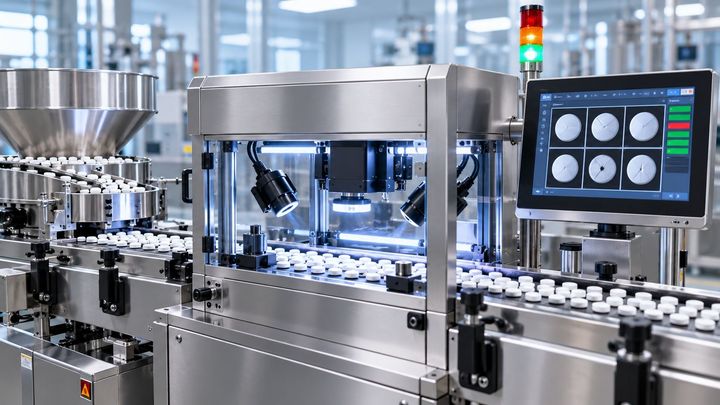
A typical system moves tablets through a controlled inspection area where cameras capture multiple views. Specialized lighting helps reveal surface defects that might be difficult to detect under ordinary lighting conditions.
Software then analyzes the captured images according to predefined inspection criteria. Tablets that meet the programmed requirements continue through the production process, while tablets identified as defective can be separated for further evaluation.
Common inspection functions include:
- Surface defect detection
- Shape and dimensional inspection
- Color and appearance verification
- Identification of cracks and chips
- Detection of broken tablets
- Verification of tablet markings
- Foreign-particle detection
- Counting and process monitoring
The exact inspection capability depends on the equipment configuration, camera technology, software, tablet characteristics, and production requirements.
Main Components
A tablet inspection machine generally contains several integrated components. Industrial cameras capture images, while controlled lighting creates consistent conditions for image analysis.
Sensors help detect the position and movement of tablets. Mechanical systems guide tablets through the inspection area, while software processes the captured information.
Some systems also include rejection mechanisms, data recording functions, production counters, alarms, and interfaces that connect with other manufacturing equipment.
Importance
Tablet inspection systems matter because tablet appearance and physical integrity can provide useful information about production consistency. A tablet with a crack, chip, unusual shape, or incorrect marking may require investigation before the batch continues through the manufacturing process.
Automated inspection can also reduce dependence on visual examination alone. Human inspection can be affected by fatigue, lighting conditions, workload, and differences in individual judgment. Machine vision systems use predefined inspection criteria to apply the same programmed checks repeatedly.
Who Uses Tablet Inspection Systems
These systems are primarily used within pharmaceutical manufacturing environments, particularly where tablets are produced in large quantities. Equipment operators, production engineers, quality teams, maintenance personnel, validation specialists, and process engineers may interact with inspection equipment.
The systems can also be relevant to manufacturers producing different tablet shapes, sizes, colors, and surface markings. A configurable inspection platform can be adjusted for different product characteristics when appropriate validation and testing procedures are completed.
Problems Addressed by Automated Inspection
Tablet inspection addresses several practical production challenges:
- High-volume visual examination
- Detection of physical tablet defects
- Consistency of appearance checks
- Identification of damaged tablets
- Monitoring of production processes
- Documentation of inspection results
- Reduction of manual inspection workload
Inspection does not replace the broader pharmaceutical quality system. Instead, it functions as one component within a larger process involving raw materials, manufacturing controls, testing, documentation, equipment qualification, and batch review.
Inspection Parameters
Different tablet characteristics require different inspection approaches. A round tablet, for example, may require checks for diameter, edge condition, and surface defects, while a scored tablet may require additional examination of the score line and imprint.
| Inspection Parameter | Typical Purpose | Common Detection Method |
|---|---|---|
| Shape | Identify abnormal geometry | Machine vision |
| Size | Check dimensional consistency | Camera measurement |
| Color | Identify appearance variation | Image analysis |
| Surface | Detect cracks, spots, or marks | Controlled imaging |
| Edges | Identify chips or damage | Multi-angle imaging |
| Markings | Check logos, letters, or codes | Pattern recognition |
| Integrity | Identify broken tablets | Image analysis |
| Foreign particles | Identify unwanted visible material | Vision and lighting |
Inspection parameters are normally established according to product specifications and manufacturing procedures rather than using one universal configuration.
Recent Updates
From 2024 through 2026, tablet inspection technology has continued moving toward more integrated machine vision, higher-speed image processing, improved data handling, and greater automation. The general direction has been toward systems that can inspect products while maintaining synchronization with high-speed production equipment.
Machine Vision Developments
Machine vision remains a central technology in tablet inspection systems. Improvements in industrial cameras, image sensors, lighting arrangements, and processing hardware allow manufacturers to capture and analyze detailed images more efficiently.
Three-dimensional imaging and multi-angle inspection can also provide additional information for products where a single camera view is insufficient. These technologies are particularly relevant when defects can appear on tablet edges or curved surfaces.
Software and Data Integration
Inspection software is increasingly designed to integrate with production monitoring systems. Recorded inspection results can help production teams identify recurring defect patterns and investigate changes in manufacturing conditions.
Data connectivity also supports broader manufacturing concepts such as electronic records, automated production monitoring, equipment diagnostics, and traceability. The specific data architecture depends on the production facility and its validated systems.
Artificial Intelligence Trends
Artificial intelligence and machine learning are receiving increasing attention in industrial vision applications. These approaches can help classify complex visual patterns when conventional rule-based inspection methods are difficult to configure.
However, AI-based inspection requires careful validation. A model must be evaluated against suitable samples and inspection requirements before being incorporated into a regulated pharmaceutical production environment. Human oversight and documented procedures remain important.
Compact and Flexible Equipment
Another current trend is the development of inspection equipment that can fit into increasingly automated production lines. Modular designs may allow inspection configurations to be adapted for different tablet formats and production requirements.
Laws or Policies
Tablet inspection systems operate within the broader regulatory framework governing pharmaceutical manufacturing. Requirements vary between jurisdictions, but regulatory systems generally emphasize product quality, process control, equipment qualification, documentation, and data integrity.
Manufacturing Controls
Pharmaceutical manufacturers are generally expected to establish documented procedures for production and quality control. Inspection equipment used as part of a controlled manufacturing process may therefore require documented operating procedures, maintenance records, calibration or verification activities, and appropriate qualification.
The exact requirements depend on the equipment's intended use and the regulatory framework applicable to the manufacturing facility.
Data Integrity
Electronic inspection systems may generate records related to production quantities, rejected tablets, inspection results, alarms, and equipment status. Data integrity principles are therefore important when inspection information becomes part of regulated records.
Systems should be configured so that relevant data remains accurate, traceable, protected from inappropriate alteration, and available for appropriate review.
Validation and Qualification
When a tablet inspection machine performs a function that can affect product quality, manufacturers generally need documented evidence that the system performs as intended.
Qualification and validation activities may include:
- Equipment installation checks
- Functional testing
- Inspection challenge testing
- Software verification
- Rejection-system testing
- Routine performance monitoring
- Change-control documentation
These activities help establish that the inspection process operates according to its defined requirements.
Tools and Resources
Several types of tools support the planning, operation, and evaluation of tablet inspection systems. The appropriate resources depend on the manufacturing environment and the inspection objectives.
Inspection Planning Tools
Specification sheets, defect libraries, sample tablets, inspection test pieces, and process maps can help define what the system needs to identify. A structured defect library can contain examples of acceptable and unacceptable tablet conditions for system evaluation.
Performance Monitoring Tools
Production dashboards and inspection software can track information such as:
- Total tablets inspected
- Number of rejected tablets
- Defect categories
- Inspection alarms
- Production interruptions
- Equipment status
- Inspection trends
Trend analysis can help identify recurring issues and support process investigations.
Regulatory and Technical Resources
Useful resources can include pharmaceutical manufacturing guidance, equipment qualification templates, validation documentation, standard operating procedures, calibration records, and data-integrity guidance.
Technical manuals and machine documentation can also explain camera configuration, lighting requirements, inspection recipes, rejection mechanisms, cleaning procedures, and routine equipment checks.
FAQs
What are Tablet Inspection Systems?
Tablet inspection systems are automated machines that use cameras, sensors, lighting, and software to examine tablets for visible defects and specified physical characteristics during pharmaceutical production.
How does a Tablet Inspection Machine work?
A tablet inspection machine moves tablets through a controlled imaging area. Cameras capture images from one or more angles, software evaluates the images against programmed criteria, and a mechanical mechanism can separate tablets that meet predefined rejection conditions.
What defects can Tablet Inspection Systems detect?
Depending on their configuration, Tablet Inspection Systems can detect cracks, chips, broken tablets, abnormal shapes, surface marks, color variations, foreign visible particles, and incorrect or damaged markings.
Are Tablet Inspection Systems required in pharmaceutical production?
There is no single universal requirement that applies to every pharmaceutical production line. Whether a particular inspection system is needed depends on the product, process, quality controls, manufacturing design, and applicable regulatory requirements.
Does AI replace conventional tablet inspection technology?
AI can supplement conventional machine vision in some inspection applications, particularly when complex visual classification is involved. It does not automatically replace established inspection methods, and any AI-based system used in a regulated process requires appropriate evaluation and validation.
Conclusion
Tablet inspection systems provide an automated method for examining tablets for defined physical and visual characteristics during pharmaceutical production. Modern systems combine machine vision, sensors, controlled lighting, software, and automated handling to support consistent inspection processes. Recent developments include improved imaging, data integration, flexible equipment designs, and growing interest in AI-assisted inspection. Regulatory expectations around documentation, qualification, validation, and data integrity remain important when these systems are incorporated into controlled pharmaceutical manufacturing environments.