AI in Manufacturing Guide: Technologies, Applications, Automation, Benefits and Industry Uses
AI in manufacturing refers to the use of artificial intelligence systems to analyze production data, recognize patterns, support decisions, and automate selected industrial tasks. It combines machine learning, computer vision, sensors, robotics, predictive analytics, and other digital technologies with manufacturing processes. As factories collect more data from machines and production lines, AI in manufacturing can help turn that information into practical insights for planning, quality control, maintenance, energy management, and process improvement.
Context
How AI Entered Manufacturing
Manufacturing has used computerized control systems and industrial automation for decades. Earlier systems generally followed programmed rules, while modern AI systems can learn patterns from historical and real-time data. This difference allows some systems to identify unusual conditions or changing production patterns without requiring every possible situation to be manually programmed.
The development of Industry 4.0 has also increased the use of connected machines, industrial sensors, cloud computing, digital twins, and Industrial Internet of Things platforms. These technologies create data streams that AI models can analyze. AI in manufacturing therefore fits into a broader shift toward connected and data-driven production environments.
Main AI Manufacturing Technologies
Several technologies can work together in an industrial setting. Machine learning can identify relationships in production data, while computer vision can inspect images for visible defects. Natural language processing can help workers interact with technical information through text or voice, and generative AI can assist with documentation, knowledge retrieval, and technical analysis.
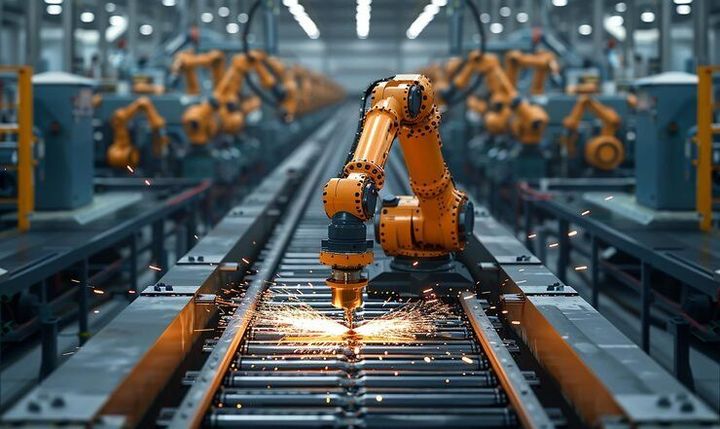
Robotics is another important area. AI-enabled robots can combine sensor information with software models to adjust movements or respond to changing conditions. Digital twins can also represent machines, production lines, or facilities in software, allowing teams to study processes and conditions using simulated environments.
Importance
Why AI Matters in Production
AI applications in manufacturing address several recurring industrial challenges. Production environments can generate large volumes of information from temperature sensors, vibration monitors, cameras, programmable controllers, machine logs, and inspection systems. Reviewing all of this information manually can be difficult, especially when changes happen quickly.
AI can support tasks such as:
- Detecting unusual machine behavior
- Identifying visual quality issues
- Forecasting maintenance needs
- Monitoring production conditions
- Optimizing production schedules
- Tracking energy and material usage
- Supporting inventory planning
- Assisting workers with technical information
These applications do not all require fully autonomous factories. In many cases, AI works as a decision-support layer while people remain responsible for supervision, validation, safety, and final decisions.
Industry Uses
AI manufacturing technologies can be applied across many industries. Automotive plants may use computer vision for component inspection and AI models for production planning. Electronics manufacturers can use image analysis to identify assembly problems. Food processing facilities can apply sensors and predictive models to monitor equipment and production conditions.
Other examples include metalworking, chemicals, pharmaceuticals, textiles, packaging, aerospace, semiconductor production, and warehouse automation. The specific application depends on the type of equipment, available data, production goals, safety requirements, and regulatory environment.
Recent Updates
Developments from 2024–2026
From 2024 onward, manufacturing AI has increasingly moved beyond isolated experiments toward broader discussions about deployment, workforce skills, data infrastructure, and responsible use. India’s government approved the IndiaAI Mission in 2024, creating a national framework covering compute capacity, datasets, future skills, application development, startup financing, and safe and trusted AI.
Manufacturing has also become a specific focus of national technology discussions. Government and industry groups have examined AI, robotics, digital twins, and advanced manufacturing as connected areas. Recent initiatives have included work on practical AI adoption among manufacturing MSMEs and discussions around AI for Manufacturing Engineering Technology.
Another development is the growing interest in physical AI and robotics. Instead of limiting AI to software analysis, newer approaches connect AI models with machines, sensors, and robotic systems. This can support adaptive automation, inspection, material movement, and other physical processes, although implementation still depends on reliable sensors, appropriate controls, safety measures, and suitable data.
Shift Toward Human-AI Collaboration
Manufacturing organizations are also paying greater attention to workforce preparation. AI may change how engineers, technicians, operators, planners, and maintenance teams interact with production systems. Training can therefore include data interpretation, automation, robotics, cybersecurity, machine monitoring, and AI-assisted decision-making.
Laws or Policies
India’s Policy Environment
In India, AI in manufacturing is influenced by several national technology and industrial initiatives. The IndiaAI Mission provides a framework for AI infrastructure, datasets, skills, applications, and responsible AI development. Its policy structure can support wider access to AI capabilities across sectors, including industrial applications.
The National Manufacturing Mission, announced through the Union Budget 2025–26, is another relevant policy development. It focuses on strengthening manufacturing through areas such as technology, skills, supply-chain integration, and industrial development. Government policy documents also identify advanced technologies such as AI, robotics, and digital systems as important parts of modern manufacturing.
Data protection can also matter when manufacturing systems process information connected to identifiable individuals. India’s Digital Personal Data Protection Act, 2023 establishes rules for processing digital personal data within its scope. Industrial AI systems that handle worker, visitor, customer, or other identifiable information may therefore need appropriate data governance.
Manufacturing facilities can also be subject to sector-specific safety, environmental, labor, cybersecurity, and industrial standards. The exact requirements depend on the industry, equipment, location, and type of data involved.
Tools and Resources
Common AI and Manufacturing Tools
A manufacturing AI project can involve several layers of technology. Typical resources include:
- Industrial sensors for collecting equipment and process data
- Computer vision cameras for image-based inspection
- Machine learning platforms for developing predictive models
- Industrial IoT platforms for connecting equipment and data
- Digital twin software for modeling machines and processes
- Manufacturing execution systems for production information
- Enterprise resource planning systems for planning and inventory data
- Robotics platforms for automated physical tasks
- Data dashboards for monitoring production indicators
- AI knowledge tools for technical documents and internal information
Public resources can also help readers understand the wider technology environment. IndiaAI provides information about national AI initiatives and AI datasets, while government manufacturing and economic publications provide information about industrial policy and technology programs.
Example Data Table
| Manufacturing area | AI application | Typical data used | Possible purpose |
|---|---|---|---|
| Quality inspection | Computer vision | Images, camera feeds | Identify visible defects |
| Maintenance | Predictive analytics | Vibration, temperature, logs | Detect changing machine conditions |
| Production planning | Machine learning | Orders, schedules, capacity | Support planning decisions |
| Energy management | Data analytics | Power and process readings | Monitor energy patterns |
| Robotics | AI control | Sensors, position data | Adapt selected machine movements |
| Supply planning | Forecasting models | Demand and inventory data | Support material planning |
The usefulness of these tools depends on data quality, system integration, model accuracy, worker knowledge, and the conditions in which the technology operates. An AI system can produce unreliable results when its training data is incomplete, outdated, poorly labeled, or different from real production conditions.
FAQs
What is AI in manufacturing?
AI in manufacturing is the use of artificial intelligence to analyze industrial data, recognize patterns, support decisions, and automate selected production tasks. Common examples include predictive maintenance, computer vision inspection, production planning, and process monitoring.
What are the main AI manufacturing technologies?
Common AI manufacturing technologies include machine learning, computer vision, predictive analytics, natural language processing, generative AI, robotics, and digital twins. These technologies may be used separately or combined within a connected production system.
How is AI used in manufacturing automation?
AI can support manufacturing automation by analyzing sensor information, detecting production changes, guiding robotic systems, identifying visual defects, and assisting with process decisions. Human supervision remains important for safety, validation, and operational control.
What are the benefits of AI applications in manufacturing?
Potential benefits include faster analysis of production data, earlier identification of unusual machine conditions, improved inspection consistency, better planning support, and greater visibility into production processes. Results vary according to the system, data, process, and implementation conditions.
Does India regulate AI in manufacturing?
India does not rely on one single rule covering every industrial AI application. Relevant requirements can come from AI initiatives, data protection law, manufacturing policies, industrial safety rules, sector-specific standards, and cybersecurity requirements, depending on the application.
Conclusion
AI in manufacturing combines artificial intelligence with industrial data, automation, robotics, sensors, and production systems. Its applications range from quality inspection and predictive maintenance to planning, energy monitoring, and technical information management. From 2024–2026, India has expanded national attention toward AI infrastructure, advanced manufacturing, robotics, and practical adoption among manufacturing organizations. The role of AI continues to depend on reliable data, suitable technology, human oversight, safety controls, and applicable rules.