Advanced Materials Explained: Types, Properties, Applications, Benefits and Key Considerations
Advanced materials are specially developed or engineered materials designed to provide particular physical, chemical, electrical, thermal, or mechanical properties. They include materials such as advanced ceramics, composites, high-performance polymers, nanomaterials, smart materials, and specialized metals. These materials have developed alongside progress in engineering, chemistry, physics, manufacturing, electronics, energy systems, transportation, and healthcare technology.
What Are Advanced Materials?
Advanced materials are materials whose composition, structure, or manufacturing process is designed to achieve specific performance characteristics. Unlike conventional materials that may be used for general purposes, advanced materials are often developed around a particular requirement, such as lower weight, higher strength, improved heat resistance, electrical conductivity, corrosion resistance, or controlled responses to environmental conditions.
The field brings together knowledge from materials science, chemistry, physics, engineering, and manufacturing. Researchers examine materials at different scales, from their overall structure down to microscopic and nanoscale features, because small changes in composition or structure can influence how a material behaves.
Main Types of Advanced Materials
Advanced materials can be grouped into several broad categories:
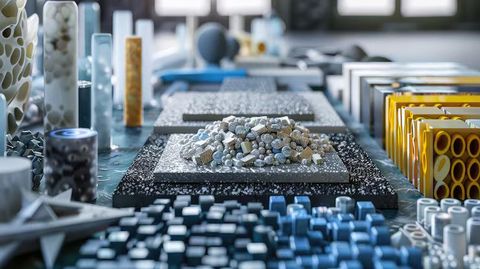
- Advanced ceramics are inorganic materials known for characteristics such as hardness, heat resistance, electrical insulation, and chemical stability.
- Composite materials combine two or more different materials to produce a combination of useful properties. Carbon-fiber composites and glass-fiber composites are common examples.
- Advanced polymers are engineered plastics and polymer-based materials designed for particular mechanical, thermal, chemical, or electrical characteristics.
- Nanomaterials contain structures or particles at the nanoscale. Their small dimensions can produce properties that differ from the same material at a larger scale.
- Smart materials can respond to changes such as temperature, pressure, electric fields, magnetic fields, or mechanical stress.
- Advanced metals and alloys are developed through changes in composition, processing, or microstructure to achieve particular strength, durability, weight, or thermal characteristics.
These categories can overlap. For example, a composite can contain nanoscale materials, while an advanced alloy may also be designed for use in a smart system.
How Advanced Materials Are Developed
Material development generally involves selecting a chemical composition, controlling the structure, processing the material, and testing its properties. Techniques may include heat treatment, coating, alloying, sintering, additive manufacturing, chemical processing, and controlled deposition.
Computer modeling and laboratory testing are also important. Researchers can use simulations to examine how materials may behave under heat, pressure, electrical conditions, or repeated mechanical loading before conducting physical experiments.
Importance
Why Advanced Materials Matter
Advanced materials can influence how products, structures, machines, and electronic systems are designed. A material with lower density may help reduce the weight of a component, while a material with high thermal stability may be suitable for environments exposed to elevated temperatures.
Material selection can also affect durability, maintenance requirements, energy use, manufacturing processes, and environmental considerations. These factors are relevant across industries rather than being limited to specialist laboratories.
Applications Across Different Industries
Advanced materials are used or studied in many fields, including:
- Aerospace and aviation, where lightweight structures and heat-resistant materials are important.
- Automotive and transportation, where materials may be developed for structural strength, lower weight, batteries, and thermal management.
- Electronics, where semiconducting, insulating, magnetic, and conductive materials support electronic components.
- Energy, where materials are used in batteries, solar technologies, fuel cells, energy storage, and power systems.
- Construction, where composites, engineered coatings, insulation materials, and specialized concrete can address structural and environmental requirements.
- Healthcare, where materials can be studied for implants, diagnostic equipment, protective devices, and controlled interactions with biological systems.
- Manufacturing, where specialized materials can be used in cutting tools, molds, sensors, machinery components, and high-temperature equipment.
The appropriate material depends on the operating environment and the required properties. A material that performs well in one application may not be suitable for another.
Key Properties to Understand
When comparing advanced materials, several properties are commonly examined:
| Property | What It Describes | Example Relevance |
|---|---|---|
| Strength | Ability to withstand applied forces | Structural components |
| Hardness | Resistance to indentation or surface damage | Tools and wear surfaces |
| Thermal stability | Ability to maintain properties under heat | Engines and industrial equipment |
| Electrical conductivity | Ability to carry electrical current | Electronics and power systems |
| Corrosion resistance | Resistance to chemical or environmental degradation | Outdoor and chemical applications |
| Density | Mass relative to volume | Lightweight transportation components |
| Flexibility | Ability to deform without breaking | Flexible electronics and polymers |
| Thermal conductivity | Ability to transfer heat | Heat-management systems |
No single property determines whether a material is suitable. Engineers normally consider several properties together with processing requirements, operating conditions, durability, and environmental factors.
Recent Updates
Research Trends
From 2024 through 2026, advanced materials research has continued to focus on sustainable processing, materials for electronics, mobility, energy conversion, sensing, and computational materials design. India's Department of Science and Technology included these areas in an Advanced Materials research call under the National Programme for Nano Science and Technology. The program covered sustainable materials processing, low-dimensional materials, structural materials for mobility, bio-inspired materials, energy-related materials, and computational design.
Another notable development has been increased attention to critical minerals and their relationship with advanced technology. India's National Critical Mineral Mission focuses on exploration, processing, recovery, recycling, research, and development across critical-mineral value chains.
Sustainability and Material Efficiency
Environmental considerations are becoming increasingly connected with material development. Researchers are examining how materials can be produced using fewer resources, how manufacturing processes can reduce waste, and how valuable elements can be recovered from products at the end of their useful life.
Recycling and material recovery are particularly relevant for technologies that depend on minerals used in batteries, electronics, renewable-energy equipment, and other advanced systems. Research is also examining alternatives that can reduce dependence on particular scarce or difficult-to-source materials.
Computational Materials Development
Computational methods are becoming an increasingly important part of materials research. Digital modeling, simulation, machine learning, and materials databases can help researchers examine relationships between composition, structure, processing, and performance.
These methods do not replace laboratory testing. Physical testing remains important because actual material behavior can be influenced by manufacturing conditions, defects, impurities, temperature, mechanical loading, and other factors.
Laws or Policies
Indian Standards and Certification
In India, materials and products can be affected by standards established through the Bureau of Indian Standards (BIS). BIS standards cover numerous materials, products, testing methods, and technical requirements.
Certification is generally voluntary unless a government notification or Quality Control Order makes compliance compulsory for a particular product or category. Requirements can therefore vary according to the material, product, application, and applicable regulation.
Critical Minerals Policy
India's National Critical Mineral Mission provides a policy framework covering exploration, mining, processing, recovery, recycling, research, and technology development for critical minerals. The mission was approved with a seven-year framework and includes research and development activities related to critical-mineral technologies.
This policy area is relevant to advanced materials because several modern technologies depend on specialized mineral resources. Battery materials, electronic components, energy technologies, and other advanced systems may require minerals whose availability and processing have strategic importance.
Chemical and Material Requirements
Certain chemicals and polymer-related materials can also fall under Quality Control Orders and mandatory Indian Standards. Regulatory requirements may address composition, testing, safety, environmental considerations, or conformity assessment.
Because requirements can change by material and product category, the applicable Indian Standard, Quality Control Order, or regulatory notification should be checked for the specific material under consideration.
Tools and Resources
Standards and Technical Information
The Bureau of Indian Standards provides resources for searching Indian Standards by standard number or keyword. Its "Know Your Standard" platform can provide information about standards, amendments, testing arrangements, and related conformity information.
Materials Databases
Materials databases can help users compare properties such as density, thermal conductivity, strength, electrical behavior, and chemical characteristics. These databases are commonly used by researchers, engineers, students, and educators when studying material selection.
Computer-Aided Materials Analysis
Simulation software can model mechanical stress, heat transfer, fluid interaction, electromagnetic behavior, and other material-related conditions. Computational materials tools can also examine how changes in composition or structure may affect performance.
Laboratory Testing Resources
Material testing laboratories use techniques such as tensile testing, hardness testing, microscopy, thermal analysis, spectroscopy, and corrosion testing. The appropriate test depends on the material and the property being examined.
FAQs
What are advanced materials?
Advanced materials are engineered materials developed to provide specific properties or performance characteristics. Examples include advanced ceramics, composites, specialized polymers, nanomaterials, smart materials, and advanced alloys.
What are the main types of advanced materials?
Common types include advanced ceramics, composite materials, advanced polymers, nanomaterials, smart materials, and specialized metals and alloys. Some materials can belong to more than one category.
Where are advanced materials used?
Advanced materials are used across aerospace, transportation, electronics, energy, construction, healthcare, manufacturing, and other technical fields. Their applications depend on properties such as strength, weight, heat resistance, conductivity, and chemical stability.
What properties are important when studying advanced materials?
Important properties can include strength, hardness, density, thermal stability, electrical conductivity, corrosion resistance, flexibility, and thermal conductivity. The relevant properties depend on the intended application and operating environment.
How are advanced materials developed?
Advanced materials are developed through research involving material composition, structure, processing, modeling, and testing. Laboratory experiments and computational methods are often used together to understand material behavior.
Conclusion
Advanced materials are engineered to provide particular combinations of physical, chemical, mechanical, thermal, or electrical properties. Their applications extend across transportation, electronics, energy, construction, healthcare, aerospace, and manufacturing. Recent developments have placed greater attention on sustainable processing, computational materials research, critical minerals, recycling, and specialized materials for emerging technologies. Understanding material types, properties, applications, regulations, and testing methods provides useful context for evaluating how advanced materials are developed and used.