Furniture Assembly Robots Guide: Working Principles, Robotic Arms, Tasks and Applications
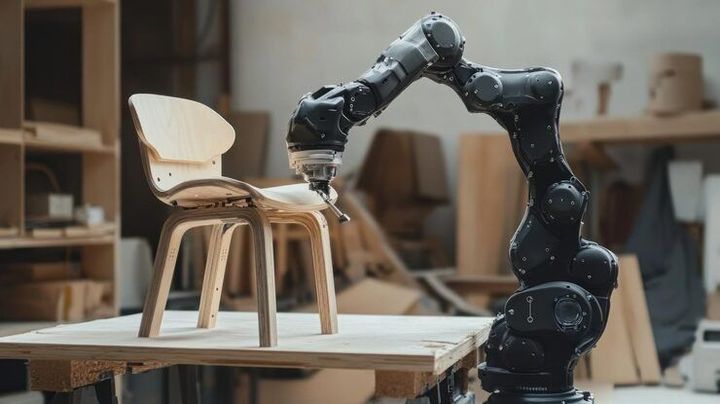
Furniture assembly robots are automated machines designed to perform selected steps involved in putting furniture components together. A furniture assembly robot may use robotic arms, cameras, sensors, grippers, screwdrivers, drills, or other end-effectors to handle panels, position components, insert fasteners, and complete repetitive assembly movements. As furniture manufacturing becomes more automated, these systems are being explored for applications involving cabinets, tables, shelving, chairs, storage units, and other products.
What Are Furniture Assembly Robots?
Furniture assembly robots are part of industrial automation systems used in manufacturing environments. Unlike a conventional machine that performs one fixed operation, a robotic arm can move through several programmed positions and interact with different components.
A typical system may combine a six-axis robotic arm with machine vision, a programmable controller, fixtures, conveyors, and specialized tools. The exact configuration depends on the furniture design, materials, assembly sequence, and required level of automation.
Furniture production traditionally involves activities such as positioning panels, aligning holes, inserting dowels, tightening screws, applying adhesive, attaching hardware, and moving completed sections. Robots can be programmed to repeat suitable parts of these processes while other activities remain under human supervision.
How Furniture Assembly Robots Work
The working principle starts with a defined assembly sequence. Components are presented to the robot through trays, conveyors, fixtures, or other material-handling systems. Sensors or cameras can help identify the location and orientation of components.
The controller then sends movement instructions to the robotic arm. Depending on the application, the arm can pick up a panel, rotate it, place it against another component, and operate a tool for fastening or drilling.
A simplified sequence may include:
- Component identification through sensors or cameras
- Picking and positioning of furniture parts
- Alignment of holes, edges, or reference points
- Fastening with screws, bolts, dowels, or other hardware
- Inspection of the assembled section
- Transfer of the completed section to the next production stage
The robot does not independently understand every furniture design. Its movements normally depend on programmed instructions, machine vision, sensors, and production software.
Importance
Why Furniture Assembly Automation Matters
Furniture assembly can involve repeated movements, awkward component handling, precise alignment, and frequent fastening operations. Large panels can also be difficult to position manually because of their dimensions and weight.
Robotic systems can help manufacturers automate repetitive physical operations while allowing people to supervise production, prepare materials, inspect components, and manage processes that require judgment.
The wider manufacturing sector has continued adopting industrial robotics. The International Federation of Robotics reported that more than 4.6 million industrial robots were operating in factories worldwide in 2024, with approximately 542,000 new installations during that year.
Who Uses These Systems?
Furniture assembly robots can be relevant to several types of manufacturing environments, including:
- Cabinet and modular furniture production
- Office furniture manufacturing
- Kitchen and storage-unit production
- Flat-pack furniture assembly
- Wooden panel processing
- Metal furniture manufacturing
- Mixed-material furniture production
The technology is particularly relevant where furniture designs contain repeatable assembly steps. Highly customized products may require additional programming, tooling, or human involvement because component shapes and assembly sequences can change frequently.
Common Problems Addressed
Automation can address several practical manufacturing challenges. These include repetitive fastening, component alignment, handling of large panels, inconsistent tool positioning, and maintaining a repeatable assembly sequence.
However, automation does not remove every production challenge. Furniture materials can vary in thickness, surface texture, stiffness, and dimensional accuracy. Screws can also enter at different angles, while panels may shift during handling. These conditions make sensors, fixtures, vision systems, and suitable grippers important parts of many robotic cells.
Recent Updates
Developments from 2024 to 2026
Industrial robotics has continued moving toward greater flexibility, machine vision, artificial intelligence, and collaborative operation. The International Federation of Robotics reported that collaborative robots represented 10.5% of industrial robots installed worldwide in 2023, while later industry data showed continued growth in overall industrial robot deployment.
For furniture assembly, machine vision is particularly relevant because furniture components can arrive in different orientations. Cameras can identify edges, holes, markings, or component shapes and provide information that helps the robot determine where to grasp or place an item.
Artificial intelligence is also being investigated for visual recognition, adaptive motion, quality inspection, and other robotic functions. These developments may allow robotic systems to respond to variations rather than relying entirely on fixed positions.
New Safety Standards
A notable development during this period was the publication of ISO 10218-1:2025 and ISO 10218-2:2025. The first standard addresses safety requirements for industrial robots, while the second addresses industrial robot applications and robot cells, including integration, commissioning, operation, maintenance, and decommissioning.
These standards are relevant when designing robotic furniture assembly cells because the safety of the complete application depends on more than the robotic arm itself. Tools, fixtures, sensors, guarding, software controls, and surrounding machinery can all influence risk.
Typical Furniture Assembly Robot Components
| Component | Main function |
|---|---|
| Robotic arm | Moves components and tools |
| Gripper | Holds panels or smaller parts |
| Camera system | Detects position and orientation |
| Screwdriver tool | Inserts and tightens fasteners |
| Drill or spindle | Creates or processes holes |
| Controller | Coordinates robot movements |
| Fixture | Holds components in a known position |
| Conveyor | Transfers parts between stages |
| Safety system | Detects access or hazardous conditions |
Laws or Policies
India
For furniture manufacturers in India, robotic assembly systems operate within the broader framework of workplace safety, machinery protection, electrical safety, and applicable state and central requirements. The Occupational Safety, Health and Working Conditions Code, 2020 includes provisions concerning machinery safeguarding, safe handling of plant, equipment, electrical machinery, and other workplace hazards.
The Ministry of Labour and Employment maintains current information on the Occupational Safety, Health and Working Conditions Code and related rules. Its recent materials also show continued development of central and state-level implementation requirements.
Indian standards are also relevant. BIS published a draft Indian Standard based on ISO 10218 for industrial robot safety, reflecting the use of international robot-safety principles within India's standards framework.
Manufacturers should therefore consider the applicable workplace, electrical, machinery, fire, and occupational-safety requirements for the specific facility and state. International standards such as ISO 10218 can provide technical guidance, but the exact legal requirements depend on the equipment, workplace, and applicable Indian rules.
Tools and Resources
Robot Programming and Simulation
Robot manufacturers commonly provide programming environments for defining movement sequences, tool actions, safety parameters, and production routines. Simulation software can also represent a robotic cell before physical installation, allowing users to examine movement paths, reach, cycle sequences, and possible interference.
Machine Vision Tools
Industrial cameras, lighting systems, image-processing software, and three-dimensional sensors can help identify furniture components. Vision systems are useful when panels or hardware are not always presented in exactly the same position.
Digital Manufacturing Platforms
Manufacturing execution systems, computer-aided manufacturing software, programmable logic controllers, and production databases can connect robotic assembly with other manufacturing stages. These platforms can help coordinate production information, machine status, material movement, and inspection data.
Safety Resources
ISO 10218-1:2025 provides requirements related to industrial robot safety, while ISO 10218-2:2025 focuses on robot applications and robot cells. These documents can be useful references for engineers, manufacturers, integrators, and safety personnel working with industrial robotic systems.
FAQs
What are furniture assembly robots?
Furniture assembly robots are automated systems that use robotic arms, sensors, tools, and control software to perform selected furniture assembly operations such as positioning, fastening, drilling, and component handling.
How do robotic arms assemble furniture?
Robotic arms follow programmed movement sequences and use tools or grippers to handle components. Cameras and sensors can provide information about component position, while fixtures help maintain alignment during assembly.
What tasks can furniture assembly robots perform?
Common tasks include panel handling, component positioning, drilling, screw insertion, fastening, adhesive application, hardware placement, inspection, and movement between production stages. The actual tasks depend on the robot, tooling, furniture design, and production setup.
Are collaborative robots used for furniture assembly?
Collaborative robots can be used for selected assembly and handling activities where the application has been designed and assessed for appropriate human-robot interaction. Their use does not automatically remove the need for safety assessment, because the complete application determines the hazards.
What safety standards apply to robotic furniture assembly?
ISO 10218-1:2025 addresses industrial robot safety, while ISO 10218-2:2025 addresses industrial robot applications and robot cells. In India, manufacturers must also consider applicable national and state workplace-safety requirements.
Conclusion
Furniture assembly robots combine robotic arms, grippers, sensors, vision systems, controllers, and specialized tools to automate selected manufacturing tasks. Their applications can include component handling, alignment, drilling, fastening, inspection, and material movement. Developments in machine vision, artificial intelligence, collaborative robotics, and updated safety standards are shaping current industrial automation. In India, robotic furniture production must also consider applicable workplace, machinery, electrical, and occupational-safety requirements.

You May Also Like