Fiber Laser Marking Machinery Guide With Precision Marking and Manufacturing Insights
Fiber laser marking machinery is a modern industrial technology used to create permanent marks, codes, numbers, symbols, patterns, and identification details on many materials. A fiber laser marking machine uses a concentrated beam of light generated through an optical fiber to modify the surface of a material without requiring physical contact.
The technology is widely associated with precision manufacturing because it can create small and detailed marks while supporting automated production processes.
Context
What Is Fiber Laser Marking Machinery
Fiber laser marking machinery uses a laser source, optical components, control electronics, and software to direct concentrated laser energy toward a selected surface. Depending on the material and operating settings, the laser can produce marks through surface color changes, controlled material removal, annealing, engraving, or other surface modifications.
Unlike mechanical marking equipment, a fiber laser marking machine does not normally require a physical cutting tool to touch the workpiece. This reduces mechanical contact during the marking process and allows manufacturers to work with small components, curved surfaces, and detailed identification areas.
The technology developed from advances in industrial laser systems, optical fiber technology, computer control, and digital manufacturing. Fiber laser systems became increasingly practical for industrial applications because they can provide a compact configuration with precise beam control and relatively low maintenance requirements.
How Fiber Laser Marking Works
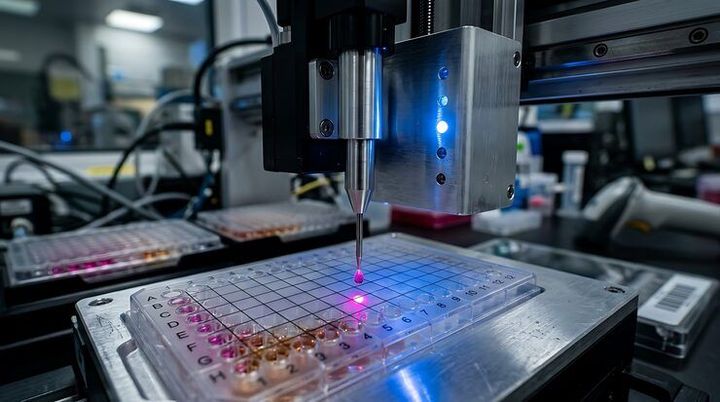
The process begins when the laser source generates a beam that travels through an optical path toward a scanning head. Galvanometer-based mirrors can move the beam rapidly across a defined marking area according to instructions created in specialized software.
The software converts text, graphics, serial numbers, barcodes, QR codes, or other designs into controlled movement patterns. Laser parameters such as power, speed, frequency, pulse characteristics, and focus position can then be adjusted according to the material and required marking result.
The main stages generally include:
- Material positioning: The component is placed within the designated marking area.
- Digital preparation: Text, symbols, codes, or graphics are configured through marking software.
- Beam focusing: The optical system concentrates the laser at the required surface position.
- Surface interaction: Laser energy modifies the selected area according to the programmed pattern.
- Inspection: The finished mark is checked for readability, contrast, alignment, and consistency.
Materials Commonly Marked
Fiber laser marking equipment is particularly associated with metals, although suitable configurations can work with selected additional materials. Common industrial applications include stainless steel, aluminum, brass, copper, titanium, coated metals, and certain engineered materials.
The marking result depends on material composition, surface condition, laser wavelength, beam characteristics, and process parameters. A setting that works on one alloy may produce a different appearance on another alloy, so process development generally involves controlled testing.
Importance
Why Precision Marking Matters
Identification has become an important part of modern manufacturing. Components may need serial numbers, batch identifiers, production codes, machine-readable symbols, or technical information to support manufacturing records and product identification.
A clear permanent mark can remain associated with a component throughout different stages of handling and production. This can help organizations distinguish similar parts and connect physical components with digital production information.
Fiber laser marking machinery is also relevant where marking accuracy is important. Small electronic components, mechanical parts, tools, medical equipment components, automotive parts, and industrial assemblies may contain limited surface space for identification.
Applications Across Manufacturing
Fiber laser marking machines can be integrated into manual workstations, semi-automated cells, or larger production lines. Applications vary according to material, product design, production volume, and required information.
| Application | Typical Marking Information | Common Material |
|---|---|---|
| Component identification | Serial numbers and codes | Metals |
| Electronics | Product codes and symbols | Metal and selected polymers |
| Automotive components | Part numbers and traceability codes | Steel and aluminum |
| Tools | Logos, specifications, and identifiers | Hardened metals |
| Industrial equipment | Technical markings | Stainless steel and alloys |
| Electrical components | Identification codes | Metals and coated surfaces |
Problems the Technology Addresses
Traditional marking approaches can involve physical contact, consumable tooling, labels, or separate identification processes. Fiber laser marking can reduce dependence on some of these approaches by creating information directly on the component surface.
Another important factor is repeatability. Computer-controlled marking allows the same digital design to be reproduced across multiple components while maintaining consistent positioning when the equipment and process parameters are properly configured.
The technology can also support traceability systems. A unique code placed on a component may be connected with production records, inspection information, inventory records, or maintenance documentation within a broader digital manufacturing system.
Recent Updates
Higher Precision and Process Control
Recent developments in fiber laser marking have focused on improved beam control, scanning accuracy, software integration, automation, and process monitoring. Modern systems can combine marking equipment with sensors, cameras, positioning systems, and programmable controllers.
These developments are particularly relevant to automated manufacturing. Instead of treating marking as an isolated operation, manufacturers can integrate it into production cells where components are positioned, marked, inspected, and transferred with limited manual intervention.
Machine Vision Integration
Machine vision is increasingly used alongside laser marking systems. Cameras can identify component orientation, locate a marking area, verify a code, or inspect the completed result.
This combination helps address situations where components arrive in slightly different positions. Vision software can identify the relevant location and provide positioning information to the marking system.
Digital Manufacturing Integration
Industrial marking is also becoming more connected to manufacturing information systems. Digital production environments may use databases containing product numbers, serial numbers, batch information, and production instructions.
When properly integrated, a fiber laser marking machine can receive variable information rather than relying only on a fixed design. This is useful for applications where each component requires a unique identifier.
Compact Industrial Equipment
Another continuing trend is the development of more compact marking systems. Smaller laser marking machines can be incorporated into workstations and production cells where floor space is limited.
Portable configurations and enclosed systems are also available for different industrial environments. The appropriate configuration depends on the material, marking area, production requirements, and workplace safety arrangements.
Laws or Policies
Workplace Laser Safety
Laser marking equipment is subject to workplace safety requirements that vary by jurisdiction. Regulations may address laser classification, protective enclosures, access controls, warning indicators, operator training, electrical safety, and exposure prevention.
Higher-powered industrial laser systems can present hazards to eyes and skin if used incorrectly. Enclosed marking systems can reduce exposure risks by restricting access to the laser operating area.
Electrical and Machine Safety
A complete marking installation may also need to meet applicable electrical and machinery safety requirements. Emergency controls, protective housings, ventilation arrangements, interlocks, and grounding provisions can be relevant depending on the equipment configuration.
Organizations operating this equipment generally need documented procedures covering installation, operation, maintenance, inspection, and emergency response. Requirements differ between jurisdictions, so applicable local regulations should be checked before equipment is placed into operation.
Environmental Considerations
Laser marking does not use ink or physical marking tools in the same way as several conventional processes, but the laser interaction with a material can produce fumes or airborne particles. Some materials may require extraction or filtration equipment.
Material safety information and workplace environmental requirements should therefore be considered when selecting a marking process. Adequate ventilation and appropriate protective measures depend on the material being processed.
Tools and Resources
Laser Marking Software
Marking software is used to create designs and control the marking sequence. Typical functions include text creation, barcode generation, QR code generation, vector graphics, serial numbering, date coding, and variable-data processing.
Software can also provide parameter libraries, positioning controls, preview functions, and production settings. Compatibility between the software, laser controller, scanning head, and manufacturing system is an important consideration.
Measurement and Inspection Tools
Inspection equipment helps determine whether a finished mark meets the required visual and technical characteristics. Depending on the application, tools may include digital microscopes, optical measurement systems, barcode readers, QR-code verification equipment, and machine vision cameras.
Common inspection factors include:
- Marking contrast
- Character dimensions
- Code readability
- Position accuracy
- Surface consistency
- Marking depth where engraving is required
Process Parameter Resources
Laser manufacturers and technical equipment documentation commonly provide information about operating parameters, material compatibility, focusing methods, and maintenance procedures. Technical reference materials can help operators understand how changes in power, speed, frequency, and focus influence the marking result.
Production teams may also maintain internal parameter tables based on validated material and component combinations. Such records can make repeat production more consistent.
FAQs
What is a fiber laser marking machine used for?
A fiber laser marking machine is used to create permanent identification, text, graphics, serial numbers, barcodes, QR codes, and other markings on suitable materials. It is widely associated with metal component marking.
How does fiber laser marking machinery work?
Fiber laser marking machinery directs a concentrated laser beam across a material surface using computer-controlled optical components. The beam modifies selected areas according to a digital design and configured process parameters.
Can a fiber laser marking machine mark stainless steel?
Yes. Stainless steel is commonly processed with fiber laser marking equipment. The resulting appearance depends on laser parameters, surface condition, alloy composition, and the desired marking method.
What affects fiber laser marking quality?
Several factors can influence marking quality, including laser power, scanning speed, focus position, pulse settings, material composition, surface condition, marking software, and component positioning.
Is laser marking suitable for automated manufacturing?
Fiber laser marking can be integrated into automated manufacturing systems. It can work alongside conveyors, robotic handling equipment, machine vision, programmable controllers, and production databases where the equipment and software are compatible.
Conclusion
Fiber laser marking machinery uses controlled laser energy to create precise identification and design information on suitable materials. Its applications include component identification, traceability, coding, industrial production, electronics, automotive manufacturing, and equipment marking. Current developments increasingly connect laser marking with machine vision, automation, digital production systems, and improved process control. Safety requirements, material characteristics, software capabilities, and operating parameters remain important factors in establishing a suitable marking process.