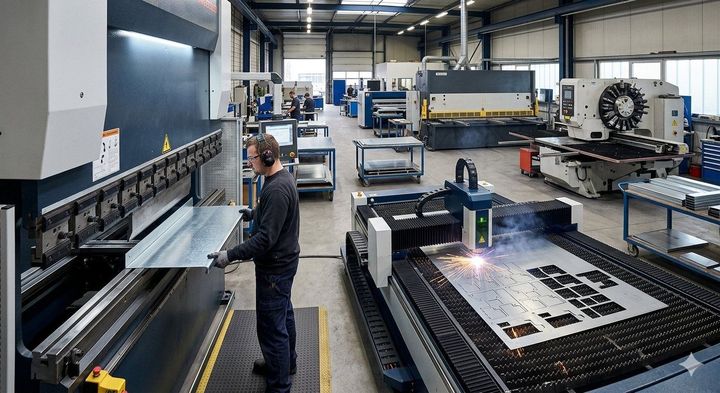
Complete Guide to Sheet Metal Fabrication Machines for Modern Manufacturing
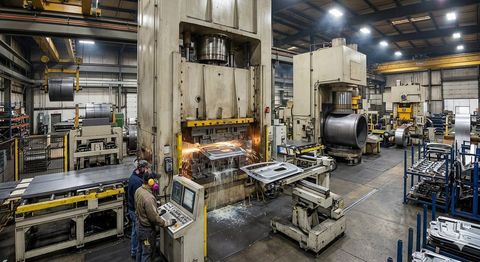
Sheet metal fabrication machines are used to cut, bend, punch, form, join, and finish metal sheets for manufacturing and construction applications. These machines have developed from manually controlled equipment into computer-controlled systems capable of producing consistent shapes and dimensions.
Common examples include CNC press brakes, laser cutting machines, plasma cutting machines, shearing machines, turret punching machines, rolling machines, and automated bending systems. Understanding how these machines work helps general readers recognize how flat metal sheets become panels, enclosures, brackets, ducts, frames, vehicle components, and other manufactured parts.
Context
What Is Sheet Metal Fabrication
Sheet metal fabrication is a manufacturing process in which relatively thin metal sheets are transformed into useful components. Materials can include steel, stainless steel, aluminum, copper, and other alloys selected according to the required strength, weight, corrosion resistance, and forming characteristics.
The process usually begins with a digital drawing or production specification. The sheet is then cut to a required shape before operations such as bending, punching, rolling, forming, joining, or surface treatment are performed.
How Fabrication Machines Developed
Early sheet metal production relied heavily on manual tools and mechanical equipment. Operators measured sheets, positioned them, and controlled cutting or forming processes directly.
Modern systems increasingly use computer numerical control, commonly called CNC. A CNC controller interprets programmed instructions and coordinates machine movement, allowing manufacturers to produce repeated components with consistent dimensions.
Automation has also changed material handling. Some production lines use automated loading, unloading, tool changing, part sorting, and inspection equipment to reduce repetitive manual operations and improve workflow consistency.
Common Sheet Metal Fabrication Machines
Different machines perform different operations. A production facility may use several machines in sequence rather than relying on one piece of equipment.
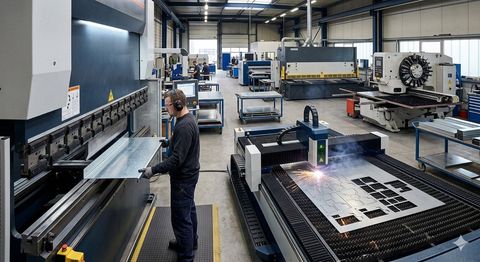
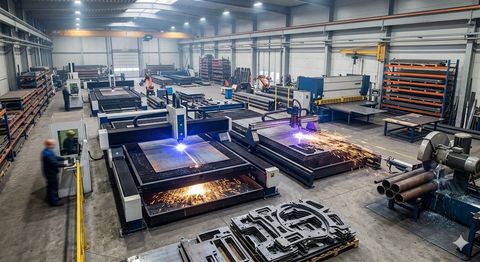
- Laser cutting machines use concentrated laser energy to separate sheet material along programmed paths.
- Plasma cutting machines use a high-temperature plasma arc to cut electrically conductive metals.
- Shearing machines cut straight lines through sheet material using mechanical or hydraulic force.
- CNC press brakes form precise bends by pressing sheet metal between a punch and die.
- Turret punching machines create holes, slots, and other shapes using interchangeable tooling.
- Rolling machines gradually curve flat sheets into cylindrical or curved forms.
- Welding equipment joins separate metal components after cutting and forming.
- Deburring and finishing equipment removes sharp edges and improves surface condition.
Importance
Why Sheet Metal Fabrication Matters
Sheet metal fabrication supports many areas of modern manufacturing. Metal components are found in electrical cabinets, ventilation systems, industrial equipment, transportation products, appliances, furniture, structural assemblies, and machinery housings.
The main challenge is converting raw sheet material into accurate components while controlling deformation, edge quality, dimensional variation, and material waste. Fabrication machines provide controlled processes that can handle these requirements more consistently than purely manual methods.
Who Uses These Machines
Sheet metal fabrication equipment is used by manufacturers, engineering departments, metalworking facilities, construction-related manufacturers, and industrial production operations.
The equipment selected depends on several factors:
- Sheet thickness and material type
- Required component dimensions
- Shape complexity
- Production quantity
- Required dimensional accuracy
- Cutting or forming method
- Available floor space
- Automation requirements
- Operator skills and training
- Electrical and ventilation requirements
Production Process
A typical sheet metal production workflow can include several stages.
First, a digital design is prepared using computer-aided design software. The design is then converted into machine instructions or manufacturing data.
Next, a laser cutting machine, plasma cutter, shear, or punching machine prepares the flat sheet. The resulting blank moves to forming equipment such as a CNC press brake or rolling machine.
After forming, components may undergo welding, fastening, grinding, deburring, cleaning, inspection, and surface treatment. The exact sequence depends on the product and material.
Sheet Metal Machine Comparison
| Machine Type | Primary Operation | Typical Application |
|---|---|---|
| Laser Cutting Machine | Profile cutting | Panels, brackets, precision parts |
| Plasma Cutting Machine | Thermal cutting | Thick conductive metal |
| Shearing Machine | Straight cutting | Sheets and rectangular blanks |
| CNC Press Brake | Bending | Channels, brackets, enclosures |
| Turret Punch | Punching and forming | Holes and repeated patterns |
| Rolling Machine | Curving | Cylinders and curved panels |
| Welding Equipment | Joining | Frames and assemblies |
| Deburring Equipment | Edge finishing | Cut and punched components |
Recent Updates
Automation and Digital Production
From 2024 through 2026, sheet metal fabrication has continued moving toward connected and automated production. CNC machines are increasingly integrated with production planning software, digital drawings, automated material handling, and inspection systems.
The objective is not simply faster machine movement. Modern production systems increasingly focus on coordinating several stages so that material movement, machine scheduling, tooling, and inspection can work together.
Laser Cutting Developments
Laser cutting technology continues to develop through improvements in beam control, machine automation, cutting heads, sensors, and software. Higher-power systems can process thicker materials, while precision-oriented systems can handle detailed profiles in thinner sheets.
Automatic focus adjustment and monitoring technologies can help machines respond to changing material conditions during production.
Smart Press Brake Technology
Modern CNC press brakes increasingly incorporate automatic setup functions, angle measurement, programmable back gauges, and digital interfaces. Some systems use sensors to monitor bending results during operation.
These developments are intended to reduce setup variation and improve repeatability across production batches.
Energy and Material Efficiency
Manufacturers are also paying greater attention to energy consumption and material utilization. Software-based nesting can arrange multiple component shapes on a sheet to reduce unused areas.
Equipment manufacturers are developing systems that use energy more efficiently, while production planners increasingly analyze material flow and machine utilization as part of manufacturing management.
Robotics and Inspection
Robotic loading, unloading, bending, welding, and part handling are becoming more common in automated production environments. Machine vision and digital inspection systems can also assist with dimensional checks and defect identification.
These technologies do not eliminate the need for trained personnel. Instead, they shift some responsibilities toward programming, monitoring, maintenance, quality control, and production planning.
Laws or Policies
Workplace Machine Safety
Rules governing sheet metal fabrication vary by jurisdiction, but occupational safety requirements commonly address machine guarding, emergency controls, electrical safety, operator training, and workplace hazards.
Machines with moving tooling, cutting mechanisms, hydraulic systems, or automated components generally require appropriate protective measures. Employers are commonly responsible for maintaining safe operating procedures and providing suitable training.
Electrical and Equipment Requirements
Electrical installations for CNC machines, laser systems, plasma equipment, and other industrial machinery may need to follow applicable electrical codes and equipment standards. Requirements can cover grounding, isolation, control panels, wiring, and emergency shutdown systems.
The exact requirements depend on the machine, workplace, and jurisdiction.
Noise, Fumes, and Waste
Cutting, grinding, welding, and finishing operations can create noise, fumes, dust, heat, or metal waste. Workplace rules may therefore address ventilation, exposure controls, protective equipment, noise management, and waste handling.
Manufacturers should consult the regulations applicable to their location and equipment because requirements differ between countries and industrial environments.
Environmental Considerations
Some fabrication processes generate metal scrap, used consumables, particulate matter, or other industrial residues. Environmental policies may regulate how these materials are collected, stored, transported, and processed.
Modern production planning increasingly considers material recovery and waste reduction alongside manufacturing efficiency.
Tools and Resources
Design and Programming Tools
Computer-aided design software is commonly used to create sheet metal components and prepare drawings. Sheet metal design modules can account for bend allowances, material thickness, bend radius, and flat patterns.
Computer-aided manufacturing software can then convert designs into machine instructions for compatible cutting, punching, or forming equipment.
Calculation Tools
Useful calculations in sheet metal work can include:
- Bend allowance calculations
- Bend deduction calculations
- Flat pattern dimensions
- Material weight calculations
- Cutting speed references
- Press brake force calculations
- Sheet utilization calculations
- Production cycle estimates
These calculations help engineers and operators understand how material properties and machine settings affect production.
Digital Manufacturing Resources
Machine manuals, tooling catalogs, technical standards, CAD templates, maintenance schedules, and operator training materials can provide practical information.
Production management platforms may also track machine availability, production schedules, material usage, inspection results, and maintenance activities. The appropriate resource depends on the machine type and manufacturing environment.
FAQs
What are sheet metal fabrication machines?
Sheet metal fabrication machines are industrial machines used to cut, bend, punch, form, join, or finish metal sheets. Different equipment performs different stages of the fabrication process.
What is a CNC press brake used for?
A CNC press brake is primarily used to bend sheet metal into programmed angles and shapes. It uses computer-controlled movement to position the material and tooling during the bending operation.
How does a laser cutting machine work?
A laser cutting machine directs concentrated laser energy onto a programmed path. The energy heats and separates the material, while machine controls guide the cutting head according to the digital design.
What is a turret punching machine?
A turret punching machine uses a collection of punches and dies to create holes, slots, and formed features in sheet metal. CNC controls coordinate the position of the sheet and selected tooling.
Which factors affect sheet metal machine selection?
Important factors include material type, sheet thickness, component dimensions, production quantity, required accuracy, shape complexity, automation requirements, available workspace, and applicable safety requirements.
Conclusion
Sheet metal fabrication machines transform flat metal sheets into accurately shaped components through cutting, bending, punching, forming, joining, and finishing processes. CNC controls, automation, digital design, inspection systems, and improved material management are shaping modern fabrication environments. Machine selection depends on material characteristics, component design, production requirements, safety considerations, and applicable regulations. Understanding these fundamentals provides a useful foundation for interpreting modern sheet metal manufacturing processes.