Commercial Ice Cream Making Machines: Buyer Tips
A commercial buyer's guide evaluating industrial batch freezers, continuous ice cream systems, and soft-serve machines for US facilities. Covers USD equipment pricing, utility specs, and supplier selection criteria.
Selecting commercial ice cream making machines requires balancing overrun targets, hourly batch output, and facility utility capacity to maximize gross margins. This buyer's guide breaks down industrial batch freezers, continuous systems, and soft-serve equipment pricing in USD for US foodservice operators and production facilities.
Key Takeaways
Commercial units range from $4,500 countertop models to $150,000+ continuous lines.
Air-cooled condensers simplify installation, while water-cooled systems handle high ambient heat.
NSF and UL certifications are mandatory for US health department compliance.
Evaluating spare part availability prevents costly peak-season production downtime.
Table of Contents
Core Commercial Ice Cream Machine Categories
2026 Commercial Equipment Pricing and Capacity Comparison
Critical Technical Specifications for Facility Buyers
Evaluating Equipment Suppliers and Warranty Terms
Maintenance and Compliance Standards
Core Commercial Ice Cream Machine Categories
Commercial ice cream production relies on distinct freezing technologies engineered for specific product textures and volume demands.
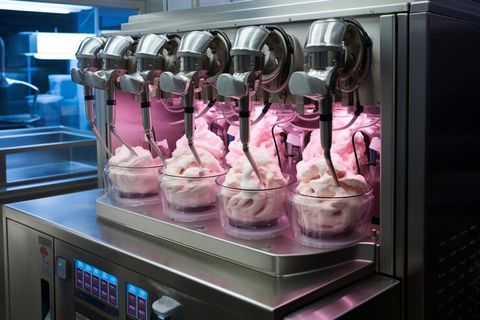
Commercial Soft Serve Machine Suppliers and Gravity vs. Pump Units
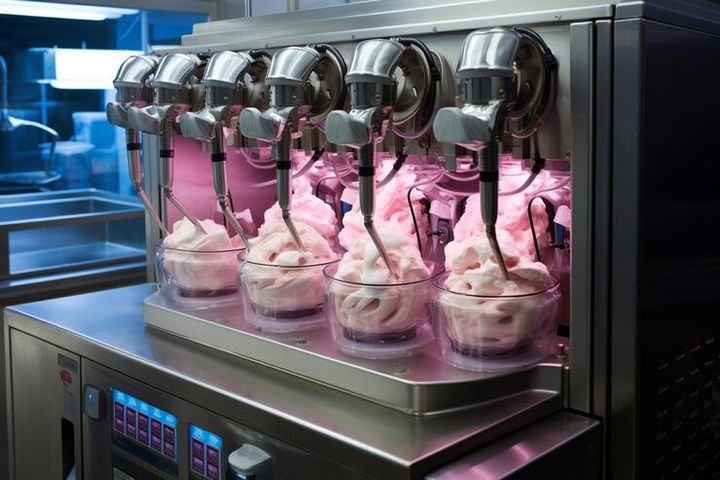
High-volume quick-service restaurants and dessert parlors rely on pressurized soft-serve dispensers to maintain consistent
Gelato Batch Freezer Equipment
Artisanal creameries and specialty kitchens utilize vertical or horizontal batch freezers designed for dense, low-overrun frozen desserts. These machines freeze liquid base rapidly in 8-to-12-minute cycles to minimize ice crystal formation, producing smooth gelato, sorbet, and premium hard-pack ice cream.
Continuous Ice Cream Freezer Systems
Mid-to-large-scale manufacturing plants deploy continuous freezers that pump mix and filtered air simultaneously through a scraped-surface heat exchanger. Unlike batch units, continuous lines run uninterrupted, feeding directly into automated pint fillers, novelty extrusion tunnels, and hardening cabinets.
[Diagram: Side-by-side internal mechanism comparison of gravity-fed soft serve, batch freezer cylinder, and continuous scraped-surface heat exchanger]
2026 Commercial Equipment Pricing and Capacity Comparison
Capital expenditure depends heavily on hourly output capacity, compressor horsepower, and automated wash-cycle controls. The table below outlines standard USD market ranges for new commercial units in the United States.
[Chart: Total 5-year cost of ownership comparing upfront purchase price, electricity draw, and water consumption across condenser types]
[Internal Guide: Commercial Walk-In Blast Freezers and Hardening Cabinets Sizing Guide]
Critical Technical Specifications for Facility Buyers
Matching machine requirements to existing building infrastructure prevents expensive electrical or plumbing retrofits after delivery.
Condenser Cooling Method: Air-cooled machines require at least 6 to 12 inches of clearance around ventilation panels and expel warm exhaust into the kitchen. Water-cooled systems operate quietly and efficiently in hot kitchens but require dedicated drain lines and increase municipal water bills unless connected to a closed-loop chiller.
Electrical Phase and Voltage: Countertop units often run on standard 115V single-phase circuits, whereas high-capacity floor batch freezers and continuous lines require 208–230V or 460V three-phase power.
Beater Blade Design: Stainless steel beaters with replaceable polymer scraper blades ensure efficient heat transfer against the cylinder wall and reduce wear over thousands of cycles.
Evaluating Equipment Suppliers and Warranty Terms
When comparing commercial soft serve machine suppliers and industrial manufacturers, procurement teams should verify post-sale service infrastructure alongside upfront quotes.
Certified Technician Network: Confirm that the distributor maintains factory-trained technicians within a 100-mile radius of your facility with guaranteed 24-to-48-hour emergency response times.
Component-Specific Warranties: Standard coverage typically includes 1 year on parts and labor, with 3 to 5 years on the hermetically sealed compressor and freezing cylinder shell.
Consumable Kit Availability: Ensure routine wear items—such as O-rings, drive belts, scraper blades, and food-grade lubricants—are stocked domestically in the US for next-day shipping.
[Internal Guide: How to Calculate ROI and Ingredient Margins for Commercial Creameries]
Maintenance and Compliance Standards
US commercial foodservice and dairy processing facilities must adhere to strict sanitation and equipment safety codes.
Regulatory Certifications: Verify that all food-contact surfaces carry NSF/ANSI 6 or 3-A Sanitary Standards certification, and electrical assemblies hold UL or ETL listings.
Heat-Treatment vs. Daily Tear-Down: Modern pasteurizing soft-serve machines run automated daily heat-treatment cycles that hold mix at 150°F (65.5°C) for 30 minutes, extending full brush-cleaning intervals from daily to every 14 days while maintaining strict bacterial control.
Editorial & Compliance Disclaimer: The pricing ranges, technical specifications, and operational benchmarks in this guide are provided for general commercial and informational planning purposes only. Actual equipment quotes, utility requirements, and sanitation regulations vary by manufacturer, state health department, and municipal building code. Always consult a licensed commercial kitchen engineer or certified equipment distributor before finalizing capital purchases or facility installations.