Automated PCB Assembly Machines Information With Surface Mount Technology and Engineering Insights
Automated PCB assembly machines play an important role in modern electronics manufacturing. A printed circuit board (PCB) is a flat board that holds and connects electronic components, allowing them to work together within devices such as computers, smartphones, industrial controllers, medical equipment, and automotive electronics.
Automated PCB assembly machines place components onto these boards and help manufacturers create consistent electronic assemblies through controlled production processes.
The development of PCB assembly automation followed the growing demand for smaller, more complex, and reliable electronic products. Earlier assembly methods depended heavily on manual placement and soldering, which required significant operator involvement. As electronic components became smaller and circuit designs more complicated, manufacturers adopted automated equipment to improve placement accuracy, production consistency, and process control.
Surface Mount Technology (SMT) is central to modern PCB assembly. It allows electronic components to be mounted directly onto conductive pads on a circuit board rather than requiring every component to pass through holes in the board. Automated PCB assembly machines combine several stages, including solder paste printing, component placement, reflow soldering, and inspection.
These systems may operate as individual machines or as connected production lines. Their configuration depends on board dimensions, component types, production volume, and electronic product requirements.
How Automated PCB Assembly Works
The assembly process typically begins with a bare PCB and a prepared production program. Solder paste is applied to designated pads, and a pick-and-place machine positions electronic components according to the board's design data.
The assembled board then passes through a reflow oven, where controlled heating melts the solder and creates electrical and mechanical connections. Inspection equipment checks whether components are positioned correctly and whether visible assembly defects are present.
Main Types of PCB Assembly Machines
Different machines perform specific functions within an electronics production line.
Solder paste printers apply solder paste to PCB pads through a stencil.
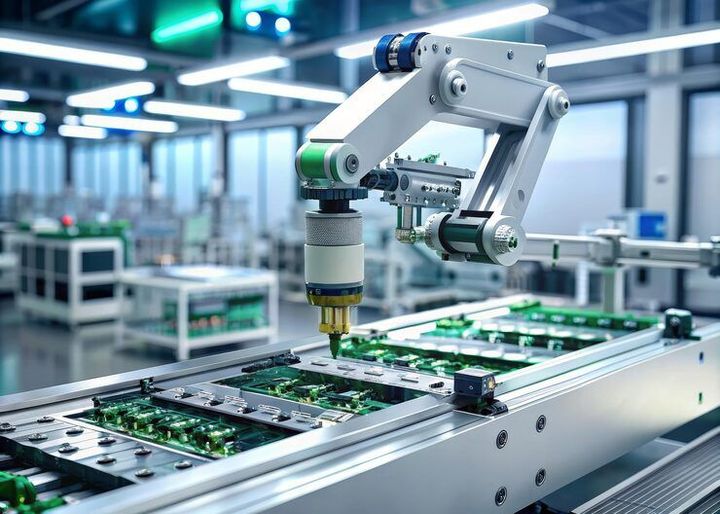
Pick-and-place machines position resistors, capacitors, integrated circuits, and other components.
Reflow soldering ovens heat the board to form solder joints.
Automated optical inspection systems examine component placement and visible soldering characteristics.
Automated X-ray inspection systems help examine hidden solder joints, including connections beneath certain packaged components.
PCB handling equipment transfers boards between production stages and manages loading or unloading.
Each machine contributes to the overall assembly process, although not every production line requires every equipment category.
Importance
Automated PCB assembly machines matter because electronic devices increasingly depend on compact circuit boards with dense component layouts. Manual assembly alone can become difficult when a board contains hundreds or thousands of components, particularly when some components have extremely small dimensions or closely spaced electrical connections.
Automation helps manufacturers manage these challenges through programmed movements, repeatable operating conditions, and inspection procedures. It can also reduce repetitive manual handling and support consistent production across multiple batches.
Industries That Use SMT Assembly Equipment
Several industries depend on automated PCB assembly systems for different applications.
Consumer electronics: Smartphones, televisions, computers, wearable devices, and household appliances.
Automotive electronics: Vehicle control modules, sensor boards, infotainment systems, and driver assistance electronics.
Industrial automation: Programmable logic controllers, motor control boards, robotics systems, and monitoring equipment.
Medical electronics: Electronic assemblies used in diagnostic equipment, patient monitoring devices, and laboratory instruments.
Telecommunications: Networking equipment, wireless communication devices, and signal processing systems.
The production requirements differ between these sectors. Automotive and medical applications, for example, may involve additional reliability testing and traceability requirements, while consumer electronics production may emphasize compact designs and rapid manufacturing cycles.
Problems Addressed by Automation
Automated assembly equipment addresses several recurring manufacturing challenges.
Placement consistency: Programmable placement heads position components according to defined coordinates.
Production repeatability: Stored programs help reproduce established assembly sequences across batches.
Component handling: Vacuum nozzles, feeders, and machine vision systems support accurate handling of small electronic parts.
Process monitoring: Sensors and inspection systems help identify production irregularities.
Manufacturing traceability: Connected systems can record machine settings, inspection results, and production identifiers.
Automation does not eliminate every defect. Incorrect solder paste volume, damaged components, poor board design, unsuitable thermal profiles, and inadequate maintenance can still affect assembly quality.
Factors That Influence Machine Performance
Machine performance depends on more than its advertised placement speed. Actual output is affected by component variety, feeder changes, board complexity, inspection requirements, machine downtime, and the efficiency of the entire production line.
Factor | Meaning | Potential effect |
|---|---|---|
Placement accuracy | Ability to position components correctly | Influences alignment and connection quality |
Placement speed | Number of components placed over time | Affects production throughput |
Feeder capacity | Number and variety of component feeders supported | Influences setup and changeover time |
Board compatibility | Supported PCB sizes, thicknesses, and configurations | Determines application suitability |
Inspection capability | Ability to identify assembly defects | Supports quality control |
Software integration | Communication with design and production systems | Improves program management and traceability |
Manufacturers generally evaluate these factors together because high placement speed alone does not establish overall production efficiency.
Recent Updates
Recent developments in automated PCB assembly focus on intelligent inspection, connected manufacturing systems, smaller component handling, and improved production flexibility. These trends reflect the growing complexity of electronic products and the need to manage manufacturing information across multiple stages.
Artificial Intelligence and Machine Vision
Machine vision systems use cameras and image-processing software to recognize components, inspect alignment, and verify board characteristics. More advanced inspection platforms incorporate artificial intelligence techniques to identify visual patterns associated with potential defects.
These systems can assist with defect classification and help engineers investigate recurring problems. Their effectiveness depends on image quality, training data, inspection settings, and validation against actual production conditions. Human review may still be necessary for unusual or uncertain results.
Smart Manufacturing and Production Data
Connected PCB assembly machines increasingly exchange information with manufacturing execution systems and other factory software. These connections can provide information about machine status, production counts, component usage, inspection results, and process interruptions.
Manufacturers can use this information to investigate bottlenecks and coordinate production activities. However, integration requires compatible interfaces, reliable data management, cybersecurity controls, and appropriate staff training.
Flexible Assembly Lines
Modern electronics manufacturing frequently involves multiple board designs and changing component requirements. Flexible SMT assembly lines can support product changeovers through programmable machine settings, automated feeder identification, and centralized production recipes.
This flexibility is particularly relevant when factories produce different electronic products on the same equipment. Nevertheless, changeover performance depends on board design, component availability, feeder preparation, and the complexity of the production program.
Miniaturization and Advanced Components
Electronic products continue to use compact components, fine-pitch packages, and increasingly dense circuit layouts. This creates demand for precise solder paste deposition, accurate placement, controlled thermal processing, and inspection methods capable of examining difficult-to-see connections.
Advanced packaging formats, including ball grid arrays and chip-scale packages, can require specialized process controls. Equipment selection therefore depends on the component packages and assembly tolerances involved.
Laws or Policies
Automated PCB assembly machines are affected by several categories of rules and technical requirements. The exact obligations depend on the manufacturing location, the equipment's intended market, the product being assembled, and whether the machinery is integrated into a larger production line.
Machinery Safety Requirements
Industrial equipment may be subject to machinery safety legislation, electrical safety requirements, and workplace health and safety rules. Relevant considerations include emergency stops, moving mechanical parts, electrical isolation, protective enclosures, and safe maintenance procedures.
Equipment manufacturers and factory operators need to identify the requirements applicable to their location and intended use. Installation, operator training, and maintenance documentation also contribute to safe operation.
Electronic Product and Environmental Requirements
Electronic products may be affected by rules concerning hazardous substances, waste electrical and electronic equipment, and environmental management. Requirements vary by market and product category.
Manufacturers may need to maintain information about materials, components, suppliers, and production processes to demonstrate compliance with applicable requirements. These obligations can influence component selection, documentation practices, and manufacturing controls.
Quality Management and Industry Standards
Quality management frameworks such as ISO 9001 provide principles for documenting processes, monitoring performance, and managing corrective actions. Certain industries may apply additional requirements for traceability, risk management, or product validation.
IPC standards are also widely referenced in electronics manufacturing for subjects such as PCB design, soldering acceptability, and assembly workmanship. Their application depends on the contract, product specification, and relevant industry requirements; they should not automatically be treated as laws.
Tools and Resources
Several technical tools help engineers plan, operate, and evaluate automated PCB assembly machines. The appropriate selection depends on production complexity, software compatibility, and quality objectives.
PCB Design and Manufacturing Software
Electronic design automation software supports schematic development, PCB layout, component placement definitions, and manufacturing output generation. Common manufacturing files include Gerber data, drill files, and pick-and-place coordinate files.
These outputs help transfer design information into the assembly process. Engineers must verify file formats, board orientation, component rotations, and reference designators before generating machine programs.
SMT Process Calculators
Process calculators help engineers estimate operating parameters and evaluate production requirements. Useful examples include:
Solder paste volume calculations based on stencil aperture dimensions.
Reflow profiling tools for evaluating temperature and heating conditions.
Production throughput calculations based on placement rates and planned operating time.
Feeder planning worksheets for organizing components and reducing setup interruptions.
First-pass yield calculations for measuring the proportion of assemblies that pass inspection without rework.
Such calculations provide estimates rather than complete assessments of manufacturing performance. Actual results depend on equipment settings, materials, board design, and operating conditions.
Inspection and Production Monitoring Systems
Automated optical inspection software records visual inspection results and identifies potential component placement or soldering problems. X-ray inspection tools help evaluate selected hidden connections, while electrical testing systems check circuit continuity and functional characteristics.
Manufacturing execution systems can connect these results with production records. Engineers use the combined information to identify recurring defects, monitor process changes, and maintain traceability.
Equipment Evaluation Checklist
When comparing automated PCB assembly machines, relevant considerations include:
Supported PCB dimensions and component packages.
Placement accuracy and verified throughput under realistic production conditions.
Compatibility with existing design and factory software.
Inspection and data-recording capabilities.
Maintenance requirements, operator training, and technical documentation.
Safety features and applicable conformity documentation.
Evaluating the complete production process provides a clearer picture than assessing individual machine specifications in isolation.
FAQs
What Are Automated PCB Assembly Machines?
Automated PCB assembly machines are industrial systems that place electronic components onto circuit boards and support soldering, inspection, and board handling. They help manufacturers produce electronic assemblies with controlled and repeatable processes.
How Does Surface Mount Technology Work in PCB Assembly?
Surface Mount Technology places components directly onto conductive pads on a PCB. Solder paste printing, automated placement, and reflow soldering are common stages in the process.
What Is the Difference Between SMT and Through-Hole Assembly?
SMT components are mounted directly onto board surfaces, while through-hole components have leads inserted through holes in the PCB. Both methods remain relevant, and some electronic assemblies use a combination of the two.
Which Factors Affect PCB Assembly Machine Performance?
Placement accuracy, component variety, feeder capacity, board design, inspection requirements, and equipment downtime all influence performance. Production results also depend on solder paste quality, thermal control, and machine maintenance.
What Standards Apply to Automated PCB Assembly Equipment?
Applicable requirements may include machinery safety regulations, electrical safety rules, environmental legislation, quality management frameworks, and electronics assembly standards. The relevant requirements depend on the equipment, product, and intended market.
Conclusion
Automated PCB assembly machines support modern electronics manufacturing through component placement, soldering, inspection, and production monitoring. Surface Mount Technology enables compact circuit designs, while automation helps manage complex assembly requirements. Developments in machine vision, connected production systems, and flexible manufacturing continue to influence equipment capabilities. Safe operation, suitable process controls, quality documentation, and compliance with applicable requirements remain important elements of effective PCB assembly.

You May Also Like